RockLatin Rock1960s–present
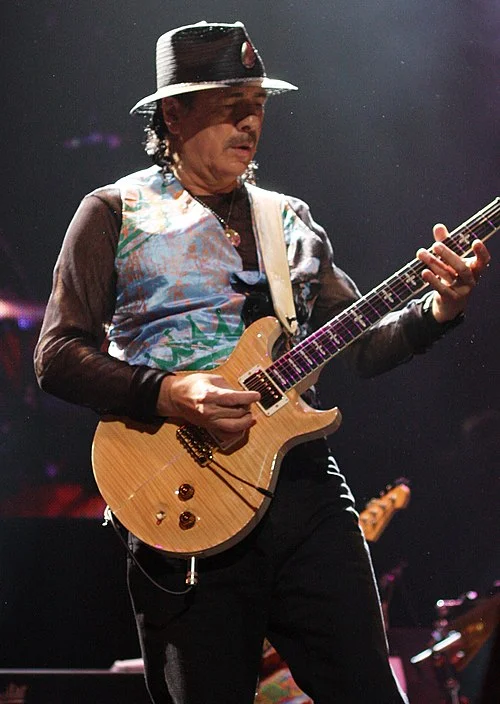
Carlos Santana — £500 · Sweet Spot Rig
PRS or SG neck pickup into a Mesa Boogie Mark I (or II) with the lead channel pushed hard — natural amp compression creates the smooth, sustaining quality. Santana's controlled pick attack and slow, wide vibrato do the rest. A chorus adds shimmer to clean parts; a touch of delay opens up the lead tone.
Signal Path
Signal Chain
Full signal path
GuitarEpiphone SG
ODBoss SD-1
AmpBlues Jr
Full Gear List
£500 · Sweet Spot — Complete Rig

● Budget$57
Tone Tips
Getting the Sound Right
- Neck pickup only — Santana's lead tone never comes from the bridge
- Mesa Boogie lead channel: gain around 6–7, master volume up for natural compression
- Use a medium-light pick held loosely — attack is everything
- Vibrato is wide and slow, almost like a singer's natural note-to-note variation
- Boss SD-1 with gain low and level boosted pushes the amp into smooth sustain
- Mid-heavy EQ: cut bass to 4, boost mids to 7–8, treble at 5
- Let notes ring fully — Santana sustains phrases that other players would cut short
- Chorus adds shimmer to clean chords; turn it off for leads to keep them direct
Avoid These Pitfalls
Common Mistakes When Chasing This Tone
- Not using a gate on the Marshall DSL's high-gain channel — self-noise at this gain level is continuous and audible between notes. A noise gate is not a style choice; it is functional equipment for this gain level
- Leaving the wah pedal engaged but stationary between rocking it — a cocked wah (fixed position, not moving) acts as a midrange filter that changes the core tone. Either rock it expressively or bypass it completely; a cocked wah changes the sound in ways that are often unintended
- Leaving the guitar volume at 10 — single coil brightness at full volume can be harsh. Rolling back to 8-9 tames the top end without killing output.
- Using the amp's volume at less than 4 — boutique clean amps are designed to be played at certain output levels. At very low volumes the tone is compressed and flat compared to full-level operation.
- Using a coloured overdrive as a boost where a transparent boost is needed — a TS-style OD adds midrange colour. A Klon-style or clean boost is more neutral and suitable for clean boost applications.
- Setting gain too high on the overdrive pedal — most overdrive pedals are most useful at gain settings of 2-5, where they add character without dominating the tone. High gain settings on an OD pedal become a distortion, not an overdrive.
- Using a humbucker where single coils are needed — the quack, string definition, and high-frequency air of single coils cannot be EQ'd into a humbucker
- Adding a compressor before the amp "for more tone" — it kills the natural attack variation that defines the style. Blues tone is uncompressed and dynamic.
Tone Profile
Carlos Santana's Sound
PRS or SG neck pickup into a Mesa Boogie Mark I (or II) with the lead channel pushed hard — natural amp compression creates the smooth, sustaining quality. Santana's controlled pick attack and slow, wide vibrato do the rest. A chorus adds shimmer to clean parts; a touch of delay opens up the lead tone.