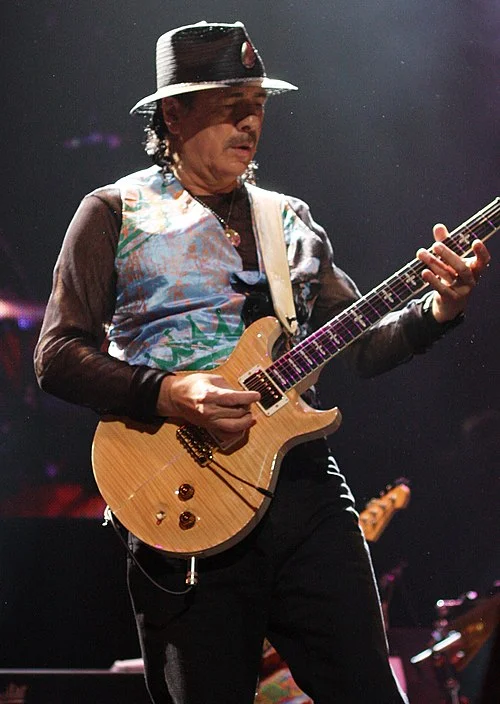
Carlos Santana — £2,500 · Premium Tone
At £2,500 · Premium, Carlos Santana's powerful and driving tone is more accessible than most players expect. Rooted in the golden age of electric guitar innovation, their sound — Carlos Santana's tone is defined by warm, sustaining lead lines with a smooth, vocal pick attack. His Mesa Boogie-driven sound — singing with natural compression and smooth overdrive — made the guitar sound as expressive as a human voice. — starts with PRS SE Custom 24-08 and Fender Deluxe Reverb (Reissue), totalling ~£2461. That combination captures the defining characteristics without the premium price tag.
Build Carlos Santana's £2,500 · Premium Rig
5 pieces · Total ~$3,125
What guitar does Carlos Santana use?
Carlos Santana is primarily associated with hss style guitars. At a £2,500 budget, PRS SE Custom 24-08 delivers the essential tonal character.
What to Buy
£2,500 · Premium — Complete Gear List
Can't find one? See alternatives:
Why This Rig Works
How Carlos Santana's gear choices create the signature tone
PRS SE Custom 24-08
The PRS SE Custom 24-08 provides the tonal foundation for the entire rig — its character shapes everything that follows.
- Expression Filtervocal mid-sweep with Fasel resonance
- OverdriveBoss SD-1 Super OverDrive
- ModulationStrymon Mobius
Fender Deluxe Reverb (Reissue)
The Fender Deluxe Reverb (Reissue) converts the guitar signal into audible sound and adds its own tonal character — EQ shaping, natural gain, and the overall feel of the final tone.
The Combined Tone
PRS or SG neck pickup into a Mesa Boogie Mark I (or II) with the lead channel pushed hard — natural amp compression creates the smooth, sustaining quality. Santana's controlled pick attack and slow, wide vibrato do the rest. A chorus adds shimmer to clean parts; a touch of delay opens up the lead tone.
Tone Tips
Getting the Sound Right
- The Fender Deluxe Reverb (Reissue) stays cleaner longer than a Marshall-style amp — push it with a low-gain overdrive (gain at 2–3, level up) rather than cranking its own gain. Set treble at 6, bass at 4, and let the guitar's volume knob handle the dynamics.
- Neck pickup only — Santana's lead tone never comes from the bridge
- Mesa Boogie lead channel: gain around 6–7, master volume up for natural compression
- Feedback is intentional — position the guitar near the amp for extra sustain
- Practice sustaining a single vibrato note for 4–8 seconds until it sounds like a human voice — Santana's goal is always to "sing" through the guitar; controlled, even vibrato over long durations is the benchmark technique to master
- Play call-and-response phrases with deliberate gaps — Santana's solos are composed in short conversational bursts, not flowing runs; the space between phrases is as musically important as the phrases themselves
- The Paul Reed Smith is not tonally identical to the SG — the PRS has longer sustain and a slightly thicker midrange, so compensate by cutting the Mesa's mid control by 1–2 steps compared to SG settings
Avoid These Pitfalls
Common Mistakes When Chasing This Tone
- Not using a gate on the Marshall DSL's high-gain channel — self-noise at this gain level is continuous and audible between notes. A noise gate is not a style choice; it is functional equipment for this gain level
- Leaving the wah pedal engaged but stationary between rocking it — a cocked wah (fixed position, not moving) acts as a midrange filter that changes the core tone. Either rock it expressively or bypass it completely; a cocked wah changes the sound in ways that are often unintended
- Setting gain too high on the overdrive pedal — most overdrive pedals are most useful at gain settings of 2-5, where they add character without dominating the tone. High gain settings on an OD pedal become a distortion, not an overdrive.
- Using a humbucker where single coils are needed — the quack, string definition, and high-frequency air of single coils cannot be EQ'd into a humbucker
- Adding a compressor before the amp "for more tone" — it kills the natural attack variation that defines the style. Blues tone is uncompressed and dynamic.
Budget Alternatives
Same Tone, Different Budget
FAQ
Carlos Santana Tone — Common Questions
Carlos Santana is primarily associated with hss style guitars. At a £2,500 budget, PRS SE Custom 24-08 delivers the essential tonal character.
Carlos Santana's amp is boutique clean voiced — clean with headroom, pushed by an overdrive pedal. At the £2,500 level, Fender Deluxe Reverb (Reissue) is the closest match.
The £2,500 tier uses Carlos Santana's actual gear choices or direct equivalents. Total: £2,461. The tonal step up from £1,000 is real but diminishing — worth it for regular performers and studio work.
Carlos Santana's essential pedals include Overdrive, Modulation. At the £2,500 tier: Dunlop GCB95 Cry Baby Wah, Boss SD-1 Super OverDrive, Strymon Mobius. Overdrive is the most important pedal — the others add nuance.
Carlos Santana's tone is defined by singing-sustain, latin, warm. The combination of hss guitar and boutique clean amp creates a sound that is immediately recognisable.
Carlos Santana's gain approach is clean-boosted — a clean amp pushed by an overdrive pedal. The pedal adds colour; the amp adds body. At £2,500, this is replicated through Fender Deluxe Reverb (Reissue) paired with Dunlop GCB95 Cry Baby Wah.
Carlos Santana — £2,500 · Premium Complete Rig
~£2461Guitar
PRS SE Custom 24-08
Wah
Dunlop GCB95 Cry Baby Wah
Overdrive
Boss SD-1 Super OverDrive
Modulation
Strymon Mobius
Amp
Fender Deluxe Reverb (Reissue)
Tone Match
Closest Real-World Tone Match
If you like Carlos Santana's tone, these players use a similar approach — same gear philosophy, comparable sound characteristics.
Related Tones