Rig Builder
Budget Rig Breakdown
Signal Chain



Essentials
Complete Your Rig
The accessories every serious guitarist needs — cables, strings, and the rest.
Ernie Ball Regular Slinky Strings (10-46)
The balance between bending ease and tone — standard gauge for blues and classic rock.
Dunlop Tortex Standard Pick 0.73mm (Pack of 12)
Medium-gauge picks used by blues and rock guitarists for attack and warmth.
Planet Waves American Stage Guitar Cable 10ft
Solderless ends and lifetime warranty. The cable most session guitarists trust.
Boss TU-3 Chromatic Tuner Pedal
The professional standard for live tuning. True bypass, powers other pedals, ultra-accurate.
Levy's M8 Guitar Strap
Quality leather strap used by touring guitarists. Genuine comfort for 3-hour sets.
Technique
Key Tone Tips
- Neck pickup only — Santana's lead tone never comes from the bridge
- Mesa Boogie lead channel: gain around 6–7, master volume up for natural compression
- Use a medium-light pick held loosely — attack is everything
- Vibrato is wide and slow, almost like a singer's natural note-to-note variation
- Boss SD-1 with gain low and level boosted pushes the amp into smooth sustain
- Mid-heavy EQ: cut bass to 4, boost mids to 7–8, treble at 5
- Let notes ring fully — Santana sustains phrases that other players would cut short
- Chorus adds shimmer to clean chords; turn it off for leads to keep them direct
- Feedback is intentional — position the guitar near the amp for extra sustain
- Practice sustaining a single vibrato note for 4–8 seconds until it sounds like a human voice — Santana's goal is always to "sing" through the guitar; controlled, even vibrato over long durations is the benchmark technique to master
- Play call-and-response phrases with deliberate gaps — Santana's solos are composed in short conversational bursts, not flowing runs; the space between phrases is as musically important as the phrases themselves
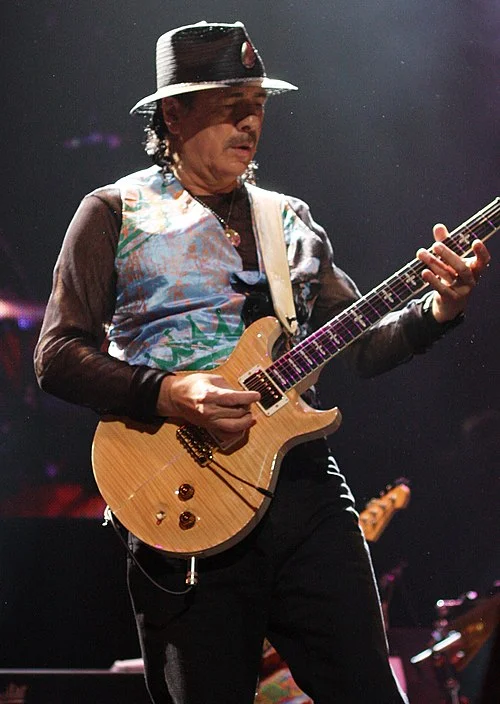
- The Paul Reed Smith is not tonally identical to the SG — the PRS has longer sustain and a slightly thicker midrange, so compensate by cutting the Mesa's mid control by 1–2 steps compared to SG settings
Background
About Carlos Santana's Sound
Carlos Santana's tone is defined by warm, sustaining lead lines with a smooth, vocal pick attack. His Mesa Boogie-driven sound — singing with natural compression and smooth overdrive — made the guitar sound as expressive as a human voice.
Tone History
Carlos Santana's Tone Evolution
Santana's core tone — warm, sustained, singing lead — has been remarkably consistent since 1969. The Yamaha SG and Mesa/Boogie Mark I created the template; every subsequent rig refinement simply maintained it.
Full timeline: 3 eras →Song Breakdowns
Carlos Santana Song Rigs
Black Magic Woman
Abraxas · 1970
Smooth, sustaining lead tone with a Latin rhythmic urgency — Santana's Mesa…
Europa
Amigos · 1976
Santana's most melodic, emotional tone — warm, lush and singing. More compr…
Evil Ways
Santana · 1969
The debut album's breakthrough single — the tone is the early Woodstock-era…