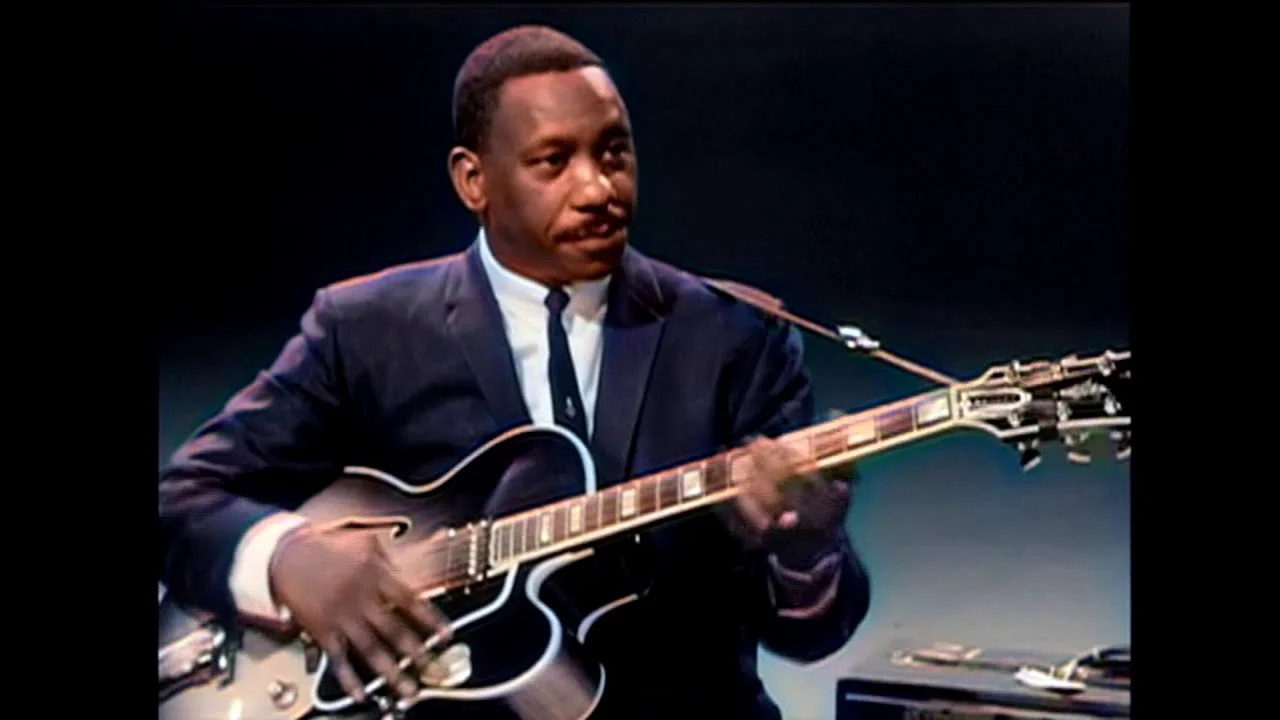
Wes Montgomery
Wes Montgomery is the most influential jazz guitarist since Charlie Christian, and his three-tier solo approach — single-note lines, then octaves, then block chords — became the template for bebop and post-bop jazz guitar playing. Self-taught, he worked in a factory while practicing at night to avoid waking his family, which led to his developing his famous thumb-picking technique: using the flat of his right-hand thumb rather than a flat pick or fingertips. The thumb's softer attack produces his characteristic warm, rounded tone — no attack transient, pure sustain. His Riverside Records recordings of the early 1960s are the essential jazz guitar canon, and his later Verve recordings introduced him to mainstream audiences through crossover instrumentals.
Extraordinarily warm, round single-note lines played with the thumb — the complete absence of pick attack creates a tone without transient spike, all sustain. Octave playing (a technique he developed to a level never surpassed) produces a thick, layered melody that fills the harmonic space normally occupied by multiple instruments. Block chord solos, the third tier, create a full-band harmonic density from a single guitar.
Signal Chain Order
Why Wes Montgomery's Rig Works
Using the flat of the thumb instead of a pick or fingertips fundamentally changes the attack transient a note starts with — a pick creates a sharp, immediate spike of energy, while a thumb's broader, softer contact area spreads that same energy over a longer initial period, essentially removing the percussive click and leaving the note starting from something closer to pure sustain. That's the specific mechanical origin of Montgomery's famously warm, round tone — it's not an amp setting or guitar choice, it's a physical consequence of how the string is set in motion.
His octave technique (playing the same note simultaneously an octave apart) works particularly well with the thumb's softer attack because the technique already thickens the sound considerably — adding a sharp pick attack on top of doubled octaves would risk sounding busy or aggressive, while the thumb's rounder onset keeps even dense octave passages sounding smooth and unified rather than cluttered.
Keeping the amp completely clean with no gain whatsoever is essential to let the thumb technique's specific tonal signature come through — any amp saturation or pedal-driven distortion would add its own attack character and harmonic content, potentially masking the very quality (transient-free, pure sustain) that thumb-picking is specifically designed to produce.
Guitars
Gibson L-5 CES
1956–1968Montgomery's definitive instrument — the L-5 CES (Cutaway Electric Spanish) with two humbucking pickups is the pinnacle of archtop jazz guitar construction. The floating humbuckers, the spruce top, and the maple back and sides produce Montgomery's warm, projecting tone when thumb-picked. He uses the neck pickup almost exclusively, with the tone control rolled back.
Gibson ES-175
1950–1956Early career guitar before the L-5 — the ES-175's laminated spruce top and single pickup produce a brighter, less expensive version of the archtop jazz sound. Used on his earliest recordings.
Amplifiers
Fender Twin Reverb
1962–1968The Fender Twin for clean headroom — Montgomery rarely approaches distortion. The Twin's crystalline clean platform at low to moderate volume allows the L-5's natural acoustic qualities to project through without coloration.
Amp guide →Gibson GA-40 Les Paul Amp
1956–1962Earlier career amplification — the GA-40's small speaker and moderate output at moderate volume provides a warmer, slightly colored tone that appears on the Riverside period recordings.
Effects Pedals
Key Albums & Tone
"Four on Six", "West Coast Blues", "Airegin" — the breakthrough Riverside album. The L-5 CES through a moderate amp level: the thumb-picking tone is immediately distinctive. "Four on Six" demonstrates all three tiers: single lines, octaves, and block chords within a single performance.
Live recording with the Wynton Kelly Trio — the definitive jazz guitar live document of the 1960s. Montgomery's octave playing in a live ensemble context: the L-5 projects clearly through the ensemble, the thumb-picking never losing warmth even at performance volume.
The Verve crossover album arranged by Don Sebesky — orchestral strings and rhythm section beneath Montgomery's guitar. A more commercial context but the L-5/thumb-picking tone is unchanged.
Frequently Asked Questions
What guitar does Wes Montgomery use?
Gibson L-5 CES and Gibson ES-175. Montgomery's definitive instrument — the L-5 CES (Cutaway Electric Spanish) with two humbucking pickups is the pinnacle of archtop jazz guitar construction. The floating humbuckers, the spruce top, and the maple back and sides produce Montgomery's warm, projecting tone when thumb-picked. He uses the neck pickup almost exclusively, with the tone control rolled back.
What amp does Wes Montgomery use?
Fender Twin Reverb and Gibson GA-40 Les Paul Amp. The Fender Twin for clean headroom — Montgomery rarely approaches distortion. The Twin's crystalline clean platform at low to moderate volume allows the L-5's natural acoustic qualities to project through without coloration.
What pedals does Wes Montgomery use?
Wes Montgomery does not use effects pedals.
What is Wes Montgomery's signature sound?
Extraordinarily warm, round single-note lines played with the thumb — the complete absence of pick attack creates a tone without transient spike, all sustain. Octave playing (a technique he developed to a level never surpassed) produces a thick, layered melody that fills the harmonic space normally occupied by multiple instruments. Block chord solos, the third tier, create a full-band harmonic density from a single guitar.
About This Data
Gear information for Wes Montgomery is compiled from live performance footage, rig-rundown interviews, manufacturer and signature-model documentation, and cross-referenced guitar press coverage — not a single source. Where accounts conflict (a common issue with decades-old gear history), we favour the version corroborated by the most independent sources and note genuine ambiguity in the text rather than presenting a guess as settled fact.
This page is maintained by Alex Hall, last reviewed July 2026. Spotted something out of date or inaccurate? Let us know — corrections are usually made within a few days.