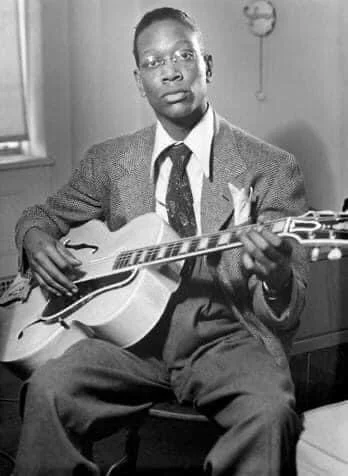
Charlie Christian
Charlie Christian was the first major electric jazz guitarist, joining Benny Goodman's band in 1939 and demonstrating that the electric guitar could function as a front-line solo instrument rather than purely a rhythm section component. His single-string melodic lines through the Gibson ES-150 and its amplifier defined the vocabulary of jazz guitar soloing — a template from which Wes Montgomery, Joe Pass, and every subsequent jazz guitarist descended. He died of tuberculosis at 25 after only three years of major-label recording, but his output in that time is foundational. His after-hours sessions at Minton's Playhouse in Harlem with Dizzy Gillespie and Thelonious Monk were among the earliest documented bebop jam sessions.
Clean, hornlike single-note lines through a Gibson ES-150 and amplifier — the amplified electric guitar as a melodic solo voice rather than a percussive rhythm instrument. Christian's lines are smooth and rhythmically mobile, running across the bar lines in a way that anticipates bebop's rhythmic displacement. The tone is warm and slightly nasal from the ES-150's blade pickup, without sustain pedal, effects, or vibrato arm.
Signal Chain Order
Why Charlie Christian's Rig Works
Before the ES-150, a guitarist in a big band setting was mechanically incapable of playing single-note melodic lines that could be heard over a full horn section — an unamplified archtop simply doesn't project enough volume for that role. The ES-150's blade pickup solved a genuine functional problem, not a tonal preference: it made the guitar loud enough to function as a legitimate solo voice trading lines with horns for the first time, which is the entire reason Christian's melodic, horn-like approach to guitar was even possible within Benny Goodman's band.
The blade pickup's specific warm, slightly nasal character (now literally called the "Charlie Christian pickup" after him) comes from its physical design — a single wide magnetic blade under all six strings, rather than six individual pole pieces — which produces a more even, blended output across the strings than later pickup designs, contributing to the smooth, unified quality of his single-note lines moving across the neck.
Using only the neck pickup with volume and tone both fully open kept his signal chain as simple as physically possible, which mattered enormously in an era with no distortion pedals, no onboard EQ sophistication, and amplifier technology still in its infancy — every element of his tone had to come from the guitar and the modest EH-150 combo alone, a constraint that shaped an entire era's understanding of what electric guitar could sound like.
Guitars
Gibson ES-150
1937–1942The ES-150 — Gibson's first production electric archtop — is inseparable from Charlie Christian's sound. The guitar's single blade pickup (known today as the 'Charlie Christian pickup') produces a warm, horn-like tone that suited his melodic, single-note approach. He was so associated with the instrument that the original bar-blade pickup design bears his name.
Amplifiers
Gibson EH-150
1937–1942The matching Gibson EH-150 amplifier sold alongside the ES-150 — a modest 15-watt combo with a single 10-inch speaker. Clean and warm at moderate volumes, providing just enough amplification to project over Goodman's full big band without straining the output section.
Effects Pedals
Key Albums & Tone
"Solo Flight", "Gone with 'What' Wind", "Air Mail Special" — the Columbia compilation of his Benny Goodman recordings. The ES-150 single-note lines over the Goodman orchestra: warm, fluid, hornlike. "Solo Flight" is the defining performance — a full instrumental guitar feature within the big band context.
Bootleg recordings of after-hours bebop sessions with Dizzy Gillespie and Thelonious Monk. Rawer recording quality than the Goodman material but capturing the experimental, forward-looking aspect of Christian's playing that the formal recordings don't fully document.
Frequently Asked Questions
What guitar does Charlie Christian use?
Gibson ES-150. The ES-150 — Gibson's first production electric archtop — is inseparable from Charlie Christian's sound. The guitar's single blade pickup (known today as the 'Charlie Christian pickup') produces a warm, horn-like tone that suited his melodic, single-note approach. He was so associated with the instrument that the original bar-blade pickup design bears his name.
What amp does Charlie Christian use?
Gibson EH-150. The matching Gibson EH-150 amplifier sold alongside the ES-150 — a modest 15-watt combo with a single 10-inch speaker. Clean and warm at moderate volumes, providing just enough amplification to project over Goodman's full big band without straining the output section.
What pedals does Charlie Christian use?
Charlie Christian does not use effects pedals.
What is Charlie Christian's signature sound?
Clean, hornlike single-note lines through a Gibson ES-150 and amplifier — the amplified electric guitar as a melodic solo voice rather than a percussive rhythm instrument. Christian's lines are smooth and rhythmically mobile, running across the bar lines in a way that anticipates bebop's rhythmic displacement. The tone is warm and slightly nasal from the ES-150's blade pickup, without sustain pedal, effects, or vibrato arm.
About This Data
Gear information for Charlie Christian is compiled from live performance footage, rig-rundown interviews, manufacturer and signature-model documentation, and cross-referenced guitar press coverage — not a single source. Where accounts conflict (a common issue with decades-old gear history), we favour the version corroborated by the most independent sources and note genuine ambiguity in the text rather than presenting a guess as settled fact.
This page is maintained by Alex Hall, last reviewed July 2026. Spotted something out of date or inaccurate? Let us know — corrections are usually made within a few days.