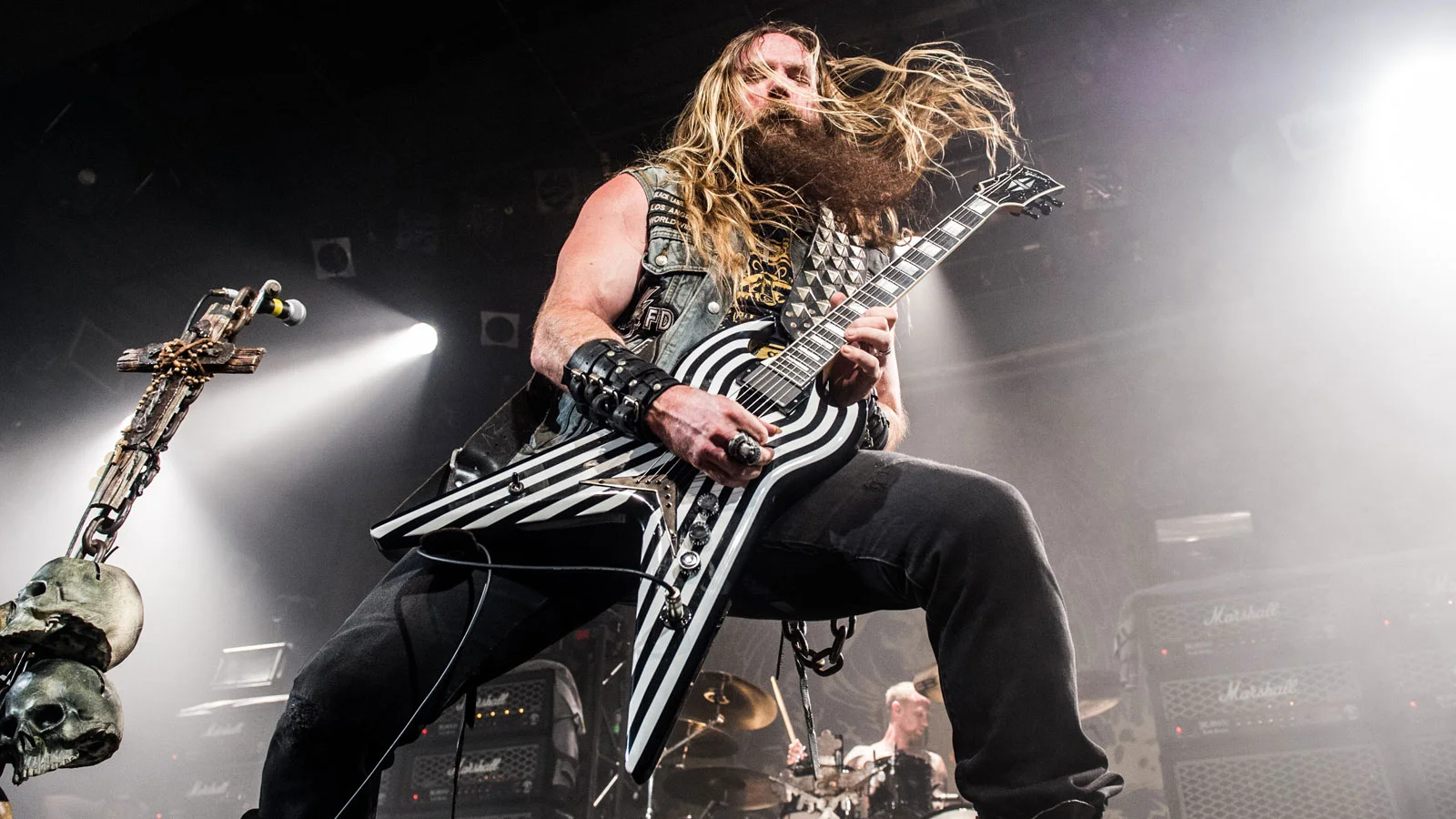
Zakk Wylde
Zakk Wylde joined Ozzy Osbourne's band as a teenager and developed one of the most powerful heavy metal tones in the genre — a wall of Marshall stacks with EMG pickups delivering crushing pinch harmonics and thunderous solos. He leads his own band, Black Label Society, and is one of the most recognisable guitarists in metal.
Les Paul with EMG-81/85 pickups into a wall of Marshall JCM800/JMP stacks — maximum gain, thick sustain, pinch harmonics at will. The EMG active pickups provide the high-output, scooped character that sits in the Marshall high-gain channel perfectly.
Why Zakk Wylde's Rig Works
Wylde's pinch harmonics — the high-pitched squeal that's become one of his signature techniques — depend directly on the EMG-81's active circuit and high output. The technique works by the pick and thumb briefly touching the string together at the point of attack, triggering an upper harmonic; a lower-output passive pickup produces a much quieter, less pronounced harmonic that's harder to control consistently, while the EMG's active preamp boosts that harmonic enough to make it a reliable, repeatable part of his vocabulary rather than an occasional accident.
Stacking multiple Marshall JCM800/JMP heads into a wall of cabinets, rather than running one amp through a larger cabinet, changes the character of the tone in the room as much as the sheer volume — each amp head has its own slightly different breakup character and phase relationship with the others, which creates a wider, more three-dimensional wall of sound on a large stage than a single amp at the same total output could produce.
The moderately scooped mid setting alongside boosted treble serves the same function it does in Hetfield or Hammett's rigs — it keeps palm-muted rhythm riffing tight and percussive — but Wylde's higher relative bass setting (6, compared to more extreme scoops used elsewhere in metal) preserves more low-end weight, which suits his blues-rock-rooted, less percussive rhythm style better than the maximally tight, scooped tone thrash metal typically favors.
Guitars
Gibson Les Paul Bullseye
Black and white bullseye finish. EMG-81/85 active pickups. His signature throughout Ozzy and BLS career.
Full specs & buy →Wylde Audio Odin
Flying V variant from his own Wylde Audio brand.
Wylde Audio Barbarian
Les Paul style with Explorer-influenced lower horn.
Amplifiers
Marshall JCM800 2203
Primary amp — all gain, all the time. High treble, moderately scooped mid.
Amp guide →Wylde Audio PA100
Signature head from his own brand.
Effects Pedals
MXR ZW-44 Berzerker Overdrive
Signature overdrive — pushes the Marshall harder for extra-saturated lead tones.
MXR ZW-90 Oink Wah
Signature wah with his voiced response.
Key Albums & Tone
"Mama, I'm Coming Home" and "No More Tears" — the peak of his Ozzy work.
First Ozzy album with Zakk — raw and aggressive.
Black Label Society debut — doom-tinged heavy riffs.
Frequently Asked Questions
What guitar does Zakk Wylde use?
Gibson Les Paul Bullseye and Wylde Audio Odin. Black and white bullseye finish. EMG-81/85 active pickups. His signature throughout Ozzy and BLS career.
What amp does Zakk Wylde use?
Marshall JCM800 2203 and Wylde Audio PA100. Primary amp — all gain, all the time. High treble, moderately scooped mid.
What pedals does Zakk Wylde use?
Zakk Wylde uses MXR ZW-44 Berzerker Overdrive, MXR ZW-90 Oink Wah, Boss NS-2 Noise Suppressor.
What is Zakk Wylde's signature sound?
Les Paul with EMG-81/85 pickups into a wall of Marshall JCM800/JMP stacks — maximum gain, thick sustain, pinch harmonics at will. The EMG active pickups provide the high-output, scooped character that sits in the Marshall high-gain channel perfectly.
About This Data
Gear information for Zakk Wylde is compiled from live performance footage, rig-rundown interviews, manufacturer and signature-model documentation, and cross-referenced guitar press coverage — not a single source. Where accounts conflict (a common issue with decades-old gear history), we favour the version corroborated by the most independent sources and note genuine ambiguity in the text rather than presenting a guess as settled fact.
This page is maintained by Alex Hall, last reviewed July 2026. Spotted something out of date or inaccurate? Let us know — corrections are usually made within a few days.