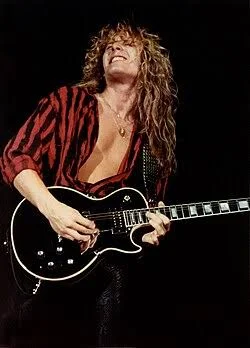
Tone Timeline
John Sykes — Tone Evolution
John Sykes is a hard rock guitarist associated with Whitesnake and Thin Lizzy — his writing credit on Whitesnake's Slide It In and 1987 (the latter recorded almost entirely by himself) gave him one of the biggest-selling rock records of the decade, despite not appearing on the subsequent tour.
1982–1985: Thin Lizzy / Slide It In
Sykes joined Thin Lizzy for their final studio album Thunder and Lightning (1983) — his aggressive Les Paul tone was a contrast with the twin-guitar melodic approach Thin Lizzy had established. He then joined Whitesnake and co-wrote Slide It In (1984). His Les Paul through a Marshall setup had a thick, compressed quality — high gain but maintaining note definition.
Signal Chain
1987: Whitesnake 1987
↑ Whitesnake '87 was Sykes' peak commercial moment — the production budget allowed his Les Paul/Marshall tone to be captured with professional polish; Still of the Night's riff is among the finest British hard rock guitar moments.
Whitesnake's self-titled 1987 album (actually 1987 in the UK, 1987 in the US) was a massive commercial success — Still of the Night, Here I Go Again, Is This Love all hit massive. Sykes recorded virtually all guitar parts but was fired before the tour and his relationship with Coverdale became acrimonious. His tone on the album is his finest hour: Les Paul through Marshall, thick and sustaining, perfectly engineered.
Signal Chain
1988–present: Blue Murder / Solo Work
↑ Blue Murder era freed Sykes from corporate rock context — more creative but less commercially successful; the guitar identity remained unchanged.
Blue Murder (with Carmine Appice) showed Sykes outside the Whitesnake context — creative freedom but less commercial impact. His solo work has continued intermittently. The Les Paul/Marshall identity has never significantly changed.
Signal Chain