Rig Builder
Budget Rig Breakdown
Signal Chain

Essentials
Complete Your Rig
The accessories every serious guitarist needs — cables, strings, and the rest.
Ernie Ball Power Slinky Strings (11-48)
Heavier gauge for drop tunings and tighter pick attack — standard for modern metal.
ISP Decimator II Noise Gate
Essential for high-gain amps and extended-range guitars. No noise gate — no clean metal tone.
Planet Waves American Stage Guitar Cable 10ft
Solderless ends and lifetime warranty. The cable most session guitarists trust.
Boss TU-3 Chromatic Tuner Pedal
The professional standard for live tuning. True bypass, powers other pedals, ultra-accurate.
Levy's M8 Guitar Strap
Quality leather strap used by touring guitarists. Genuine comfort for 3-hour sets.
Technique
Key Tone Tips
- Vibrato is the defining technique — Sykes' vibrato is wide, slow and operatic. Every sustained note gets extended vibrato treatment, adding the emotional weight that defines his solos
- Bridge pickup exclusively for lead: the DiMarzio Super Distortion in the bridge position gives the dense, singing quality; neck pickup is occasionally used for rhythm only
- Crank the Marshall volume: the saturation comes from the amp running hot, not from the pedals alone. The SD-1 or MXR Distortion+ is used to push the front end harder, not as the primary distortion source
- Sustained notes with heavy bends: Sykes' lead phrasing relies on long, sustaining bent notes held for several beats — light gauge strings (.009–.046) under high action make wide bends easier
- The tone is mid-forward: keep bass around 4, mids at 7–8, treble at 6–7 on the Marshall. The scooped 'bedroom tone' sounds wrong at stage volumes
- Pentatonic minor with chromatic passing tones: the lead vocabulary is blues-based pentatonic minor, but chromatic approach notes (b2 and b6 as passing tones) give the phrases a more dramatic, melodic quality
- Listen to 'Still of the Night', 'Is This Love' and 'Here I Go Again' (1987 version): these three tracks cover the full range — aggressive riffing, lyrical ballad lead and mid-tempo hard rock respectively
- The harmony guitar parts on Whitesnake 1987 are all played by Sykes: he recorded every guitar track on the album. When reproducing the harmony leads, the interval is typically a diatonic third above the primary melody line
- Thin Lizzy period (Sykes in Lizzy 1982–83): the tone here is brighter and less saturated than the Whitesnake sound — a reminder that the thick 1987 tone was a deliberate recording and production choice as much as a playing choice
- Dynamics within the sustained note: the vibrato changes speed and width within a single held note. Start slow and wide, then increase the rate as the note decays — this mimics the classical operatic vibrato technique
- The legato pull-off runs use the 'speed through relaxation' principle — Sykes' fast passages in solos like 'Looking for Love' use hammer-ons and pull-offs with minimal right-hand picking to maintain smoothness at high tempo
- The JCM800 treble channel is the tone source: the gain is high but not the extreme of later amps — the sound has a mid-forward clarity that modern high-gain amps obscure. Avoid scooped EQ or the tone becomes thin and generic
Background
About John Sykes's Sound
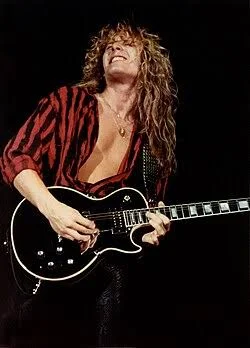
John Sykes defined the sound of late 1980s hard rock with the massive, creamy lead tone he forged on Whitesnake's 1987 album — arguably the most commercially successful guitar sound of its era. Playing a modified PAF-loaded Les Paul through cranked Marshalls, Sykes combined Gary Moore's melodic sensibility with a ferocious vibrato and an aggressive attack that made every note sustain seemingly forever.
Tone History
John Sykes's Tone Evolution
John Sykes is a hard rock guitarist associated with Whitesnake and Thin Lizzy — his writing credit on Whitesnake's Slide It In and 1987 (the latter recorded almost entirely by himself) gave him one of the biggest-selling rock records of the decade, despite not appearing on the subsequent tour.
Full timeline: 3 eras →Song Breakdowns
John Sykes Song Rigs
Still of the Night
Whitesnake · 1987
Possibly the heaviest, most authoritative British hard rock riff tone of th…
Is This Love
Whitesnake · 1987
The counterpart to Still of the Night on the same album — Sykes demonstrate…
Thunder and Lightning
Thunder and Lightning · 1983
Sykes's work with Thin Lizzy — a harder, slightly rawer tone than the polis…