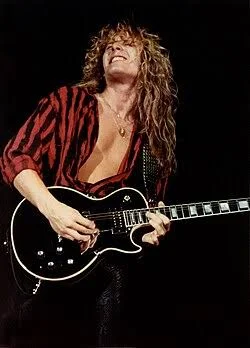
John Sykes — £200 · Beginner Rig
Modified Gibson Les Paul with PAF-style humbuckers (often a single-cut Les Paul Standard with DiMarzio Super Distortion in the bridge) into a cranked Marshall JCM800. The tone is thick, sustained and heavily mid-forward — the overdriven Marshall provides the saturation while the Les Paul provides the warmth and compression. Sykes often boosted with a Boss SD-1 or MXR Distortion+ to further saturate the front end.
Signal Path
Signal Chain
Full signal path
Full Gear List
£200 · Beginner — Complete Rig
Tone Tips
Getting the Sound Right
- Vibrato is the defining technique — Sykes' vibrato is wide, slow and operatic. Every sustained note gets extended vibrato treatment, adding the emotional weight that defines his solos
- Bridge pickup exclusively for lead: the DiMarzio Super Distortion in the bridge position gives the dense, singing quality; neck pickup is occasionally used for rhythm only
- Crank the Marshall volume: the saturation comes from the amp running hot, not from the pedals alone. The SD-1 or MXR Distortion+ is used to push the front end harder, not as the primary distortion source
- Sustained notes with heavy bends: Sykes' lead phrasing relies on long, sustaining bent notes held for several beats — light gauge strings (.009–.046) under high action make wide bends easier
- The tone is mid-forward: keep bass around 4, mids at 7–8, treble at 6–7 on the Marshall. The scooped 'bedroom tone' sounds wrong at stage volumes
- Pentatonic minor with chromatic passing tones: the lead vocabulary is blues-based pentatonic minor, but chromatic approach notes (b2 and b6 as passing tones) give the phrases a more dramatic, melodic quality
- Listen to 'Still of the Night', 'Is This Love' and 'Here I Go Again' (1987 version): these three tracks cover the full range — aggressive riffing, lyrical ballad lead and mid-tempo hard rock respectively
- The harmony guitar parts on Whitesnake 1987 are all played by Sykes: he recorded every guitar track on the album. When reproducing the harmony leads, the interval is typically a diatonic third above the primary melody line
Avoid These Pitfalls
Common Mistakes When Chasing This Tone
- Scooping mids on the JCM800 with humbuckers — the mid-forward character of British amps with humbuckers is the central sound of classic rock. A mid scoop removes the fundamental voice of the combination
- Leaving the wah pedal engaged but stationary between rocking it — a cocked wah (fixed position, not moving) acts as a midrange filter that changes the core tone. Either rock it expressively or bypass it completely; a cocked wah changes the sound in ways that are often unintended
- Ignoring the individual pickup volume and tone controls — the two-pickup switching options on a Les Paul give you four distinct tones within a single setting. Most players only use two.
- Using a high-gain distortion pedal instead of amp gain — British crunch amps have a specific harmonic character when driven from their own gain stage. A pedal changes this character.
- Playing at bedroom volume expecting amp-driven tone — the power-tube saturation that defines this gain structure only occurs when the amp is working at substantial output. This is not replicable at low volumes.
- Setting gain too high on the overdrive pedal — most overdrive pedals are most useful at gain settings of 2-5, where they add character without dominating the tone. High gain settings on an OD pedal become a distortion, not an overdrive.
- Not setting delay to song tempo — a delay that doesn't match the song tempo creates a rhythmic clash that builds and becomes increasingly obvious. Tap the tempo every time.
- Ignoring down-tuning — trying to achieve dropped-tuning riff character at standard pitch produces a thinner, less aggressive result regardless of EQ.
Tone Profile
John Sykes's Sound
Modified Gibson Les Paul with PAF-style humbuckers (often a single-cut Les Paul Standard with DiMarzio Super Distortion in the bridge) into a cranked Marshall JCM800. The tone is thick, sustained and heavily mid-forward — the overdriven Marshall provides the saturation while the Les Paul provides the warmth and compression. Sykes often boosted with a Boss SD-1 or MXR Distortion+ to further saturate the front end.