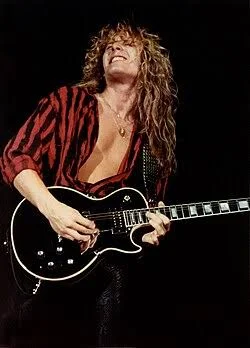
John Sykes — £500 · Sweet Spot Tone
At £500 · Sweet Spot, John Sykes's heavy and assertive tone is more accessible than most players expect. Rooted in the decade of guitar virtuosity and arena rock, their sound — John Sykes defined the sound of late 1980s hard rock with the massive, creamy lead tone he forged on Whitesnake's 1987 album — arguably the most commercially successful guitar sound of its era. Playing a modified PAF-loaded Les Paul through cranked Marshalls, Sykes combined Gary Moore's melodic sensibility with a ferocious vibrato and an aggressive attack that made every note sustain seemingly forever. — starts with Epiphone Les Paul Standard and Boss Katana 50 MkII, totalling ~£507. That combination captures the defining characteristics without the premium price tag.
Build John Sykes's £500 · Sweet Spot Rig
3 pieces · Total ~$644
What guitar does John Sykes use?
John Sykes is primarily associated with lp style guitars. At a £500 budget, Epiphone Les Paul Standard delivers the essential tonal character.
What to Buy
£500 · Sweet Spot — Complete Gear List
Can't find one? See alternatives:
Why This Rig Works
How John Sykes's gear choices create the signature tone
Epiphone Les Paul Standard
The set-neck construction and ProBucker humbuckers deliver the sustain, thickness and mid-forward push of the genuine article. Bridge pickup into a crunch amp is the authentic hard rock formula.
Joyo Vintage Overdrive
Joyo Vintage Overdrive — overdrive coloring added to the signal.
Boss Katana 50 MkII
Its 'Brown' amp character at low gain is an excellent approximation of the Fender-style clarity that Hendrix, Mayer, Gilmour and SRV all relied on. Built-in effects mean you're a few knob turns away from the right tone.
The Combined Tone
Modified Gibson Les Paul with PAF-style humbuckers (often a single-cut Les Paul Standard with DiMarzio Super Distortion in the bridge) into a cranked Marshall JCM800. The tone is thick, sustained and heavily mid-forward — the overdriven Marshall provides the saturation while the Les Paul provides the warmth and compression. Sykes often boosted with a Boss SD-1 or MXR Distortion+ to further saturate the front end.
Tone Tips
Getting the Sound Right
- On the Boss Katana 50 MkII: use the Brown channel — the closest model to a Marshall-voiced preamp at this price. Set character to 8, gain to 5. For John Sykes's lead volume jump, use the Boost mode rather than adding a separate boost pedal.
- Vibrato is the defining technique — Sykes' vibrato is wide, slow and operatic. Every sustained note gets extended vibrato treatment, adding the emotional weight that defines his solos
- Bridge pickup exclusively for lead: the DiMarzio Super Distortion in the bridge position gives the dense, singing quality; neck pickup is occasionally used for rhythm only
- Crank the Marshall volume: the saturation comes from the amp running hot, not from the pedals alone. The SD-1 or MXR Distortion+ is used to push the front end harder, not as the primary distortion source
- Sustained notes with heavy bends: Sykes' lead phrasing relies on long, sustaining bent notes held for several beats — light gauge strings (.009–.046) under high action make wide bends easier
- The tone is mid-forward: keep bass around 4, mids at 7–8, treble at 6–7 on the Marshall. The scooped 'bedroom tone' sounds wrong at stage volumes
- Stacking TS9 into a JCM800 with Les Paul humbuckers: the order matters — guitar → TS → amp. The humbucker drives the TS which drives the amp. Keep TS gain at 1-2 maximum or the harmonic layering becomes too thick
- A Les Paul's humbucker output into a JCM800 is a self-contained amp distortion system — try the sound without any drive pedals first. Most players add overdrive before fully exploring what the amp alone can do
Avoid These Pitfalls
Common Mistakes When Chasing This Tone
- Scooping mids on the JCM800 with humbuckers — the mid-forward character of British amps with humbuckers is the central sound of classic rock. A mid scoop removes the fundamental voice of the combination
- Leaving the wah pedal engaged but stationary between rocking it — a cocked wah (fixed position, not moving) acts as a midrange filter that changes the core tone. Either rock it expressively or bypass it completely; a cocked wah changes the sound in ways that are often unintended
- Ignoring the individual pickup volume and tone controls — the two-pickup switching options on a Les Paul give you four distinct tones within a single setting. Most players only use two.
- Using a high-gain distortion pedal instead of amp gain — British crunch amps have a specific harmonic character when driven from their own gain stage. A pedal changes this character.
- Playing at bedroom volume expecting amp-driven tone — the power-tube saturation that defines this gain structure only occurs when the amp is working at substantial output. This is not replicable at low volumes.
Budget Alternatives
Same Tone, Different Budget
FAQ
John Sykes Tone — Common Questions
John Sykes is primarily associated with lp style guitars. At a £500 budget, Epiphone Les Paul Standard delivers the essential tonal character.
John Sykes's amp is british crunch voiced — the amp running hot, providing natural tube saturation. At the £500 level, Boss Katana 50 MkII is the closest match.
Yes — £500 covers a real guitar and amp in the right tonal family. This rig totals £507 and captures the essential character. The guitar and amp account for 80% of the tone; pedals are secondary at this budget.
John Sykes's essential pedals include Overdrive, Delay, Reverb. At the £500 tier: Joyo Vintage Overdrive. Overdrive is the most important pedal — the others add nuance.
John Sykes's tone is defined by British-hard-rock, warm-lead, legato. The combination of lp guitar and british crunch amp creates a sound that is immediately recognisable.
John Sykes's gain approach is amp-driven — natural tube saturation from pushing the amp hard, not from distortion pedals. At £500, this is replicated through Boss Katana 50 MkII paired with Joyo Vintage Overdrive.
John Sykes — £500 · Sweet Spot Complete Rig
~£507Guitar
Epiphone Les Paul Standard
Overdrive
Joyo Vintage Overdrive
Amp
Boss Katana 50 MkII
Tone Match
Closest Real-World Tone Match
If you like John Sykes's tone, these players use a similar approach — same gear philosophy, comparable sound characteristics.
Related Tones