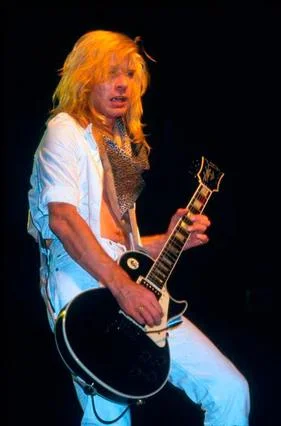
Steve Clark — £500 · Sweet Spot Tone
At £500 · Sweet Spot, Steve Clark's heavy and assertive tone is more accessible than most players expect. Rooted in the decade of guitar virtuosity and arena rock, their sound — Steve Clark was one half of Def Leppard's twin-guitar attack — alongside Phil Collen, Clark's combination of blues feeling and hard rock power helped create the polished, harmony-drenched sound of Pyromania (1983) and Hysteria (1987). His Les Paul and ES-335 tones added a warmth and personality that balanced Collen's more precise superstrat approach. — starts with Epiphone Les Paul Standard and Boss Katana 50 MkII, totalling ~£478. That combination captures the defining characteristics without the premium price tag.
Build Steve Clark's £500 · Sweet Spot Rig
2 pieces · Total ~$607
What guitar does Steve Clark use?
Steve Clark is primarily associated with lp style guitars. At a £500 budget, Epiphone Les Paul Standard delivers the essential tonal character.
What to Buy
£500 · Sweet Spot — Complete Gear List
Can't find one? See alternatives:
Why This Rig Works
How Steve Clark's gear choices create the signature tone
Epiphone Les Paul Standard
The set-neck construction and ProBucker humbuckers deliver the sustain, thickness and mid-forward push of the genuine article. Bridge pickup into a crunch amp is the authentic hard rock formula.
Boss Katana 50 MkII
Its 'Brown' amp character at low gain is an excellent approximation of the Fender-style clarity that Hendrix, Mayer, Gilmour and SRV all relied on. Built-in effects mean you're a few knob turns away from the right tone.
The Combined Tone
Gibson Les Paul Standard and Gibson ES-335 into Marshall and Rockman amp units (on the Hysteria sessions). Clark's tone is warmer and bluesier than Collen's — the Les Paul provides mid-range emphasis and natural compression that suits his more feel-based playing style. On recordings, the guitar sounds were heavily processed through the Rockman headphone amp, which contributed to the distinctive 1980s Def Leppard compression.
Tone Tips
Getting the Sound Right
- On the Boss Katana 50 MkII: use the Brown channel — the closest model to a Marshall-voiced preamp at this price. Set character to 8, gain to 5. For Steve Clark's lead volume jump, use the Boost mode rather than adding a separate boost pedal.
- Harmony guitar parts are the signature technique: Clark and Collen recorded harmony guitar solos in parallel thirds and sixths. To recreate this, record two passes — one on the primary melody, one at the diatonic third above. This technique is heard throughout 'Photograph', 'Rock of Ages' and 'Pour Some Sugar on Me'
- The Rockman sound: Def Leppard's Hysteria-era recordings used the Rockman amp unit as a recording device. The characteristic compressed, slightly clinical sheen on the guitars can be approximated with a heavy compressor pedal after the overdrive, or using a modeller with a Rockman cabinet impulse response
- Bluesier vibrato than the stereotypical 1980s lead: Clark's solos have a more organic, relaxed vibrato compared to the tight technical style of players like Steve Lukather. The emotional range is wider — the bends are expressively wide and slow on ballads
- The ES-335 for rhythm: Clark often used the semi-hollow on rhythm parts, adding a natural warmth and slight feedback-prone quality to the rhythm parts that distinguishes his work from the cleaner rhythm tone of Collen's Charvel/Jackson
- Mid-forward Marshall settings: treble 6, mid 7, bass 5, presence 6 — the JCM800 is not scooped. This keeps the guitar in the mix on a dense, multi-tracked production
- The neck humbucker on a Les Paul into a JCM800 gives a warm, singing sustain for leads; the bridge humbucker gives a cutting, aggressive crunch for rhythm. Toggle between them rather than using EQ changes
- Semi-hollow guitars feed back at lower gain levels than solid-body guitars — the body cavity amplifies certain frequencies acoustically. Learn which notes trigger feedback by playing sustained notes at stage volume and remembering the positions
Avoid These Pitfalls
Common Mistakes When Chasing This Tone
- Scooping mids on the JCM800 with humbuckers — the mid-forward character of British amps with humbuckers is the central sound of classic rock. A mid scoop removes the fundamental voice of the combination
- Setting the amp bass too high — the inherent warmth of mahogany means you need less bass EQ than with a Strat. Starting at 5 rather than 7 prevents low-end mud.
- Using a high-gain distortion pedal instead of amp gain — British crunch amps have a specific harmonic character when driven from their own gain stage. A pedal changes this character.
- Playing at bedroom volume expecting amp-driven tone — the power-tube saturation that defines this gain structure only occurs when the amp is working at substantial output. This is not replicable at low volumes.
- Too many repeats at high mix — more than 3 repeats makes the delay effect accumulate and overwhelm the dry guitar signal. Keep it to 2-3 repeats at a subtle mix level.
Budget Alternatives
Same Tone, Different Budget
FAQ
Steve Clark Tone — Common Questions
Steve Clark is primarily associated with lp style guitars. At a £500 budget, Epiphone Les Paul Standard delivers the essential tonal character.
Steve Clark's amp is british crunch voiced — the amp running hot, providing natural tube saturation. At the £500 level, Boss Katana 50 MkII is the closest match.
Yes — £500 covers a real guitar and amp in the right tonal family. This rig totals £478 and captures the essential character. The guitar and amp account for 80% of the tone; pedals are secondary at this budget.
Steve Clark's tone is defined by hard-rock, dual-guitar-harmony, british-crunch. The combination of lp guitar and british crunch amp creates a sound that is immediately recognisable.
Steve Clark's gain approach is amp-driven — natural tube saturation from pushing the amp hard, not from distortion pedals. At £500, this is replicated through Boss Katana 50 MkII.
Steve Clark — £500 · Sweet Spot Complete Rig
~£478Guitar
Epiphone Les Paul Standard
Amp
Boss Katana 50 MkII
Tone Match
Closest Real-World Tone Match
If you like Steve Clark's tone, these players use a similar approach — same gear philosophy, comparable sound characteristics.
Related Tones