Rig Builder
Budget Rig Breakdown
Signal Chain
Essentials
Complete Your Rig
The accessories every serious guitarist needs — cables, strings, and the rest.
Ernie Ball Power Slinky Strings (11-48)
Heavier gauge for drop tunings and tighter pick attack — standard for modern metal.
ISP Decimator II Noise Gate
Essential for high-gain amps and extended-range guitars. No noise gate — no clean metal tone.
Planet Waves American Stage Guitar Cable 10ft
Solderless ends and lifetime warranty. The cable most session guitarists trust.
Boss TU-3 Chromatic Tuner Pedal
The professional standard for live tuning. True bypass, powers other pedals, ultra-accurate.
Levy's M8 Guitar Strap
Quality leather strap used by touring guitarists. Genuine comfort for 3-hour sets.
Technique
Key Tone Tips
- Harmony guitar parts are the signature technique: Clark and Collen recorded harmony guitar solos in parallel thirds and sixths. To recreate this, record two passes — one on the primary melody, one at the diatonic third above. This technique is heard throughout 'Photograph', 'Rock of Ages' and 'Pour Some Sugar on Me'
- The Rockman sound: Def Leppard's Hysteria-era recordings used the Rockman amp unit as a recording device. The characteristic compressed, slightly clinical sheen on the guitars can be approximated with a heavy compressor pedal after the overdrive, or using a modeller with a Rockman cabinet impulse response
- Bluesier vibrato than the stereotypical 1980s lead: Clark's solos have a more organic, relaxed vibrato compared to the tight technical style of players like Steve Lukather. The emotional range is wider — the bends are expressively wide and slow on ballads
- The ES-335 for rhythm: Clark often used the semi-hollow on rhythm parts, adding a natural warmth and slight feedback-prone quality to the rhythm parts that distinguishes his work from the cleaner rhythm tone of Collen's Charvel/Jackson
- Mid-forward Marshall settings: treble 6, mid 7, bass 5, presence 6 — the JCM800 is not scooped. This keeps the guitar in the mix on a dense, multi-tracked production
- Study 'Photograph' (lead break), 'Too Late for Love' and 'Bringin' on the Heartbreak' for Clark's primary lead vocabulary — pentatonic minor with expressive bends and occasional double-stop unisons
- The recording compression is heavy: Hysteria was produced by Mutt Lange with multiple guitar overdubs. Live reproduction of the studio tone should use heavier compression than would typically be used — a compressor set to slow attack, high ratio after the distortion mimics the tape compression of the original recordings
- Double-tracking is essential for the Def Leppard wall-of-sound: every rhythm guitar part is at minimum double-tracked, panned left and right. A single guitar playing the same part will always sound thinner than the record
- The lead tone sits in the upper mid-range: Clark's solos cut through a dense mix by emphasising the 2–4kHz range. A mid-boost before the amp (such as a TS9 or SD-1) in front of the Marshall achieves this presence without harshness
- Listen chronologically: the tone on Pyromania (1983) is harder and less polished than Hysteria (1987). The Pyromania sound is a more straightforward JCM800 — the Hysteria sound adds the Rockman compression layer
- Rhythm playing uses palm muting sparingly — unlike heavier metal, Def Leppard rhythm parts are mostly open (non-muted) power chords with tightly defined attack. The compression and room sound of the studio controlled the note length rather than physical muting
- The guitar rig doubles as a textural instrument: on songs like 'Love Bites', Clark's guitar provides sustained chordal texture rather than melodic leads. Treating the guitar as a textural voice within an ensemble arrangement rather than always as a lead instrument is central to understanding his role
Background
About Steve Clark's Sound
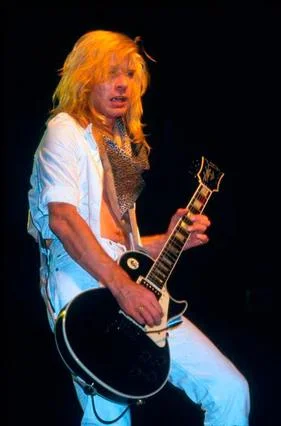
Steve Clark was one half of Def Leppard's twin-guitar attack — alongside Phil Collen, Clark's combination of blues feeling and hard rock power helped create the polished, harmony-drenched sound of Pyromania (1983) and Hysteria (1987). His Les Paul and ES-335 tones added a warmth and personality that balanced Collen's more precise superstrat approach.
Tone History
Steve Clark's Tone Evolution
Steve Clark was Def Leppard's lead guitarist alongside Phil Collen — his melodic, harmony-driven approach and Gibson Les Paul through a Marshall stack gave Hysteria and Pyromania their guitar character. He died in 1991 from alcohol-related health problems at age 30.
Full timeline: 2 eras →Song Breakdowns
Steve Clark Song Rigs
Pour Some Sugar on Me
Hysteria · 1987
Def Leppard's biggest single and a masterclass in 1980s arena rock guitar p…
Photograph
Pyromania · 1983
The Pyromania album's signature track — Clark's guitar tone on the Pyromani…
Love Bites
Hysteria · 1987
Def Leppard's most successful power ballad — Clark's clean, sustained guita…