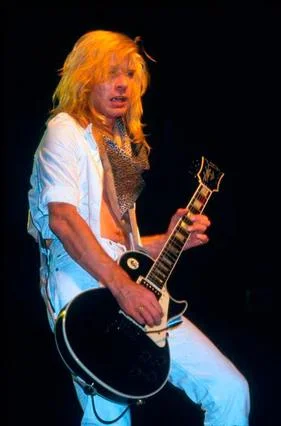
Steve Clark — £1,000 · Pro-Level Tone
At £1,000 · Pro-Level, Steve Clark's heavy and assertive tone is more accessible than most players expect. Rooted in the decade of guitar virtuosity and arena rock, their sound — Steve Clark was one half of Def Leppard's twin-guitar attack — alongside Phil Collen, Clark's combination of blues feeling and hard rock power helped create the polished, harmony-drenched sound of Pyromania (1983) and Hysteria (1987). His Les Paul and ES-335 tones added a warmth and personality that balanced Collen's more precise superstrat approach. — starts with Epiphone Les Paul Special and Boss Katana 100 MkII, totalling ~£976. That combination captures the defining characteristics without the premium price tag.
Build Steve Clark's £1,000 · Pro-Level Rig
4 pieces · Total ~$1,240
What guitar does Steve Clark use?
Steve Clark is primarily associated with lp style guitars. At a £1,000 budget, Epiphone Les Paul Special delivers the essential tonal character.
What to Buy
£1,000 · Pro-Level — Complete Gear List
Can't find one? See alternatives:
Why This Rig Works
How Steve Clark's gear choices create the signature tone
Epiphone Les Paul Special
The 650R/700T humbucker pair gives instant Les Paul darkness and warmth. They nail the aggressive, mid-forward crunch that hard rock is built on.
- ChorusTC Electronic Corona Chorus
- DelayStrymon Timeline
Boss Katana 100 MkII
The extra headroom lets you push the clean channel harder before it breaks up, essential for loud-amp technique. More speaker excursion gives a fuller, more three-dimensional clean.
The Combined Tone
Gibson Les Paul Standard and Gibson ES-335 into Marshall and Rockman amp units (on the Hysteria sessions). Clark's tone is warmer and bluesier than Collen's — the Les Paul provides mid-range emphasis and natural compression that suits his more feel-based playing style. On recordings, the guitar sounds were heavily processed through the Rockman headphone amp, which contributed to the distinctive 1980s Def Leppard compression.
Tone Tips
Getting the Sound Right
- On the Boss Katana 100 MkII: use the Brown channel — the closest model to a Marshall-voiced preamp at this price. Set character to 8, gain to 5. For Steve Clark's lead volume jump, use the Boost mode rather than adding a separate boost pedal.
- Harmony guitar parts are the signature technique: Clark and Collen recorded harmony guitar solos in parallel thirds and sixths. To recreate this, record two passes — one on the primary melody, one at the diatonic third above. This technique is heard throughout 'Photograph', 'Rock of Ages' and 'Pour Some Sugar on Me'
- The Rockman sound: Def Leppard's Hysteria-era recordings used the Rockman amp unit as a recording device. The characteristic compressed, slightly clinical sheen on the guitars can be approximated with a heavy compressor pedal after the overdrive, or using a modeller with a Rockman cabinet impulse response
- Mid-forward Marshall settings: treble 6, mid 7, bass 5, presence 6 — the JCM800 is not scooped. This keeps the guitar in the mix on a dense, multi-tracked production
- Study 'Photograph' (lead break), 'Too Late for Love' and 'Bringin' on the Heartbreak' for Clark's primary lead vocabulary — pentatonic minor with expressive bends and occasional double-stop unisons
- The recording compression is heavy: Hysteria was produced by Mutt Lange with multiple guitar overdubs. Live reproduction of the studio tone should use heavier compression than would typically be used — a compressor set to slow attack, high ratio after the distortion mimics the tape compression of the original recordings
- Double-tracking is essential for the Def Leppard wall-of-sound: every rhythm guitar part is at minimum double-tracked, panned left and right. A single guitar playing the same part will always sound thinner than the record
Avoid These Pitfalls
Common Mistakes When Chasing This Tone
- Scooping mids on the JCM800 with humbuckers — the mid-forward character of British amps with humbuckers is the central sound of classic rock. A mid scoop removes the fundamental voice of the combination
- Setting the amp bass too high — the inherent warmth of mahogany means you need less bass EQ than with a Strat. Starting at 5 rather than 7 prevents low-end mud.
- Too many repeats at high mix — more than 3 repeats makes the delay effect accumulate and overwhelm the dry guitar signal. Keep it to 2-3 repeats at a subtle mix level.
- No noise gate at high gain — self-noise at high gain levels is constant and distracting. A gate is not optional for this style.
- Setting gain to maximum — above 8 on most amp channels, note separation degrades and riffs lose definition. The loudness feels greater but the clarity goes down.
Budget Alternatives
Same Tone, Different Budget
FAQ
Steve Clark Tone — Common Questions
Steve Clark is primarily associated with lp style guitars. At a £1,000 budget, Epiphone Les Paul Special delivers the essential tonal character.
Steve Clark's amp is british crunch voiced — the amp running hot, providing natural tube saturation. At the £1,000 level, Boss Katana 100 MkII is the closest match.
The £1,000 tier adds noticeably better build quality and tonal nuance over the £500 rig. This build totals £976 with Epiphone Les Paul Special, Boss Katana 100 MkII, 2 effects. This is the tier where the tone becomes genuinely convincing for gigging and recording.
Steve Clark's essential pedals include Chorus, Delay. At the £1,000 tier: TC Electronic Corona Chorus, Strymon Timeline. Chorus is the most important pedal — the others add nuance.
Steve Clark's tone is defined by hard-rock, dual-guitar-harmony, british-crunch. The combination of lp guitar and british crunch amp creates a sound that is immediately recognisable.
Steve Clark's gain approach is amp-driven — natural tube saturation from pushing the amp hard, not from distortion pedals. At £1,000, this is replicated through Boss Katana 100 MkII paired with TC Electronic Corona Chorus.
Steve Clark — £1,000 · Pro-Level Complete Rig
~£976Guitar
Epiphone Les Paul Special
Chorus
TC Electronic Corona Chorus
Amp
Boss Katana 100 MkII
Delay
Strymon Timeline
Tone Match
Closest Real-World Tone Match
If you like Steve Clark's tone, these players use a similar approach — same gear philosophy, comparable sound characteristics.
Related Tones