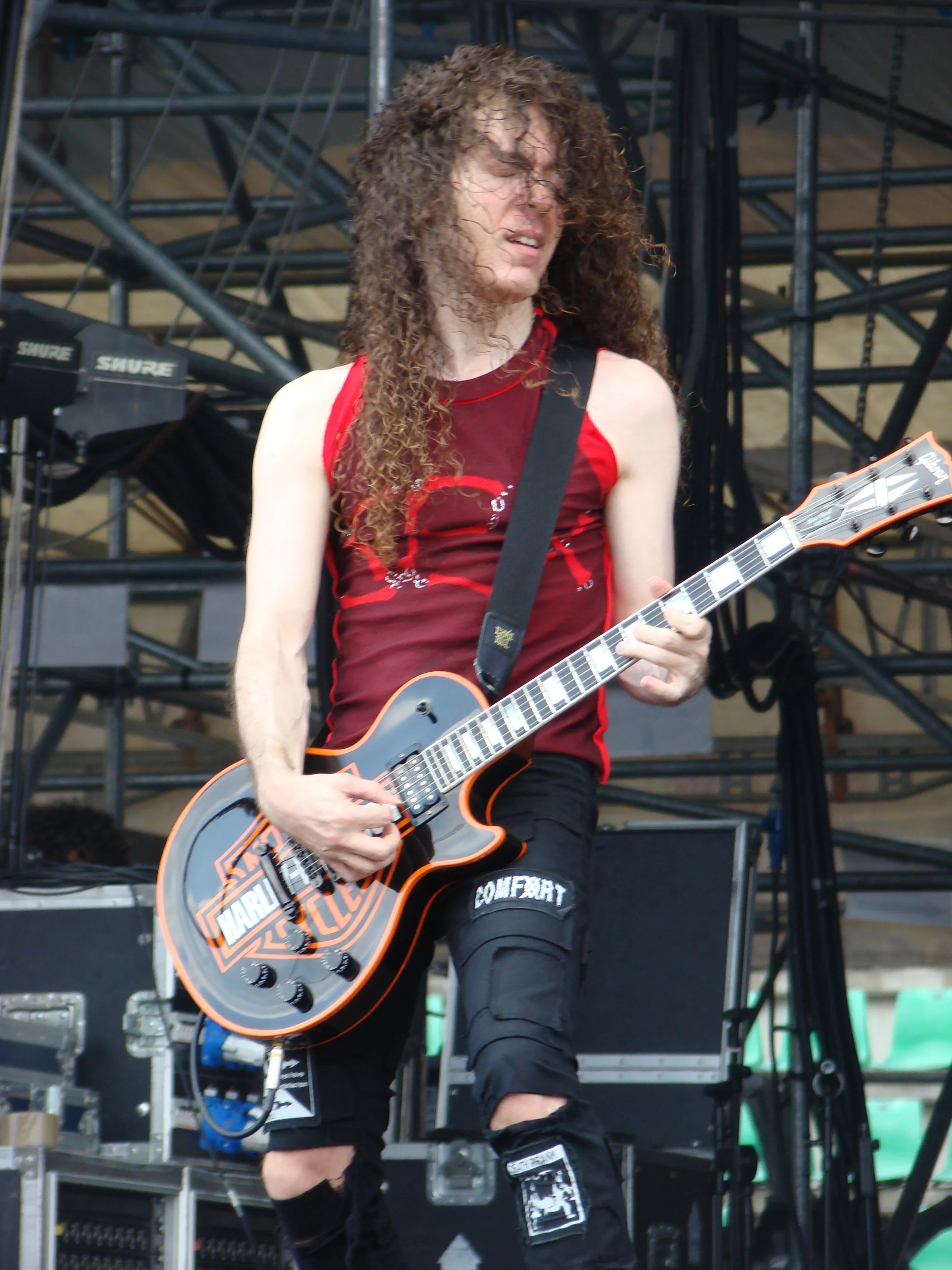
Song Rig
Hangar 18
Marty Friedman · Rust in Peace · 1990
Tone Overview
What Makes This Sound Unique
A showcase of two distinct lead voices alternating through multiple solo sections — Marty's melodically rich Eastern-influenced phrasing contrasts with Dave Mustaine's more angular thrash-derived approach. Marty's sections are identifiable by wider vibrato and greater scalar variety.
Signal Chain
- 1Jackson DK2 Dinky (DiMarzio Super Distortion)
- 2Mesa Boogie Mark II C+ (lead channel)
- 3Marshall 1960 cabinet
- 4Boss DD-3 Delay (short slapback between solo sections)
Amp Settings
Slightly brighter than Tornado of Souls — more treble to cut through the fast riff sections. The Mesa tight response makes single-note runs at thrash tempos intelligible even with rhythm guitars competing.
Technique
How to Play It
Consecutive alternate picking runs mixed with wide intervallic leaps — Marty moves through positions quickly, covering a wide fretboard range in a small number of notes compared to more linear shred approaches.
Budget Alternative
Achievable With
Active-pickup superstrat (EMG 81/85) or DiMarzio-loaded Jackson → Mesa Boogie or 5150 clone → minimal reverb. Active pickups tighten the low end at this gain level.
Your Gear
Adapt to My Amp
More from Marty Friedman
Other Song Rigs
Tornado of Souls
Rust in Peace · 1990
Widely regarded as one of the greatest guitar solos ever recorded — the tone is …
View rig →A Tout le Monde
Countdown to Extinction · 1992
Marty's most emotionally direct work — the solo shifts from aggressive to heartf…
View rig →Into the Arena
Dragon's Kiss · 1988
Marty's solo debut showcase — a melodic neoclassical instrumental built on his u…
View rig →For a Friend
Introduction · 1994
Marty's most beautiful post-Megadeth solo piece — a slow, lyrical instrumental d…
View rig →Thunder March
Scenes · 1992
Marty's first post-Megadeth album solo track — a full orchestral arrangement wit…
View rig →