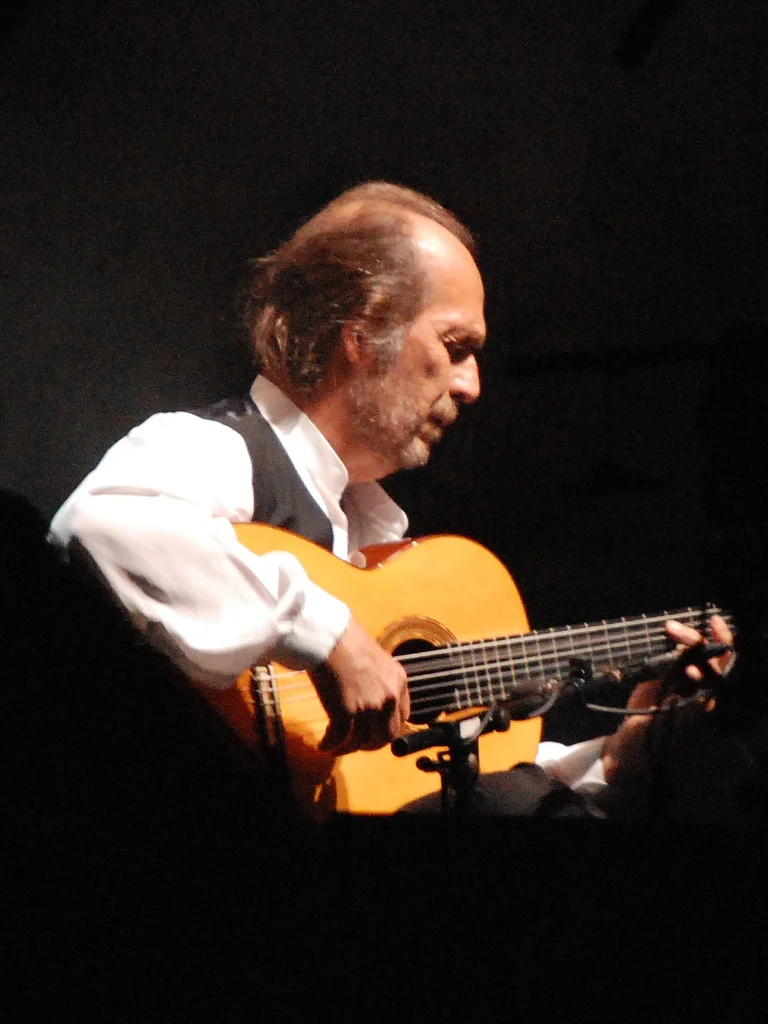
Tone Timeline
Paco de Lucía — Tone Evolution
Paco de Lucía was the most technically advanced flamenco guitarist of the 20th century — he both preserved traditional forms and extended flamenco into jazz fusion with John McLaughlin and Al Di Meola. His tone came entirely from technique applied to a traditional Spanish acoustic guitar.
1967–1975: Traditional Flamenco
De Lucía's early recordings were pure flamenco — the traditional forms (soleares, bulerías, seguiriyas) played on a traditional cedar-top Spanish guitar. His technique was already exceptional: his right-hand rasgueado (finger-roll strumming) and picado (single-line speed) were faster and more precise than any contemporary. Entre Dos Aguas (1973) was a flamenco-pop crossover that introduced him to a wider Spanish audience.
Signal Chain
1980–1990: Friday Night in San Francisco / Diálogo
↑ Amplification was a compromise for concert venues — de Lucía preferred pure acoustic but pragmatically added minimal pickup systems; the philosophy remained anti-effects.
Friday Night in San Francisco (1981, with Al Di Meola and John McLaughlin) is the best-selling acoustic guitar album ever recorded. The combination of jazz (McLaughlin) and jazz-fusion (Di Meola) with flamenco (de Lucía) produced extraordinary cross-genre improvisation. De Lucía used a similar traditional Spanish guitar but amplified through a DI or contact mic for concert venues — the acoustic character was preserved. His Paco de Lucía Sextet brought jazz harmonics into flamenco contexts.
Signal Chain
1992–2014: Zyryab / Canción Andaluza
↑ Late de Lucía showed technique becoming transparent — the music, not the speed, was the priority; his late recordings have a depth and gravity absent from virtuosity-focused earlier work.
De Lucía's late career was revered and somewhat private — fewer recordings, more contemplative. Zyryab (1990) and his final recordings showed an extraordinary maturity; technique was fully in service of musical expression rather than demonstration. He died of a heart attack in 2014 at age 66 while playing with his children on a beach in Mexico. His legacy as the definitive flamenco guitarist is uncontested.
Signal Chain