Rig Builder
Budget Rig Breakdown
Signal Chain

Essentials
Complete Your Rig
The accessories every serious guitarist needs — cables, strings, and the rest.
D'Addario Chromes Flatwound Strings 11-50
Flatwound strings eliminate string noise and produce the warm, smooth tone jazz requires.
Dunlop Ultex Standard Pick 0.60mm
Thin picks produce the softer, warmer jazz attack — less attack = more warmth.
Planet Waves American Stage Guitar Cable 10ft
Solderless ends and lifetime warranty. The cable most session guitarists trust.
Boss TU-3 Chromatic Tuner Pedal
The professional standard for live tuning. True bypass, powers other pedals, ultra-accurate.
Levy's M8 Guitar Strap
Quality leather strap used by touring guitarists. Genuine comfort for 3-hour sets.
Technique
Key Tone Tips
- Rasgueado technique: fan the four fingers outward across the strings in rapid succession — little finger first, then ring, middle, index — creating a rolling strumming effect
- Picado (single-note scales): use rest stroke technique — the finger follows through and rests on the next string, producing the sharp, percussive attack
- Golpe (tap on the guitar body): tap the index or ring finger on the soundboard in rhythm alongside playing. This provides percussive rhythm from the guitar itself
- The capo (cejilla) is used in almost every flamenco piece — different positions change the key without changing the finger patterns, transposing Phrygian mode to different pitches
- Phrygian mode is the harmonic foundation of flamenco — the flamenco system ("por arriba" = E Phrygian, "por medio" = A Phrygian) uses the Phrygian dominant scale over specific chord progressions
- The flamenco guitar produces a drier, more percussive tone than a classical guitar — a classical guitar is not an adequate substitute for serious flamenco study
- Compás (rhythm) is more important than notes — flamenco rhythm forms (Soleá, Alegrías, Bulería, Tientos) each have specific rhythmic cycles that must be internalised before improvising
- Study "Entre dos Aguas" and "Zyryab" for the accessible entry point to Paco's style — these pieces demonstrate his approach to rhythm, melody and harmony
- Thumb and fingers work completely independently in flamenco — the thumb handles bass strings while the fingers handle rasgueado and picado simultaneously
- Rasgueado technique requires each finger to be conditioned independently before the full multi-finger roll is attempted — begin with single-finger rasgueado (index alone, then middle, then ring, then little) before combining into the rolling four-finger fan stroke that crosses all strings
- Alzapúa (simultaneous melody and bass with alternating thumb direction) moves the thumb both upward AND downward — unlike standard guitar where the thumb only strokes downward, alzapúa uses both directions to produce a rapid bass-melody alternation that sounds like two instruments playing simultaneously
- Study 'Entre dos aguas' for the rumba flamenco style that brought Paco mainstream recognition — this track demonstrates how flamenco rhythm, rasgueado, and picado (single-note scale runs) can be applied to an accessible song structure while maintaining the full integrity of classical flamenco technique
Background
About Paco de Lucía's Sound
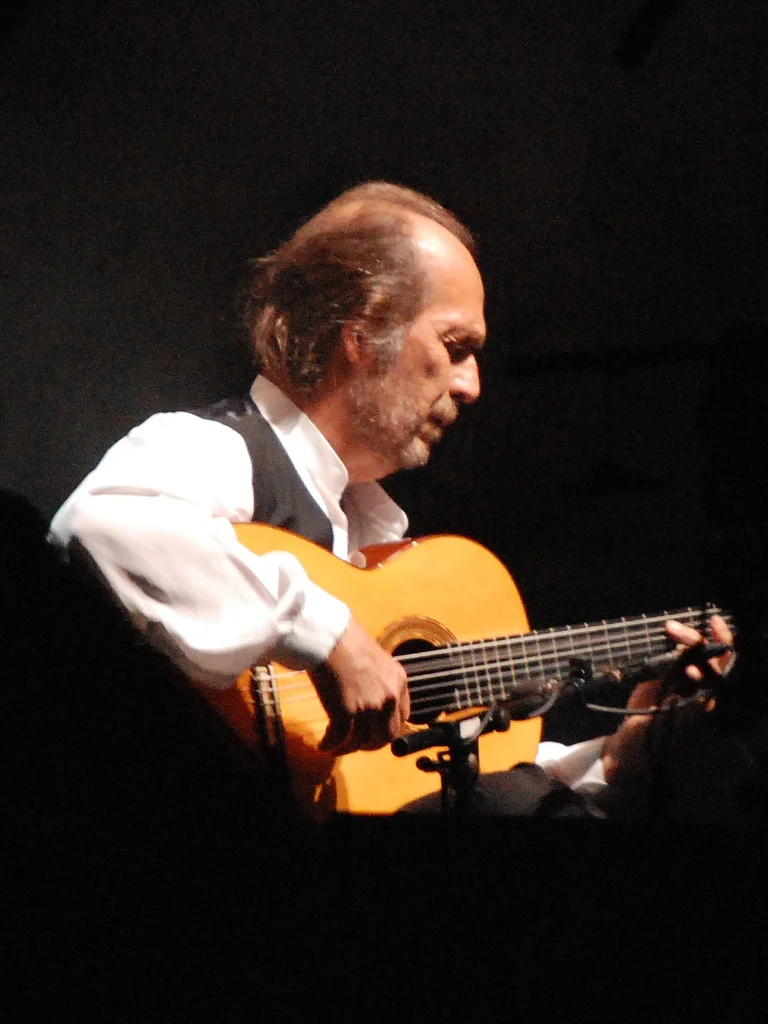
Paco de Lucía was the greatest flamenco guitarist of the 20th century — bringing the traditional Andalusian art form to international concert halls, collaborating with John McLaughlin and Al Di Meola, and developing a speed and precision on nylon string guitar never seen before.
Tone History
Paco de Lucía's Tone Evolution
Paco de Lucía was the most technically advanced flamenco guitarist of the 20th century — he both preserved traditional forms and extended flamenco into jazz fusion with John McLaughlin and Al Di Meola. His tone came entirely from technique applied to a traditional Spanish acoustic guitar.
Full timeline: 3 eras →Song Breakdowns
Paco de Lucía Song Rigs
Entre Dos Aguas
Entre Dos Aguas · 1976
The song that made flamenco a pop phenomenon — a rumba-flamenco hybrid that…
Almoraima
Almoraima · 1976
The title track of Paco's breakthrough solo album — a showcase of the forma…
Río Ancho
Siroco · 1987
Paco's mature fusion period — Siroco added jazz and world music influences …