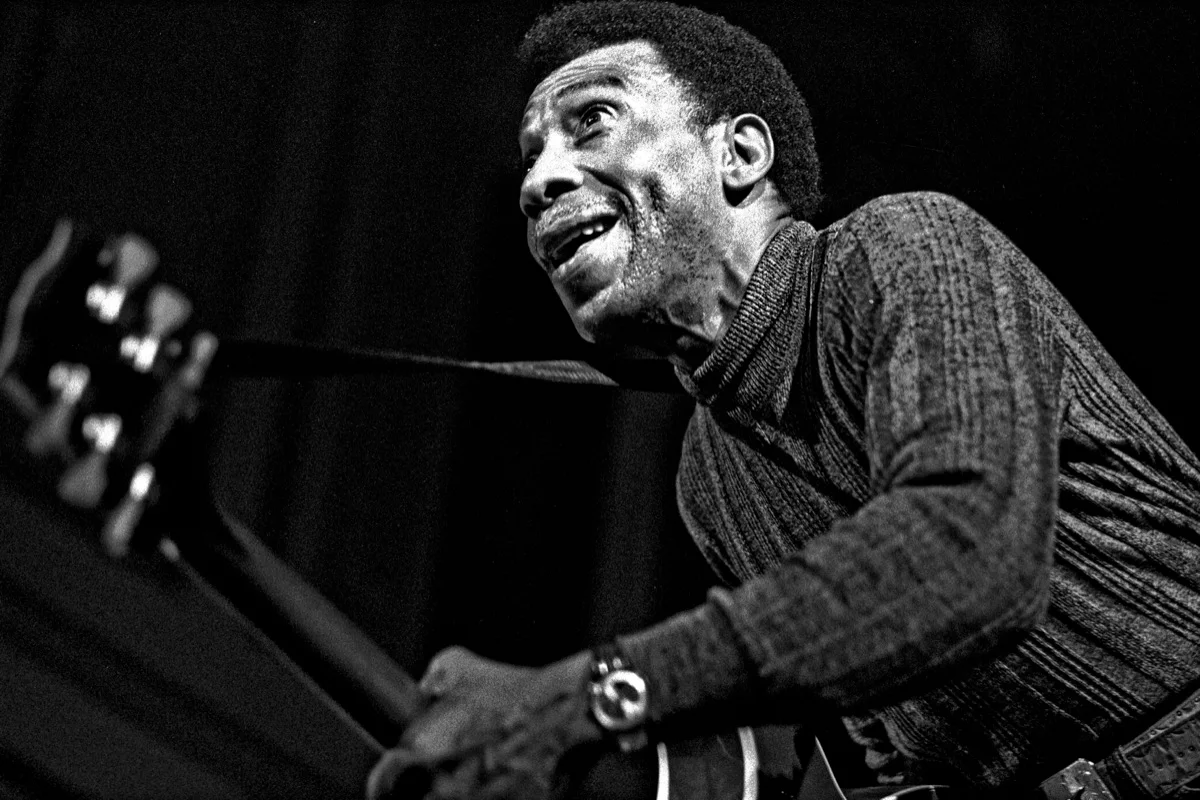
Song Rig
Two Bones and a Pick
T-Bone Walker · Imperial Records Sessions · 1950
Tone Overview
What Makes This Sound Unique
T-Bone's Imperial Records era tone — slightly cleaner and more recorded than the earlier Capitol and Black & White sessions. The guitar-forward production of these sessions emphasises the full-bodied ES-5 sound with more dynamic range than the earlier recordings compressed into 78rpm format.
Signal Chain
- 1Gibson ES-5 or similar jazz archtop
- 2Fender or small vintage amp
Amp Settings
Clean, warm, jazz-oriented — the Imperial sessions gave T-Bone a more controlled studio environment than the early recordings. The tone is fully clean rather than driven.
Technique
How to Play It
Jazz guitar vocabulary applied to blues — T-Bone uses chord substitutions and tritone substitutions inherited from the bebop tradition, applying jazz sophistication to 12-bar blues structures.
Budget Alternative
Achievable With
ES-335 or L-5 style archtop → clean amp → practice jazz chord substitution: replacing the I chord with a bIII or bVII chord creates the harmonic colour of T-Bone's sophisticated blues playing.
Your Gear
Adapt to My Amp
More from T-Bone
Other Song Rigs
T-Bone Shuffle
The Complete Recordings of T-Bone Walker 1940–1954 · 1942
The earliest sophisticated electric blues guitar tone on record — T-Bone Walker …
View rig →Call It Stormy Monday
Call It Stormy Monday (single) · 1947
The slow blues template — T-Bone's most influential single performance, cited by…
View rig →Mean Old World
Mean Old World (single) · 1942
T-Bone's earliest surviving recordings showcase a rawer, less refined version of…
View rig →Bobby Sox Baby
T-Bone Walker Sings the Blues · 1942
T-Bone's jump blues at its most exuberant — an upbeat, swinging track that showc…
View rig →Hard Way Blues
Imperial Records · 1950
T-Bone at his most direct and blues-fundamental — a slow, heavy blues track that…
View rig →