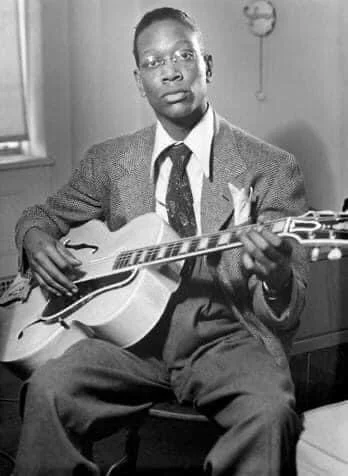
Sound Like Charlie Christian
Charlie Christian stands as one of jazz's most enduring tonal references — nuanced and harmonically sophisticated by nature and endlessly studied. Charlie Christian essentially invented the electric guitar as a solo jazz instrument, replacing the banjo in the rhythm section and stepping forward as a frontline voice. His fluid, horn-like single-note lines with Benny Goodman's sextet defined how jazz guitar would sound for decades. These complete rig guides at four budget levels show exactly what gear it takes to get there.
Quick Answer
To sound like Charlie Christian, start with a Squier Classic Vibe 60s Jaguar into a Boss Katana 50 MkII.
Tone Analysis
Charlie Christian's Guitar Tone — In Depth
Tone Philosophy
Charlie Christian invented jazz electric guitar. Before Christian, the electric guitar was amplified acoustic guitar — louder, but playing the same role. Christian identified what the amplified guitar could do that the acoustic could not: sustain notes long enough to function as a horn instrument, play single-note bebop-precursor lines at the speed of a saxophone, and be heard above the big band. He created the vocabulary that every subsequent jazz guitarist has inherited.
The Signature Sound
The Benny Goodman Sextet and Small Groups recordings from 1939-1941 — Solo Flight, Seven Come Eleven, Swing to Bop — feature Christian's Gibson ES-150 through a Charlie Christian pickup (an early P-90 predecessor) and a Gibson EH-185 amplifier. The tone is warm and projecting, with the sustain of an electric instrument and the attack character of the time.
Key Gear
The Gibson ES-150 with the original "Charlie Christian" bar pickup is his defining instrument. The Gibson EH-185 amplifier provided clean, powerful amplification.
Playing Approach
Christian's single-note lines anticipated bebop harmony by several years — his note choices over chord changes contain the seeds of the harmonic vocabulary that Parker and Gillespie systematised. His swing feel and rhythmic vocabulary were built from the earlier Kansas City jazz tradition.
Legacy
There is no jazz electric guitar history without Charlie Christian. He died at age twenty-five, leaving recordings from only three years. Those recordings established every fundamental principle of jazz guitar playing that followed.
Budget Comparison
Pick Your Budget Level
£500 · Sweet Spot
~£498
- GuitarSquier Classic Vibe 60s Jaguar
- AmpBoss Katana 50 MkII
£1,000 · Pro-Level
~£1,080
- GuitarGibson ES-335
- AmpFender Blues Junior IV
- PickupLollar Charlie Christian Neck Pickup
- StringsD'Addario ECG25 Chrome Flatwound 11–52
£2,500 · Premium
~£2347
- GuitarGretsch G5420T Electromatic
- AmpFender Blues DeVille
- ReverbStrymon Flint
Shop Now
Buy the Key Gear — £500 Sweet Spot
Guitar, amp and essential effects for the authentic C. Christian sound. The guitar and amp together account for 80% of the tone.
Complete the Rig
Essentials Every Guitarist Needs
These aren't exciting — but every rig needs them. Buy once, sorted forever.
Tone Profile
C. Christian's Sound
Charlie Christian's tone is warm, round and entirely clean — the neck pickup of his Gibson ES-150 through an early Gibson EH-150 amplifier, producing a full, dark midrange without any effects. His single-note lines have a woody, acoustic quality despite being amplified, with an even attack and long sustain from the laminated archtop body. The tone sits just behind the horns in frequency, making it blend beautifully with brass and piano. No reverb, no vibrato arm, no distortion — just pick attack, dynamics and impeccable timing.
Modeling Amps
Get C. Christian's Tone on Your Modeler
Targeting Clean + Overdrive rig. Use these amp models and IRs as your starting point — dial in from there using the knob settings above.
Adjust presence and master to taste for this artist's era
Use Fractal's Tone Match feature against reference tracks for accuracy
Song Match
Which C. Christian Songs Suit Your Amp
Tone Match
Closest Real-World Tone Match
If you like Charlie Christian's tone, these players use a similar approach — same gear philosophy, comparable sound characteristics.
Weekly Tone Tips
One setting, one artist insight, one gear pick. No noise.