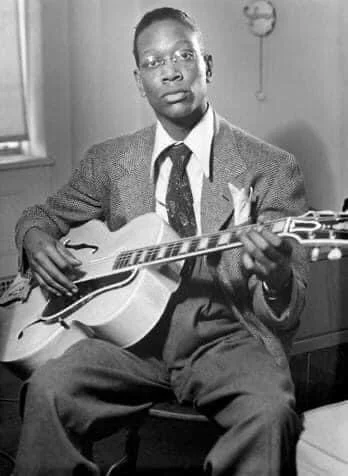
Charlie Christian — £2,500 · Premium Tone
Charlie Christian essentially invented the electric guitar as a solo jazz instrument, replacing the banjo in the rhythm section and stepping forward as a frontline voice. His fluid, horn-like single-note lines with Benny Goodman's sextet defined how jazz guitar would sound for decades. Replicating that nuanced and harmonically sophisticated sound at the £2,500 · Premium mark means Gretsch G5420T Electromatic into Fender Blues DeVille. The effects — Strymon Flint — add the finishing texture. This build totals ~£2347 and captures the core character — a premium build targeting the most accurate recreation possible.
Build Charlie Christian's £2,500 · Premium Rig
3 pieces · Total ~$2,981
What guitar does C. Christian use?
C. Christian is primarily associated with hollow style guitars. At a £2,500 budget, Gretsch G5420T Electromatic delivers the essential tonal character.
What to Buy
£2,500 · Premium — Complete Gear List
Can't find one? See alternatives:
Why This Rig Works
How Charlie Christian's gear choices create the signature tone
Gretsch G5420T Electromatic
The Gretsch G5420T Electromatic provides the tonal foundation for the entire rig — its character shapes everything that follows.
Strymon Flint
Strymon Flint — reverb coloring added to the signal.
Fender Blues DeVille
The Fender Blues DeVille converts the guitar signal into audible sound and adds its own tonal character — EQ shaping, natural gain, and the overall feel of the final tone.
The Combined Tone
Charlie Christian's tone is warm, round and entirely clean — the neck pickup of his Gibson ES-150 through an early Gibson EH-150 amplifier, producing a full, dark midrange without any effects. His single-note lines have a woody, acoustic quality despite being amplified, with an even attack and long sustain from the laminated archtop body. The tone sits just behind the horns in frequency, making it blend beautifully with brass and piano. No reverb, no vibrato arm, no distortion — just pick attack, dynamics and impeccable timing.
Tone Tips
Getting the Sound Right
- The Fender Blues DeVille stays cleaner longer than a Marshall-style amp — push it with a low-gain overdrive (gain at 2–3, level up) rather than cranking its own gain. Set treble at 6, bass at 4, and let the guitar's volume knob handle the dynamics.
- Use the neck pickup for maximum warmth and roundness
- Keep the amp perfectly clean — no overdrive whatsoever
- Practice playing long lines that breathe like a saxophone — phrase over 2–4 bars, not measure by measure
- Practice comping with root-position and first-inversion chord voicings on strings 1–4, leaving the bass free
- Target the Charlie Christian blade pickup or a reproduction as the primary hardware choice — modern pickups cannot fully replicate its dark, warm midrange character
- Set the amp volume to where the guitar is audible in a small room but not loud — Christian played at moderate volume to blend with acoustic instruments
Avoid These Pitfalls
Common Mistakes When Chasing This Tone
- Playing at high volume without managing feedback — hollow-body guitars are acoustically live and will feedback freely at stage volumes. Amp positioning and pickup height affect this dramatically.
- Using a distortion pedal instead of pushing the amp — vintage-voiced amps create better overdrive by being pushed hard than by a pedal circuit. Let the amp do the work.
- Adding compression to fix flat clean tone — a flat, lifeless clean tone usually means the amp gain or presence is wrong, not that compression is needed. Compression on a flat tone just makes it louder.
- Playing next to the bridge — the metallic, brittle quality near the bridge pickup is a jazz tone destroyer. Move your picking hand closer to the neck.
- Using spring reverb heavily — spring reverb has a metallic wobble quality that is characteristic of rock and country, not jazz. A subtle plate or room reverb is more appropriate.
Budget Alternatives
Same Tone, Different Budget
FAQ
Charlie Christian Tone — Common Questions
C. Christian is primarily associated with hollow style guitars. At a £2,500 budget, Gretsch G5420T Electromatic delivers the essential tonal character.
C. Christian's amp is vintage blues voiced — clean to moderate gain. At the £2,500 level, Fender Blues DeVille is the closest match.
The £2,500 tier uses C. Christian's actual gear choices or direct equivalents. Total: £2,347. The tonal step up from £1,000 is real but diminishing — worth it for regular performers and studio work.
C. Christian's tone is defined by pioneering-jazz-electric, single-pickup, bebop. The combination of hollow guitar and vintage blues amp creates a sound that is immediately recognisable.
C. Christian's gain approach is very clean — minimal distortion even at volume. The tone comes from the amp's natural warmth. At £2,500, this is replicated through Fender Blues DeVille paired with Strymon Flint.
Charlie Christian — £2,500 · Premium Complete Rig
~£2347Guitar
Gretsch G5420T Electromatic
Amp
Fender Blues DeVille
Reverb
Strymon Flint
Tone Match
Closest Real-World Tone Match
If you like Charlie Christian's tone, these players use a similar approach — same gear philosophy, comparable sound characteristics.
Related Tones