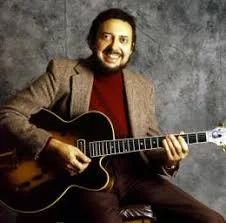
Barney Kessel — £1,000 · Pro-Level Rig
Barney Kessel's tone is polished, articulate and clean — built around his signature Gibson Barney Kessel model or an ES-350, running into a clean amplifier with no effects. His sound is brighter than many jazz contemporaries, with a crisper attack that cuts through ensembles and busy pop arrangements. He used both neck and bridge pickups depending on context: neck for ballads, bridge for rhythm playing in pop sessions. The clarity is important — as a session player, his parts had to be heard on the first take.
Signal Path
Signal Chain
Full signal path
Full Gear List
£1,000 · Pro-Level — Complete Rig



Tone Tips
Getting the Sound Right
- Use the bridge pickup for session comping — cuts through dense arrangements
- Switch to neck pickup for ballads and melody work
- Blend major 6th and 9th chord voicings for a classic pop-jazz sound
- Study the recordings with Oscar Peterson — Kessel's comping under a piano is masterful
- Keep the amp clean and bright — Barney valued clarity and attack over warmth
- Jazz bebop vocabulary on a Gibson ES-330 or ES-175 — Kessel's hollow archtop gave the warm, full projection needed in acoustic jazz and amplified Los Angeles studio sessions, and the semi-hollow body resonance contributes harmonic richness no solidbody can replicate
- Single-coil pickup combined with a warm, slightly rounded tone-knob setting gives the precise articulation without the muddy thickness of a full humbucking pickup — aim for a bright-but-round character by keeping treble moderate and mids slightly boosted
- Study 'Easy Like' and the complete 'Poll Winners' album with Shelly Manne and Ray Brown — these recordings document the California bebop chamber jazz context that shaped the full range of Kessel's harmonic and rhythmic vocabulary
Avoid These Pitfalls
Common Mistakes When Chasing This Tone
- Using high-gain distortion — hollowbody guitars are designed for clean and light-drive use. High gain causes uncontrollable acoustic resonance that the pickup amplifies as noise.
- Using the amp's volume at less than 4 — boutique clean amps are designed to be played at certain output levels. At very low volumes the tone is compressed and flat compared to full-level operation.
- Expecting a clean tone to cover all playing dynamics — clean tone requires picking technique to do all the work. Lazy picking dynamics become very audible on a clean signal.
- Keeping the tone knob at 10 — full treble on a jazz guitar gives a nasal, honky quality that sounds nothing like the warm round jazz ideal.
- Using round-wound strings — they are brighter, last longer, and have more sustain, but they also sound more "electric" and less woody than flat-wounds for jazz.
Tone Profile
Kessel's Sound
Barney Kessel's tone is polished, articulate and clean — built around his signature Gibson Barney Kessel model or an ES-350, running into a clean amplifier with no effects. His sound is brighter than many jazz contemporaries, with a crisper attack that cuts through ensembles and busy pop arrangements. He used both neck and bridge pickups depending on context: neck for ballads, bridge for rhythm playing in pop sessions. The clarity is important — as a session player, his parts had to be heard on the first take.