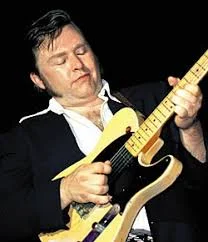
Danny Gatton — £1,000 · Pro-Level Rig
Danny Gatton's Telecaster tone is a benchmark: a 1953 Fender Telecaster with a lipstick tube pickup in the neck and a standard bridge single coil, running into a clean Fender Deluxe Reverb at modest volume, with no effects except the amp's natural spring reverb. The tone is bright, punchy and incredibly transparent — every nuance of his hybrid picking, banjo rolls, behind-the-nut string bends, and bottle neck slides comes through without any compression from overdrive. His manipulation of the Telecaster's controls mid-performance — rolling off the tone for a cocked-wah effect — became part of his trademark sound.
Signal Path
Signal Chain
Full signal path
Full Gear List
£1,000 · Pro-Level — Complete Rig



Tone Tips
Getting the Sound Right
- Roll the Telecaster tone knob slowly while playing for a cocked-wah vocal effect
- Practice behind-the-nut bends — push strings between the nut and tuning pegs for a pedal steel effect
- Hybrid pick: hold the pick between thumb and index, use middle, ring, and pinky fingers for picking
- Use the neck (lipstick tube) pickup for warm jazz lines, bridge for twangy country runs
- The amp should be clean and loud — Gatton never used pedals for his core sound
- The Telecaster neck pickup is used as prominently as the bridge — Gatton switched pickup positions mid-phrase to change tone character, using the neck pickup for warm jazz-influenced passages and the bridge for twangy country lines within the same song
- Hybrid picking with fingers and a flat pick simultaneously allows the rapid string-crossing of Gatton's country-jazz synthesis — the pick handles downstroke attack while fingers pluck simultaneously on different strings, producing a harp-like multi-string fluency
- Bending behind the nut creates a wide pitch-up effect — Gatton pulled the strings between the nut and the tuning pegs to produce pitch rises without the tremolo arm. This technique requires the strings to have some slack at the nut rather than being pulled tight
Avoid These Pitfalls
Common Mistakes When Chasing This Tone
- Setting the compressor ratio too high with single coils — above 4:1, the compressor eliminates the natural pick attack dynamics that give single-coil playing its expressiveness. The compressor should even out the extremes, not remove all variation
- Ignoring the neck pickup position as a usable tone — the neck pickup on a Tele produces a warm, jazz-like sound completely unlike the bridge. It is not an afterthought.
- Using a distortion pedal instead of pushing the amp — vintage-voiced amps create better overdrive by being pushed hard than by a pedal circuit. Let the amp do the work.
- Setting the boost level too high relative to the base tone — a boost for solos should raise the presence of the guitar, not cause a volume jump that overwhelms the mix. Level matching matters.
- Setting compression ratio too high — a 6:1 or higher compression ratio completely homogenises the playing dynamics. The effect should be subtle and felt, not obviously audible on individual notes.
- Choosing a pick that is too heavy — thin to medium picks give edge noise and articulation that heavier picks smooth away. That edge is part of the sound.
- Setting amp gain at 5 or higher — blues tone lives at the edge of breakup (gain 3-4), not in full saturation. High gain compresses away all the dynamic feel.
Tone Profile
Gatton's Sound
Danny Gatton's Telecaster tone is a benchmark: a 1953 Fender Telecaster with a lipstick tube pickup in the neck and a standard bridge single coil, running into a clean Fender Deluxe Reverb at modest volume, with no effects except the amp's natural spring reverb. The tone is bright, punchy and incredibly transparent — every nuance of his hybrid picking, banjo rolls, behind-the-nut string bends, and bottle neck slides comes through without any compression from overdrive. His manipulation of the Telecaster's controls mid-performance — rolling off the tone for a cocked-wah effect — became part of his trademark sound.