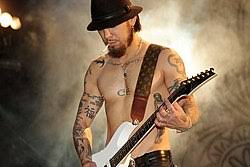
Alternative RockHard Rock1990s–present
Dave Navarro — £1,000 · Pro-Level Rig
PRS Custom or Schecter into a Marshall head, with heavy reverb (Boss RV-6 or similar) on both rhythm and lead tones. A wah pedal is used as a filter on funk-influenced rhythm parts. The tone is dark and reverberant on cleans, saturated on leads. Like a Pink Floyd/Hendrix hybrid filtered through 1990s LA rock.
Signal Path
Signal Chain
Full signal path
GuitarLP Std
WahCry Baby
FuzzBig Muff
AmpDSL20
ReverbBoss RV-6
Full Gear List
£1,000 · Pro-Level — Complete Rig
£££ Pro-Level£399
££ Mid-Range£329

£ Budget£99

£ Budget£69

Tone Tips
Getting the Sound Right
- Reverb is always on — unlike most rock players who keep reverb subtle, Navarro uses reverb as a significant part of the tone, not just ambience
- The wah is used as a fixed filter on rhythm parts — park it mid-sweep and leave it for a nasal, vocal quality rather than sweeping it
- Funk-influenced right-hand muting on rhythm parts — dead-string "ch" strokes between chord stabs, similar to Nile Rodgers's technique
- Clean → heavily reverbed is a Navarro signature — the combination of a very dry rhythm guitar suddenly going to a washy reverb lead is compositionally striking
- PRS neck pickup for lead solos — the wide-range humbucker at the neck produces the dark, sustained quality
- A light touch produces the clean dynamics; heavy attack produces breakup on the same amp settings — Navarro exploits this range
- Study "Three Days" from Jane's Addiction — the guitar arpeggio demonstrates his ability to build tension over a long repeated pattern
- Fuzz before reverb creates the singing lead character of his Jane's solos — try Big Muff into a large spring reverb
Avoid These Pitfalls
Common Mistakes When Chasing This Tone
- Not exploring the JCM800 alone before adding pedals — a Les Paul or humbucker guitar into a British amp is already a near-complete overdrive system. Adding drive pedals on top is often unnecessary and muddies the amp's natural character
- Running the fuzz pedal into an already-driven amp channel — fuzz into a driven amp creates uncontrolled intermodulation that sounds chaotic rather than musical. The fuzz pedal works best into a clean or barely-clean amp
- Setting the amp bass too high — the inherent warmth of mahogany means you need less bass EQ than with a Strat. Starting at 5 rather than 7 prevents low-end mud.
- Scooping the mids on a Marshall-style amp — the upper midrange emphasis is what makes British amps cut through. Mid-scoop EQ sounds good alone but disappears in a band mix.
- Using too much gain on the drive pedal — pedal-driven tone works best with the amp providing some character and the pedal adding focus and saturation, not replacing the amp entirely.
- Leaving the wah in a fixed position (cocked) between uses — a cocked wah acts as a midrange filter and changes the tone. If not using the wah expressively, take it out of the chain.
- Homogenising the tone — playing at the same volume and gain level throughout removes the compositional impact of the loud-quiet dynamic.
- Over-compressing the clean tone — alt-rock clean guitar has natural dynamic variation. Heavy compression turns it into a flat, featureless sound.
Tone Profile
Dave Navarro's Sound
PRS Custom or Schecter into a Marshall head, with heavy reverb (Boss RV-6 or similar) on both rhythm and lead tones. A wah pedal is used as a filter on funk-influenced rhythm parts. The tone is dark and reverberant on cleans, saturated on leads. Like a Pink Floyd/Hendrix hybrid filtered through 1990s LA rock.