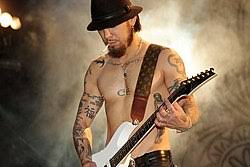
Dave Navarro — £500 · Sweet Spot Tone
Dave Navarro's heavy and assertive tone took shape during a defining era for electric guitar and remains one of the most sought-after sounds on guitar. Dave Navarro of Jane's Addiction and Red Hot Chili Peppers blends funk-influenced rhythm playing with heavy reverb-soaked lead tones — a unique combination that is neither conventional metal nor conventional funk. At the £500 · Sweet Spot mark — the sweet spot — enough to get genuinely close to the sound without breaking the bank — the build centres on a Epiphone Les Paul Standard running through a Boss Katana 50 MkII, with Boss DS-1 Distortion completing the signal chain, totalling ~£527.
Build Dave Navarro's £500 · Sweet Spot Rig
3 pieces · Total ~£527
What guitar does Dave Navarro use?
Dave Navarro is primarily associated with lp style guitars. At a £500 budget, Epiphone Les Paul Standard delivers the essential tonal character.
What to Buy
£500 · Sweet Spot — Complete Gear List
Why This Rig Works
How Dave Navarro's gear choices create the signature tone
Epiphone Les Paul Standard
The set-neck construction and ProBucker humbuckers deliver the sustain, thickness and mid-forward push of the genuine article. Bridge pickup into a crunch amp is the authentic hard rock formula.
Boss DS-1 Distortion
The DS-1 at moderate gain acts as a loud, slightly dirty boost into a clean-ish amp. At lower gain settings it adds grit without completely masking the guitar's character — versatile for everything from crunch to full distortion.
Boss Katana 50 MkII
Its 'Brown' amp character at low gain is an excellent approximation of the Fender-style clarity that Hendrix, Mayer, Gilmour and SRV all relied on. Built-in effects mean you're a few knob turns away from the right tone.
The Combined Tone
PRS Custom or Schecter into a Marshall head, with heavy reverb (Boss RV-6 or similar) on both rhythm and lead tones. A wah pedal is used as a filter on funk-influenced rhythm parts. The tone is dark and reverberant on cleans, saturated on leads. Like a Pink Floyd/Hendrix hybrid filtered through 1990s LA rock.
Tone Tips
Getting the Sound Right
- Reverb is always on — unlike most rock players who keep reverb subtle, Navarro uses reverb as a significant part of the tone, not just ambience
- The wah is used as a fixed filter on rhythm parts — park it mid-sweep and leave it for a nasal, vocal quality rather than sweeping it
- Funk-influenced right-hand muting on rhythm parts — dead-string "ch" strokes between chord stabs, similar to Nile Rodgers's technique
- Clean → heavily reverbed is a Navarro signature — the combination of a very dry rhythm guitar suddenly going to a washy reverb lead is compositionally striking
- PRS neck pickup for lead solos — the wide-range humbucker at the neck produces the dark, sustained quality
- A light touch produces the clean dynamics; heavy attack produces breakup on the same amp settings — Navarro exploits this range
- Study "Three Days" from Jane's Addiction — the guitar arpeggio demonstrates his ability to build tension over a long repeated pattern
- Fuzz before reverb creates the singing lead character of his Jane's solos — try Big Muff into a large spring reverb
Avoid These Pitfalls
Common Mistakes When Chasing This Tone
- Not exploring the JCM800 alone before adding pedals — a Les Paul or humbucker guitar into a British amp is already a near-complete overdrive system. Adding drive pedals on top is often unnecessary and muddies the amp's natural character
- Running the fuzz pedal into an already-driven amp channel — fuzz into a driven amp creates uncontrolled intermodulation that sounds chaotic rather than musical. The fuzz pedal works best into a clean or barely-clean amp
- Setting the amp bass too high — the inherent warmth of mahogany means you need less bass EQ than with a Strat. Starting at 5 rather than 7 prevents low-end mud.
- Scooping the mids on a Marshall-style amp — the upper midrange emphasis is what makes British amps cut through. Mid-scoop EQ sounds good alone but disappears in a band mix.
- Using too much gain on the drive pedal — pedal-driven tone works best with the amp providing some character and the pedal adding focus and saturation, not replacing the amp entirely.
- Leaving the wah in a fixed position (cocked) between uses — a cocked wah acts as a midrange filter and changes the tone. If not using the wah expressively, take it out of the chain.
- Homogenising the tone — playing at the same volume and gain level throughout removes the compositional impact of the loud-quiet dynamic.
- Over-compressing the clean tone — alt-rock clean guitar has natural dynamic variation. Heavy compression turns it into a flat, featureless sound.
Budget Alternatives
Same Tone, Different Budget
FAQ
Dave Navarro Tone — Common Questions
Dave Navarro is primarily associated with lp style guitars. At a £500 budget, Epiphone Les Paul Standard delivers the essential tonal character.
Dave Navarro's amp is british crunch voiced — clean to moderate gain. At the £500 level, Boss Katana 50 MkII is the closest match.
Yes — £500 covers a real guitar and amp in the right tonal family. This rig totals £527 and captures the essential character. The guitar and amp account for 80% of the tone; pedals are secondary at this budget.
Dave Navarro's essential pedals include Distortion, Wah. At the £500 tier: Boss DS-1 Distortion. Distortion is the most important pedal — the others add nuance.
Dave Navarro's tone is defined by gothic-atmosphere, cinematic, melodic-lead. The combination of lp guitar and british crunch amp creates a sound that is immediately recognisable.
Dave Navarro's gain approach is pedal-driven — distortion pedals into a relatively clean amp. The pedal defines the distortion character. At £500, this is replicated through Boss Katana 50 MkII paired with Boss DS-1 Distortion.
Dave Navarro — £500 · Sweet Spot Complete Rig
~£527Guitar
Epiphone Les Paul Standard
Distortion
Boss DS-1 Distortion
Amp
Boss Katana 50 MkII
Tone Match
Closest Real-World Tone Match
If you like Dave Navarro's tone, these players use a similar approach — same gear philosophy, comparable sound characteristics.
Related Tones