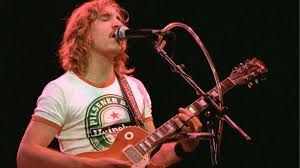
Joe Walsh — £2,500 · Premium Rig
Gibson Les Paul through a Marshall 100W — warm, thick sustain with natural amp saturation. A talk box (Heil HT-1) produces the distinctive vocal-filtered guitar tone on "Rocky Mountain Way". Walsh's playing is relatively restrained and melody-focused; he uses space and dynamic contrast where other hard rock players would fill every gap.
Signal Path
Signal Chain
Full signal path
Full Gear List
£2,500 · Premium — Complete Rig




Tone Tips
Getting the Sound Right
- Talk box: shape vowels slowly as the guitar holds a note — "wah", "oo-ah" for the iconic effect
- Les Paul neck pickup for the smooth, thick sustained tones on Hotel California-style playing
- Marshall at medium gain — Walsh's tone is warm saturation, not aggressive crunch
- Vibrato is medium speed and width — more BB King than Hendrix in its measured quality
- Acoustic fingerpicking: Hotel California intro uses thumb + 3 fingers, alternating bass pattern
- Pentatonic scale with tasteful chromatic passing tones gives his solos a jazz-blues quality
- Space is key — Walsh leaves breathing room that most rock guitarists fill with notes
- Double-stop bends (2 strings at once) are a recurring signature in his rhythm fills
Avoid These Pitfalls
Common Mistakes When Chasing This Tone
- Not exploring the Marshall DSL alone before adding pedals — a Les Paul or humbucker guitar into a British amp is already a near-complete overdrive system. Adding drive pedals on top is often unnecessary and muddies the amp's natural character
- Ignoring the individual pickup volume and tone controls — the two-pickup switching options on a Les Paul give you four distinct tones within a single setting. Most players only use two.
- Scooping the mids on a Marshall-style amp — the upper midrange emphasis is what makes British amps cut through. Mid-scoop EQ sounds good alone but disappears in a band mix.
- Using a distortion pedal to replace amp saturation — amp-driven tone has a specific feel (dynamics, touch sensitivity, natural compression) that pedal distortion cannot replicate. The source of gain matters.
- Setting gain too high on the overdrive pedal — most overdrive pedals are most useful at gain settings of 2-5, where they add character without dominating the tone. High gain settings on an OD pedal become a distortion, not an overdrive.
- Too many repeats at high mix — more than 3 repeats makes the delay effect accumulate and overwhelm the dry guitar signal. Keep it to 2-3 repeats at a subtle mix level.
- Using a humbucker where single coils are needed — the quack, string definition, and high-frequency air of single coils cannot be EQ'd into a humbucker
- Adding a compressor before the amp "for more tone" — it kills the natural attack variation that defines the style. Blues tone is uncompressed and dynamic.
Tone Profile
Joe Walsh's Sound
Gibson Les Paul through a Marshall 100W — warm, thick sustain with natural amp saturation. A talk box (Heil HT-1) produces the distinctive vocal-filtered guitar tone on "Rocky Mountain Way". Walsh's playing is relatively restrained and melody-focused; he uses space and dynamic contrast where other hard rock players would fill every gap.