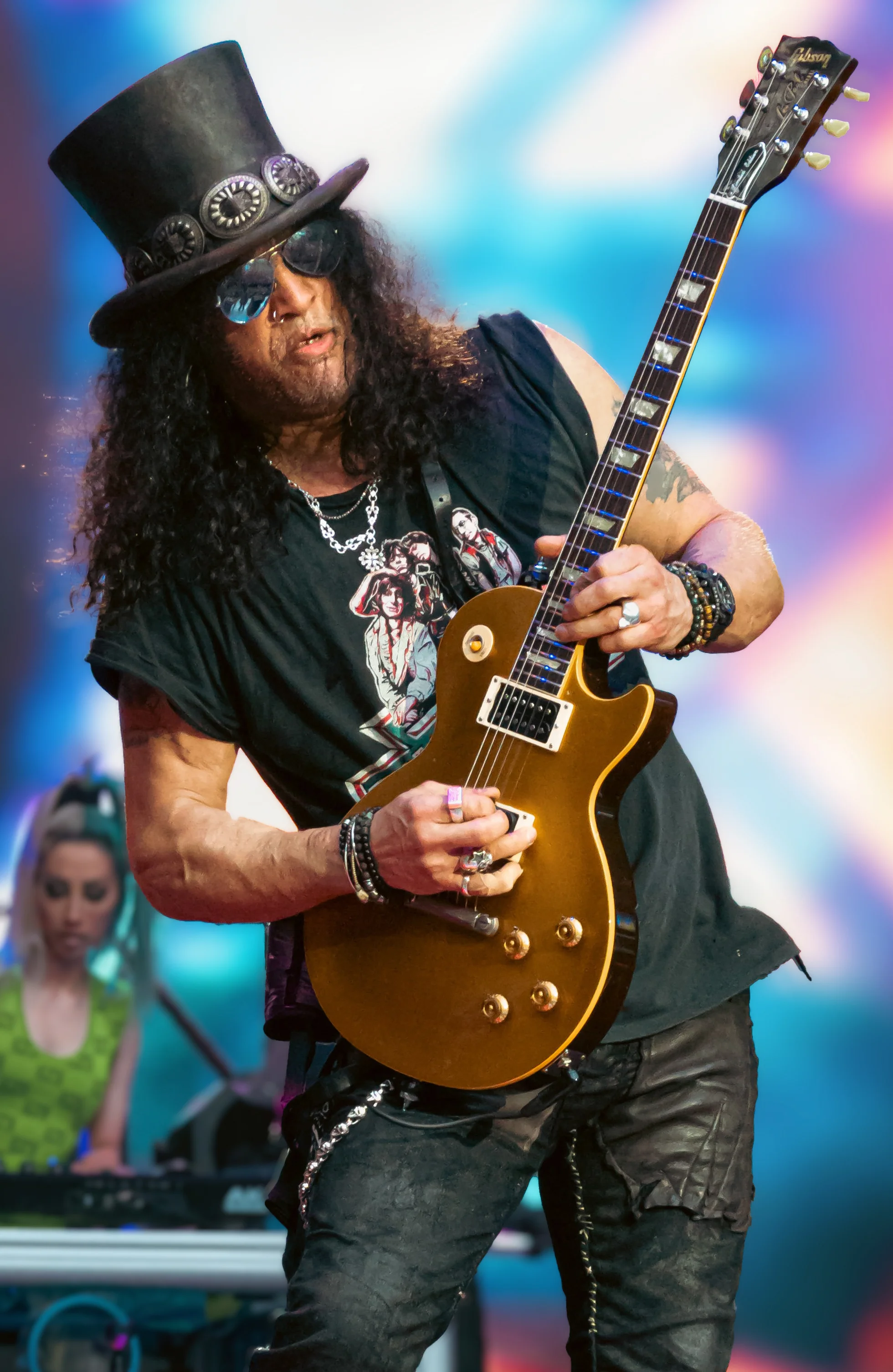
Hard RockHeavy Metal1980s–present
Slash — £1,000 · Pro-Level Rig
Humbucker-loaded Les Paul into a cranked Marshall — thick midrange saturation, singing sustain and a warm but aggressive attack. No scooped mids: Slash's tone is all about that mid-forward Marshall crunch.
Signal Path
Signal Chain
Full signal path
GuitarLP Std
EQMXR EQ
DistDS-1
AmpDSL20
Full Gear List
£1,000 · Pro-Level — Complete Rig
●●● Pro-Level$507
●● Mid-Range$418
● Budget$57
Tone Tips
Getting the Sound Right
- Use the Les Paul bridge pickup for the classic Slash crunch
- Crank the amp — Marshall distortion comes from the amp, not pedals
- Keep the bass and treble moderate, boost the mids
- Let notes sustain naturally — avoid over-playing
- Use the wah expressively for solos, parked for rhythm texture
- Tune to Eb standard (half step down) — Slash plays in Eb, which adds warmth to the Les Paul and makes heavy strings more comfortable
- Hold the pick almost perpendicular to the strings at a slight angle — the firm, angled attack gives Slash's notes their distinctive initial "thwack" before the sustain blooms
- Don't scoop the mids on the Marshall even though it's tempting — Slash's cut in a band mix comes from the mid-forward voicing, not scooped highs and lows
Avoid These Pitfalls
Common Mistakes When Chasing This Tone
- Scooping mids on the JCM800 with humbuckers — the mid-forward character of British amps with humbuckers is the central sound of classic rock. A mid scoop removes the fundamental voice of the combination
- Leaving the wah pedal engaged but stationary between rocking it — a cocked wah (fixed position, not moving) acts as a midrange filter that changes the core tone. Either rock it expressively or bypass it completely; a cocked wah changes the sound in ways that are often unintended
- Ignoring the individual pickup volume and tone controls — the two-pickup switching options on a Les Paul give you four distinct tones within a single setting. Most players only use two.
- Using a high-gain distortion pedal instead of amp gain — British crunch amps have a specific harmonic character when driven from their own gain stage. A pedal changes this character.
- Playing at bedroom volume expecting amp-driven tone — the power-tube saturation that defines this gain structure only occurs when the amp is working at substantial output. This is not replicable at low volumes.
- Setting gain too high on the overdrive pedal — most overdrive pedals are most useful at gain settings of 2-5, where they add character without dominating the tone. High gain settings on an OD pedal become a distortion, not an overdrive.
- Leaving the wah in a fixed position (cocked) between uses — a cocked wah acts as a midrange filter and changes the tone. If not using the wah expressively, take it out of the chain.
- Ignoring the guitar volume knob — rolling back to 6-7 is your rhythm setting; 10 is for leads. Most players leave it at 10 and miss the entire dynamic vocabulary.
Tone Profile
Slash's Sound
Humbucker-loaded Les Paul into a cranked Marshall — thick midrange saturation, singing sustain and a warm but aggressive attack. No scooped mids: Slash's tone is all about that mid-forward Marshall crunch.