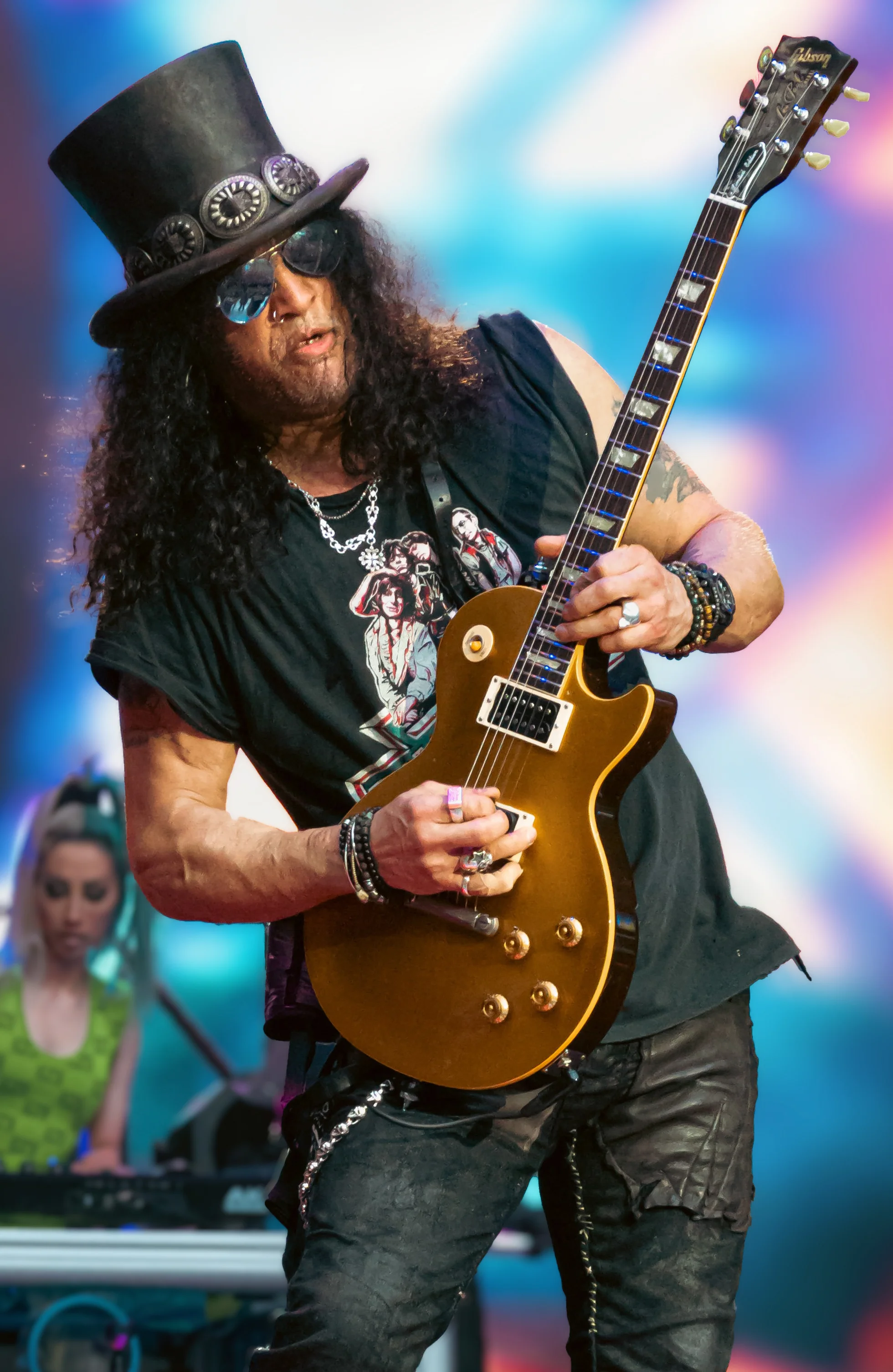
Slash — £2,500 · Premium Tone
The £2,500 · Premium build for Slash's heavy and assertive sound opens with Gibson Les Paul Junior — the tonal foundation that defines the character. Into Marshall DSL100H paired with Dunlop GCB95 Cry Baby Wah and Analogman Modded TS9, the rig comes to ~£2496 and delivers the essential elements. Slash's tone is the gold standard of hard rock — a Les Paul into a Marshall, saturated with crunch and singing with natural sustain. Raw, aggressive and always musical.
Build Slash's £2,500 · Premium Rig
4 pieces · Total ~$3,170
What guitar does Slash use?
Slash is primarily associated with lp style guitars. At a £2,500 budget, Gibson Les Paul Junior delivers the essential tonal character.
What to Buy
£2,500 · Premium — Complete Gear List
Can't find one? See alternatives:
Why This Rig Works
How Slash's gear choices create the signature tone
Gibson Les Paul Junior
The Gibson Les Paul Junior delivers warm humbucker thickness and singing sustain — the classic foundation for rock and blues tones.
- Expression Filtervocal mid-sweep with Fasel resonance
- OverdriveAnalogman Modded TS9
Marshall DSL100H
The Marshall DSL100H converts the guitar signal into audible sound and adds its own tonal character — EQ shaping, natural gain, and the overall feel of the final tone.
The Combined Tone
Humbucker-loaded Les Paul into a cranked Marshall — thick midrange saturation, singing sustain and a warm but aggressive attack. No scooped mids: Slash's tone is all about that mid-forward Marshall crunch.
Tone Tips
Getting the Sound Right
- The Marshall DSL100H delivers power-tube saturation at master volume 6–7 — this compression and sag is what separates amp-driven tone from pedal tone. Set the master first, then dial back the channel gain to taste rather than the other way around.
- Use the Les Paul bridge pickup for the classic Slash crunch
- Crank the amp — Marshall distortion comes from the amp, not pedals
- Dial in gain until open chord strums start to sustain and feedback slightly — that ringing sustain on the verge of feedback is the Slash sweet spot
- The wah pedal is central to Slash's lead vocabulary — park it in a slightly open position for a nasal rhythm texture, or sweep it expressively during melodic solo sections. The wah position at the start of each phrase determines how the note opens and colours the entire phrase character
- Study 'November Rain' and 'Estranged' guitar solos for the melodic, restrained side of Slash's vocabulary — these demonstrate melodic sentence structure over ballad accompaniment and contrast with the faster pentatonic aggression of heavier tracks, showing the full range of his approach
- Pentatonic position shifts during solos give the sense of continuous forward movement — Slash connects the five pentatonic positions by ending each phrase at the start of the next position. Practice mapping all five positions in Eb and connecting them smoothly to follow where phrases naturally want to go
Avoid These Pitfalls
Common Mistakes When Chasing This Tone
- Scooping mids on the JCM800 with humbuckers — the mid-forward character of British amps with humbuckers is the central sound of classic rock. A mid scoop removes the fundamental voice of the combination
- Leaving the wah pedal engaged but stationary between rocking it — a cocked wah (fixed position, not moving) acts as a midrange filter that changes the core tone. Either rock it expressively or bypass it completely; a cocked wah changes the sound in ways that are often unintended
- Setting gain too high on the overdrive pedal — most overdrive pedals are most useful at gain settings of 2-5, where they add character without dominating the tone. High gain settings on an OD pedal become a distortion, not an overdrive.
- Leaving the wah in a fixed position (cocked) between uses — a cocked wah acts as a midrange filter and changes the tone. If not using the wah expressively, take it out of the chain.
- Ignoring the guitar volume knob — rolling back to 6-7 is your rhythm setting; 10 is for leads. Most players leave it at 10 and miss the entire dynamic vocabulary.
Budget Alternatives
Same Tone, Different Budget
FAQ
Slash Tone — Common Questions
Slash is primarily associated with lp style guitars. At a £2,500 budget, Gibson Les Paul Junior delivers the essential tonal character.
Slash's amp is british crunch voiced — the amp running hot, providing natural tube saturation. At the £2,500 level, Marshall DSL100H is the closest match.
The £2,500 tier uses Slash's actual gear choices or direct equivalents. Total: £2,496. The tonal step up from £1,000 is real but diminishing — worth it for regular performers and studio work.
Slash's essential pedals include Overdrive, Wah. At the £2,500 tier: Dunlop GCB95 Cry Baby Wah, Analogman Modded TS9. Overdrive is the most important pedal — the others add nuance.
Slash's tone is defined by les-paul-driven, marshall-crunch, bluesy-hard-rock. The combination of lp guitar and british crunch amp creates a sound that is immediately recognisable.
Slash's gain approach is amp-driven — natural tube saturation from pushing the amp hard, not from distortion pedals. At £2,500, this is replicated through Marshall DSL100H paired with Dunlop GCB95 Cry Baby Wah.
Slash — £2,500 · Premium Complete Rig
~£2496Guitar
Gibson Les Paul Junior
Wah
Dunlop GCB95 Cry Baby Wah
Overdrive
Analogman Modded TS9
Amp
Marshall DSL100H
Tone Match
Closest Real-World Tone Match
If you like Slash's tone, these players use a similar approach — same gear philosophy, comparable sound characteristics.
Related Tones