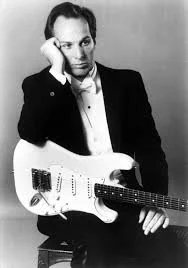
Adrian Belew — £200 · Beginner Rig
Adrian Belew's tone is defined by radical effects experimentation rather than a single core sound. His base guitar is a Parker Fly (piezo acoustic + magnetic pickups) routed through a Fernandes Sustainer for infinite feedback, then into a carefully sequenced effects board featuring Roland VG-8 guitar synthesiser, DigiTech Whammy, stereo chorus, and various pitch-shifting devices. His amp tone, when you hear it without effects, is relatively clean — the drama comes from real-time manipulation of pitch, time, and dynamics. He is the master of "what was that?" guitar moments.
Signal Path
Signal Chain
Full signal path
Full Gear List
£200 · Beginner — Complete Rig

Tone Tips
Getting the Sound Right
- Add a Whammy pedal and use it for octave bends to unexpected intervals
- Use infinite sustain (sustainer or Ebow) for ambient drone textures
- Think about "tonal painting" — what does this phrase evoke emotionally, not musically?
- Stereo chorus and delay in stereo make simple phrases sound cinematic
- Record loops and layer them — Belew builds textures through accumulation
- The chorus and flanger pedals used together create the wide, shimmering textural base — Belew uses both modulation effects simultaneously as a primary tone element rather than one at a time. Set the chorus rate slow with moderate depth; set the flanger rate very slow for a wide sweep
- Volume swells created by the guitar's volume knob allow entry without pick attack transient — turn the volume to zero before picking, then roll it up during the note. The result is a synthesizer-like smooth attack that is central to Belew's textural solo approach on recordings like 'Big Electric Cat'
- The Steinberger headless guitar's tuning stability under heavy tremolo use made Belew's extended dive-bombs practical in a recording context — before the Steinberger, consistent tuning through extended dives was not reliably achievable. The guitar choice is a direct function of the technique
Avoid These Pitfalls
Common Mistakes When Chasing This Tone
- Using a humbucker guitar as a substitute — the quack, string noise, and bright attack of single coils are irreplaceable. No amount of EQ on a humbucker produces the same result.
- Using a high-gain distortion pedal instead of amp gain — British crunch amps have a specific harmonic character when driven from their own gain stage. A pedal changes this character.
- Clean amp at too low a volume — even a clean amp provides warmth and tonal character that the pedal sits in. An amp at minimum volume has no character for the pedal to interact with.
- Too many repeats at high mix — more than 3 repeats makes the delay effect accumulate and overwhelm the dry guitar signal. Keep it to 2-3 repeats at a subtle mix level.
- Using too much reverb on clean passages — prog clean tone should be open and detailed. Long reverb tails wash out the note clarity that makes complex chord voicings readable.
- Ignoring the room or PA system — prog guitar changes tone dramatically in different acoustic environments. Dialling in EQ in isolation gives a different result than through a full PA.
Tone Profile
Belew's Sound
Adrian Belew's tone is defined by radical effects experimentation rather than a single core sound. His base guitar is a Parker Fly (piezo acoustic + magnetic pickups) routed through a Fernandes Sustainer for infinite feedback, then into a carefully sequenced effects board featuring Roland VG-8 guitar synthesiser, DigiTech Whammy, stereo chorus, and various pitch-shifting devices. His amp tone, when you hear it without effects, is relatively clean — the drama comes from real-time manipulation of pitch, time, and dynamics. He is the master of "what was that?" guitar moments.