Grant Green — £200 · Beginner Rig
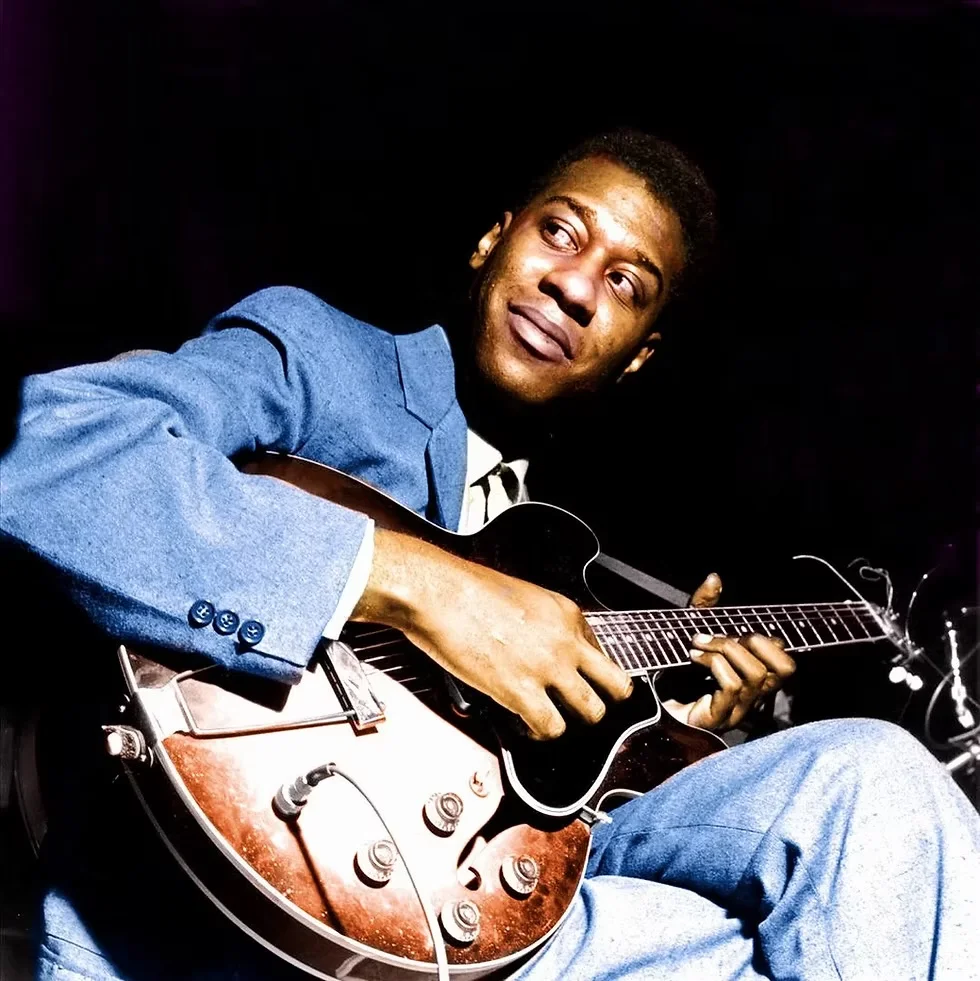
Grant Green's tone is unmistakably dark and clean: a Gibson ES-330 (thinline, fully hollow) through a clean Fender or Ampeg combo, with the neck pickup providing a round, slightly muffled warmth. His sound sits low in the frequency range, far from brittle or bright. What distinguishes it is the rhythmic confidence — every note is placed exactly on or slightly behind the beat for a laid-back, swinging feel. There is no overdrive, no chorus, no effects whatsoever. The funk and gospel of his playing is all in the hands, not the gear.
Signal Path
Signal Chain
Full signal path
Full Gear List
£200 · Beginner — Complete Rig


Tone Tips
Getting the Sound Right
- Use a fully hollow or thinline guitar for maximum acoustic warmth
- Lay back slightly behind the beat for soul-jazz swing
- Play single-note lines only — Grant rarely played chords in solos
- Use ghost notes (muted notes) between strong melody notes for rhythm
- Keep tone control around 6–7 on the neck pickup for controlled warmth
- The Gibson ES-330 with P-90 single-coil pickups provides the edgy, biting single-note tone — the semi-hollow body adds warmth while the P-90's raw output prevents muddiness. Full neck pickup with rolled-back tone at moderate amp volume is the starting point
- Blues vocabulary embedded within hard bop harmonic contexts is the core synthesis — Green played blues-derived licks over ii-V-I progressions the way Charlie Parker did on saxophone. Practicing blues phrases over standard jazz chord changes builds this vocabulary systematically
- Rests are as prominent as notes — Green left dramatic space between phrases, sometimes for full bars. Impose a minimum rest of two beats between every phrase in your improvisation to internalise his spacious, declarative approach
Avoid These Pitfalls
Common Mistakes When Chasing This Tone
- Running high-gain settings on a semi-hollow — the resonant body cavity feeds back uncontrollably at high gain levels. These guitars require lower gain and benefit from the natural resonance.
- Running multiple pedals into the input — boutique amps are designed for the natural guitar signal. Too many pedals before the input changes the input impedance and alters the amp's response.
- Adding compression to fix flat clean tone — a flat, lifeless clean tone usually means the amp gain or presence is wrong, not that compression is needed. Compression on a flat tone just makes it louder.
- Playing next to the bridge — the metallic, brittle quality near the bridge pickup is a jazz tone destroyer. Move your picking hand closer to the neck.
- Using spring reverb heavily — spring reverb has a metallic wobble quality that is characteristic of rock and country, not jazz. A subtle plate or room reverb is more appropriate.
Tone Profile
Grant Green's Sound
Grant Green's tone is unmistakably dark and clean: a Gibson ES-330 (thinline, fully hollow) through a clean Fender or Ampeg combo, with the neck pickup providing a round, slightly muffled warmth. His sound sits low in the frequency range, far from brittle or bright. What distinguishes it is the rhythmic confidence — every note is placed exactly on or slightly behind the beat for a laid-back, swinging feel. There is no overdrive, no chorus, no effects whatsoever. The funk and gospel of his playing is all in the hands, not the gear.