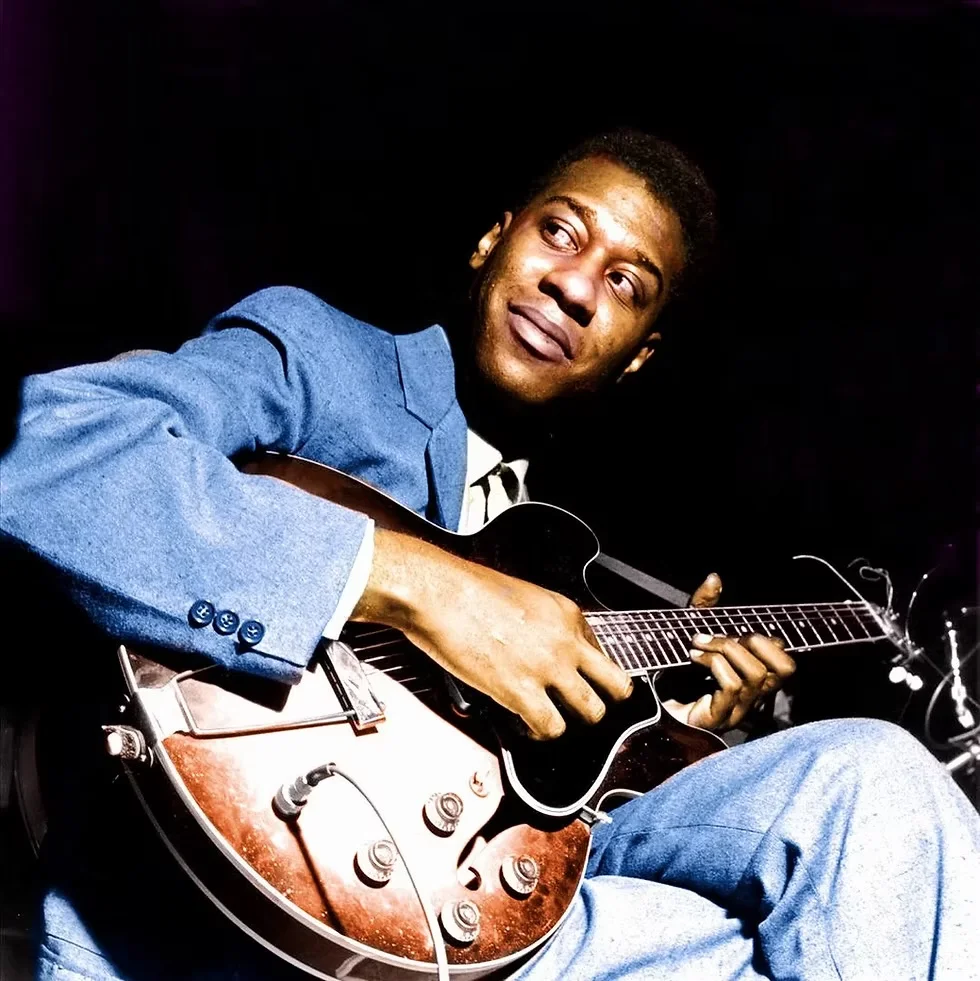
Grant Green — £2,500 · Premium Tone
Grant Green is the definitive soul-jazz guitarist — direct, single-note lines drenched in gospel and blues feeling, a complete lack of excess, and a swinging pocket that made him one of Blue Note Records' most prolific session players. Replicating that nuanced and harmonically sophisticated sound at the £2,500 · Premium mark means Epiphone ES-339 into Carr Rambler 1×12 Combo. The effects — Boss RV-6 Reverb — add the finishing texture. This build totals ~£2497 and captures the core character — a premium build targeting the most accurate recreation possible.
Build Grant Green's £2,500 · Premium Rig
3 pieces · Total ~$3,171
What guitar does Grant Green use?
Grant Green is primarily associated with semi hollow style guitars. At a £2,500 budget, Epiphone ES-339 delivers the essential tonal character.
What to Buy
£2,500 · Premium — Complete Gear List
Can't find one? See alternatives:
Why This Rig Works
How Grant Green's gear choices create the signature tone
Epiphone ES-339
The Epiphone ES-339 provides the tonal foundation for the entire rig — its character shapes everything that follows.
Boss RV-6 Reverb
Boss RV-6 Reverb — reverb coloring added to the signal.
Carr Rambler 1×12 Combo
The Carr Rambler 1×12 Combo converts the guitar signal into audible sound and adds its own tonal character — EQ shaping, natural gain, and the overall feel of the final tone.
The Combined Tone
Grant Green's tone is unmistakably dark and clean: a Gibson ES-330 (thinline, fully hollow) through a clean Fender or Ampeg combo, with the neck pickup providing a round, slightly muffled warmth. His sound sits low in the frequency range, far from brittle or bright. What distinguishes it is the rhythmic confidence — every note is placed exactly on or slightly behind the beat for a laid-back, swinging feel. There is no overdrive, no chorus, no effects whatsoever. The funk and gospel of his playing is all in the hands, not the gear.
Tone Tips
Getting the Sound Right
- At the £2,500 tier the Epiphone ES-339 has enough tonal character to reward small adjustments — pickup height, tone knob position (start at 7, not 10), and pick gauge all interact with the amp in ways that are clearly audible at this quality level.
- Use a fully hollow or thinline guitar for maximum acoustic warmth
- Lay back slightly behind the beat for soul-jazz swing
- Study 'Idle Moments' and 'Ain't It Funky Now' for the full range — the former is languid, melodic hard bop and the latter is hard-driving soul-jazz funk. Both emerge from the same vocabulary applied in completely different rhythmic and harmonic contexts
- Octave intervals appear as rhythmic punctuation at phrase endings — rather than continuous bebop flow, Green regularly plants octave hits on strong beats to re-establish the pulse and add rhythmic emphasis that scalar lines alone cannot provide
- The amplifier should produce slight warmth at moderate volume — just below natural breakup adds harmonic content that makes single notes speak with more body without adding distortion that would muddy the harmonic clarity of his jazz voicings
- Play directly into the changes rather than connecting every chord with approach notes — Green often placed notes squarely on the beat directly on chord tones, creating a direct, declarative quality rather than the floating, approach-note-heavy style of other jazz guitarists
Avoid These Pitfalls
Common Mistakes When Chasing This Tone
- Running high-gain settings on a semi-hollow — the resonant body cavity feeds back uncontrollably at high gain levels. These guitars require lower gain and benefit from the natural resonance.
- Running multiple pedals into the input — boutique amps are designed for the natural guitar signal. Too many pedals before the input changes the input impedance and alters the amp's response.
- Adding compression to fix flat clean tone — a flat, lifeless clean tone usually means the amp gain or presence is wrong, not that compression is needed. Compression on a flat tone just makes it louder.
- Playing next to the bridge — the metallic, brittle quality near the bridge pickup is a jazz tone destroyer. Move your picking hand closer to the neck.
- Using spring reverb heavily — spring reverb has a metallic wobble quality that is characteristic of rock and country, not jazz. A subtle plate or room reverb is more appropriate.
Budget Alternatives
Same Tone, Different Budget
FAQ
Grant Green Tone — Common Questions
Grant Green is primarily associated with semi hollow style guitars. At a £2,500 budget, Epiphone ES-339 delivers the essential tonal character.
Grant Green's amp is boutique clean voiced — clean to moderate gain. At the £2,500 level, Carr Rambler 1×12 Combo is the closest match.
The £2,500 tier uses Grant Green's actual gear choices or direct equivalents. Total: £2,497. The tonal step up from £1,000 is real but diminishing — worth it for regular performers and studio work.
Grant Green's tone is defined by soul-jazz, funky-single-notes, blue-note-era. The combination of semi hollow guitar and boutique clean amp creates a sound that is immediately recognisable.
Grant Green's gain approach is very clean — minimal distortion even at volume. The tone comes from the amp's natural warmth. At £2,500, this is replicated through Carr Rambler 1×12 Combo paired with Boss RV-6 Reverb.
Grant Green — £2,500 · Premium Complete Rig
~£2497Guitar
Epiphone ES-339
Amp
Carr Rambler 1×12 Combo
Reverb
Boss RV-6 Reverb
Tone Match
Closest Real-World Tone Match
If you like Grant Green's tone, these players use a similar approach — same gear philosophy, comparable sound characteristics.
Related Tones