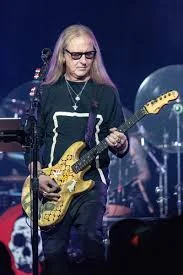
Jerry Cantrell — £2,500 · Premium Tone
Jerry Cantrell's Alice in Chains tone is among the darkest and most distinctive in rock — heavily palm-muted minor riffs, precise down-picking, dual vocal harmonies mirrored in guitar harmonies and an earthy, mid-forward crunch. Replicating that abrasive and emotionally direct sound at the £2,500 · Premium mark means Gibson Les Paul Junior into Marshall DSL40CR. The effects — Wilson Effects MkII Wah, Boss GE-7 Equalizer — add the finishing texture. This build totals ~£2490 and captures the core character — a premium build targeting the most accurate recreation possible.
Build Jerry Cantrell's £2,500 · Premium Rig
6 pieces · Total ~$3,162
What guitar does Jerry Cantrell use?
Jerry Cantrell is primarily associated with lp style guitars. At a £2,500 budget, Gibson Les Paul Junior delivers the essential tonal character.
What to Buy
£2,500 · Premium — Complete Gear List
Can't find one? See alternatives:
Why This Rig Works
How Jerry Cantrell's gear choices create the signature tone
Gibson Les Paul Junior
The Gibson Les Paul Junior delivers warm humbucker thickness and singing sustain — the classic foundation for rock and blues tones.
- WahWilson Effects MkII Wah
- EQBoss GE-7 Equalizer
- DistortionFriedman BE-OD Deluxe
- DelayMXR Carbon Copy Analog Delay
Marshall DSL40CR
The Marshall DSL40CR converts the guitar signal into audible sound and adds its own tonal character — EQ shaping, natural gain, and the overall feel of the final tone.
The Combined Tone
G&L Rampage or Cantrell signature into a Bogner Ecstasy or Marshall, with a Boss GE-7 providing a targeted mid-boost. The tone is thick, palm-muted crunch — not high gain, but heavy. DigiTech Whammy for the octave-up screams and a Dunlop Cry Baby for expressive solos.
Tone Tips
Getting the Sound Right
- The Marshall DSL40CR delivers power-tube saturation at master volume 6–7 — this compression and sag is what separates amp-driven tone from pedal tone. Set the master first, then dial back the channel gain to taste rather than the other way around.
- Drop D tuning is mandatory for most Alice in Chains riffs — the open D string under a power chord creates the characteristic "sludge"
- Palm muting defines his rhythm playing — the mute should be very heavy, right at the saddles, with almost no string resonance
- The bridge pickup provides the focused attack for palm muting — neck pickup for the cleaner, more melancholic parts
- Tune to Eb standard for most recordings, not full standard — the slightly looser string tension helps with the heaviness
- The overall gain level is medium, not extreme — what makes it heavy is the playing technique (palm muting, downpicking) not massive distortion
- The JCM800's gain at 7-8 with Les Paul humbuckers gives you the target saturation — above 8, palm mutes lose individual string definition. The clarity you're hearing at 7 versus 10 is not a small difference
- Rat-style distortion into a JCM800: the pedal has its own voice that dominates regardless of the amp character. This is different from an OD pedal — the amp's job is mainly to amplify, not add character. A flat, clean JCM800 is more appropriate than a crunchy one
Avoid These Pitfalls
Common Mistakes When Chasing This Tone
- Running the JCM800's gain channel at maximum — above 8 on most high-gain channels, palm mutes lose note separation and become an indistinct wall. The target is the minimum gain for the target saturation, not maximum
- Leaving the wah pedal engaged but stationary between rocking it — a cocked wah (fixed position, not moving) acts as a midrange filter that changes the core tone. Either rock it expressively or bypass it completely; a cocked wah changes the sound in ways that are often unintended
- Leaving the wah in a fixed position (cocked) between uses — a cocked wah acts as a midrange filter and changes the tone. If not using the wah expressively, take it out of the chain.
- Using single-coil pickups — the lack of output and mid-frequency push makes it impossible to achieve the tightness needed for high-gain rhythm playing.
- Skipping the Tube Screamer-style boost — this pedal is not about adding gain. It focuses the low end before the amp sees the signal, which produces tighter palm mutes.
Budget Alternatives
Same Tone, Different Budget
FAQ
Jerry Cantrell Tone — Common Questions
Jerry Cantrell is primarily associated with lp style guitars. At a £2,500 budget, Gibson Les Paul Junior delivers the essential tonal character.
Jerry Cantrell's amp is high gain voiced — high-gain with significant distortion from the amp itself. At the £2,500 level, Marshall DSL40CR is the closest match.
The £2,500 tier uses Jerry Cantrell's actual gear choices or direct equivalents. Total: £2,490. The tonal step up from £1,000 is real but diminishing — worth it for regular performers and studio work.
Jerry Cantrell's essential pedals include Wah, Distortion. At the £2,500 tier: Wilson Effects MkII Wah, Boss GE-7 Equalizer, Friedman BE-OD Deluxe. Wah is the most important pedal — the others add nuance.
Jerry Cantrell's tone is defined by grunge-metal, dark-harmonies, sludge-heavy. The combination of lp guitar and high gain amp creates a sound that is immediately recognisable.
Jerry Cantrell's gain approach is high-gain — dedicated high-gain amp channels or heavy drive pedals with significant distortion. At £2,500, this is replicated through Marshall DSL40CR paired with Wilson Effects MkII Wah.
Jerry Cantrell — £2,500 · Premium Complete Rig
~£2490Guitar
Gibson Les Paul Junior
Wah
Wilson Effects MkII Wah
EQ
Boss GE-7 Equalizer
Distortion
Friedman BE-OD Deluxe
Amp
Marshall DSL40CR
Delay
MXR Carbon Copy Analog Delay
Tone Match
Closest Real-World Tone Match
If you like Jerry Cantrell's tone, these players use a similar approach — same gear philosophy, comparable sound characteristics.
Related Tones