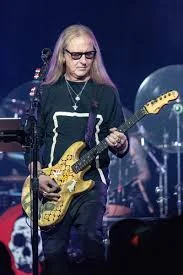
Jerry Cantrell — £500 · Sweet Spot Tone
Jerry Cantrell's Alice in Chains tone is among the darkest and most distinctive in rock — heavily palm-muted minor riffs, precise down-picking, dual vocal harmonies mirrored in guitar harmonies and an earthy, mid-forward crunch. Replicating that abrasive and emotionally direct sound at the £500 · Sweet Spot mark means Epiphone Les Paul Standard into Boss Katana 50 MkII. The effects — Boss DS-1 Distortion — add the finishing texture. This build totals ~£527 and captures the core character — the sweet spot — enough to get genuinely close to the sound without breaking the bank.
Build Jerry Cantrell's £500 · Sweet Spot Rig
3 pieces · Total ~$669
What guitar does Jerry Cantrell use?
Jerry Cantrell is primarily associated with lp style guitars. At a £500 budget, Epiphone Les Paul Standard delivers the essential tonal character.
What to Buy
£500 · Sweet Spot — Complete Gear List
Can't find one? See alternatives:
Why This Rig Works
How Jerry Cantrell's gear choices create the signature tone
Epiphone Les Paul Standard
The set-neck construction and ProBucker humbuckers deliver the sustain, thickness and mid-forward push of the genuine article. Bridge pickup into a crunch amp is the authentic hard rock formula.
Boss DS-1 Distortion
The DS-1 at moderate gain acts as a loud, slightly dirty boost into a clean-ish amp. At lower gain settings it adds grit without completely masking the guitar's character — versatile for everything from crunch to full distortion.
Boss Katana 50 MkII
Its 'Brown' amp character at low gain is an excellent approximation of the Fender-style clarity that Hendrix, Mayer, Gilmour and SRV all relied on. Built-in effects mean you're a few knob turns away from the right tone.
The Combined Tone
G&L Rampage or Cantrell signature into a Bogner Ecstasy or Marshall, with a Boss GE-7 providing a targeted mid-boost. The tone is thick, palm-muted crunch — not high gain, but heavy. DigiTech Whammy for the octave-up screams and a Dunlop Cry Baby for expressive solos.
Tone Tips
Getting the Sound Right
- On the Boss Katana 50 MkII: use the Brown channel — the closest model to a Marshall-voiced preamp at this price. Set character to 8, gain to 5. For Jerry Cantrell's lead volume jump, use the Boost mode rather than adding a separate boost pedal.
- Drop D tuning is mandatory for most Alice in Chains riffs — the open D string under a power chord creates the characteristic "sludge"
- Palm muting defines his rhythm playing — the mute should be very heavy, right at the saddles, with almost no string resonance
- The GE-7 mid-boost is the secret weapon — push the 800Hz band by +3–4dB to give the guitar more cut without adding more distortion gain
- Minor third harmony above the main riff is a signature Cantrell technique — double the melody a minor third up for the AIC harmony guitar parts
- The Whammy is set to one octave up, and kick to the toe position for the screaming harmonic — it's not an effect used on most notes
- The JCM800's gain at 7-8 with Les Paul humbuckers gives you the target saturation — above 8, palm mutes lose individual string definition. The clarity you're hearing at 7 versus 10 is not a small difference
- Rat-style distortion into a JCM800: the pedal has its own voice that dominates regardless of the amp character. This is different from an OD pedal — the amp's job is mainly to amplify, not add character. A flat, clean JCM800 is more appropriate than a crunchy one
Avoid These Pitfalls
Common Mistakes When Chasing This Tone
- Running the JCM800's gain channel at maximum — above 8 on most high-gain channels, palm mutes lose note separation and become an indistinct wall. The target is the minimum gain for the target saturation, not maximum
- Leaving the wah pedal engaged but stationary between rocking it — a cocked wah (fixed position, not moving) acts as a midrange filter that changes the core tone. Either rock it expressively or bypass it completely; a cocked wah changes the sound in ways that are often unintended
- Ignoring the individual pickup volume and tone controls — the two-pickup switching options on a Les Paul give you four distinct tones within a single setting. Most players only use two.
- Not using a noise gate — self-noise at metal gain levels is continuous between notes. A gate is not stylistic; it is required for professional-sounding silence between riffs.
- Maximum gain on the amp channel — this is the most common mistake in high-gain playing. The clarity and note separation that makes fast playing readable degrades at maximum gain.
Budget Alternatives
Same Tone, Different Budget
FAQ
Jerry Cantrell Tone — Common Questions
Jerry Cantrell is primarily associated with lp style guitars. At a £500 budget, Epiphone Les Paul Standard delivers the essential tonal character.
Jerry Cantrell's amp is high gain voiced — high-gain with significant distortion from the amp itself. At the £500 level, Boss Katana 50 MkII is the closest match.
Yes — £500 covers a real guitar and amp in the right tonal family. This rig totals £527 and captures the essential character. The guitar and amp account for 80% of the tone; pedals are secondary at this budget.
Jerry Cantrell's essential pedals include Wah, Distortion. At the £500 tier: Boss DS-1 Distortion. Wah is the most important pedal — the others add nuance.
Jerry Cantrell's tone is defined by grunge-metal, dark-harmonies, sludge-heavy. The combination of lp guitar and high gain amp creates a sound that is immediately recognisable.
Jerry Cantrell's gain approach is high-gain — dedicated high-gain amp channels or heavy drive pedals with significant distortion. At £500, this is replicated through Boss Katana 50 MkII paired with Boss DS-1 Distortion.
Jerry Cantrell — £500 · Sweet Spot Complete Rig
~£527Guitar
Epiphone Les Paul Standard
Distortion
Boss DS-1 Distortion
Amp
Boss Katana 50 MkII
Tone Match
Closest Real-World Tone Match
If you like Jerry Cantrell's tone, these players use a similar approach — same gear philosophy, comparable sound characteristics.
Related Tones