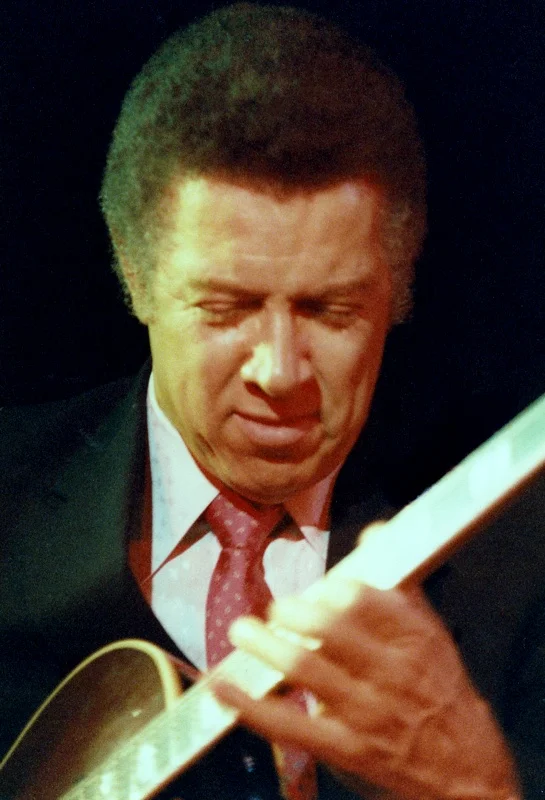
Kenny Burrell — £200 · Beginner Rig
Kenny Burrell's tone is a benchmark for warm jazz guitar: a Gibson ES-175 or ES-335, neck pickup, into a clean amplifier kept just loud enough to let the guitar's natural acoustics translate. His sound is round, unhurried, and never harsh — even on fast bebop lines there is a softness to his attack that reflects his deep blues roots. No effects, no distortion. The guitar does all the work: thick strings, a high action that rewards controlled fretting-hand pressure, and a picking angle that produces a full-bodied thwack on each note.
Signal Path
Signal Chain
Full signal path
Full Gear List
£200 · Beginner — Complete Rig


Tone Tips
Getting the Sound Right
- Play with the neck pickup and tone rolled to about 7 for warm, rounded clarity
- Use slightly heavier strings (12–52) for fuller tone and bending resistance
- Practise blues scales alongside bebop vocabulary — Burrell blended both freely
- Voice chords in closed position on the middle four strings for a piano-like comping sound
- Listen for the spaces — Burrell's phrasing is defined by what he doesn't play
- The Gibson ES-175 with a clean Fender or Polytone amp is the starting point — Burrell's tone is warm, round, and slightly dark. The treble control on the guitar should be below 5 to prevent any harshness on single notes from cutting against the warm harmonic character
- Blues and gospel phrasing embedded within bebop frameworks is the Burrell synthesis — phrases begin with a blues-style bend or note-slide, then continue with a bebop chord substitution or chromatic run. Both vocabularies coexist within the same phrase as naturally as breath
- Chord-melody in a solo guitar context requires bass, inner voice, and melody to fill all three registers simultaneously — study 'Guitar Forms' for extended examples of how Burrell voices the complete harmonic and melodic content of a standard on solo guitar without any accompaniment
Avoid These Pitfalls
Common Mistakes When Chasing This Tone
- Playing at high volume without managing feedback — hollow-body guitars are acoustically live and will feedback freely at stage volumes. Amp positioning and pickup height affect this dramatically.
- Running multiple pedals into the input — boutique amps are designed for the natural guitar signal. Too many pedals before the input changes the input impedance and alters the amp's response.
- Adding compression to fix flat clean tone — a flat, lifeless clean tone usually means the amp gain or presence is wrong, not that compression is needed. Compression on a flat tone just makes it louder.
- Choosing a pick that is too heavy — thin to medium picks give edge noise and articulation that heavier picks smooth away. That edge is part of the sound.
- Setting amp gain at 5 or higher — blues tone lives at the edge of breakup (gain 3-4), not in full saturation. High gain compresses away all the dynamic feel.
Tone Profile
Burrell's Sound
Kenny Burrell's tone is a benchmark for warm jazz guitar: a Gibson ES-175 or ES-335, neck pickup, into a clean amplifier kept just loud enough to let the guitar's natural acoustics translate. His sound is round, unhurried, and never harsh — even on fast bebop lines there is a softness to his attack that reflects his deep blues roots. No effects, no distortion. The guitar does all the work: thick strings, a high action that rewards controlled fretting-hand pressure, and a picking angle that produces a full-bodied thwack on each note.