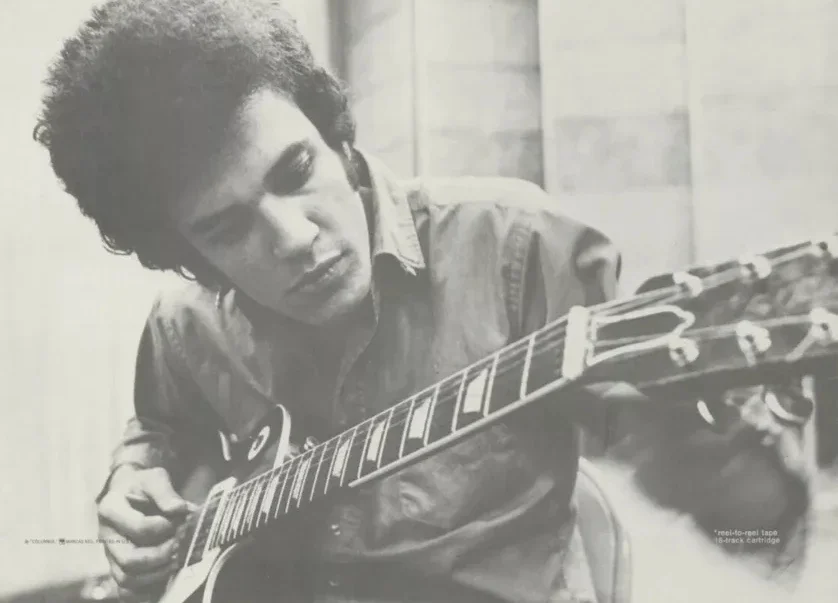
Mike Bloomfield — £1,000 · Pro-Level Tone
Mike Bloomfield brought the electric blues to white rock audiences — his work with the Paul Butterfield Blues Band and on Bob Dylan's "Highway 61 Revisited" introduced millions to the Chicago electric blues tradition. Replicating that soulful and deeply expressive sound at the £1,000 · Pro-Level mark means Epiphone Les Paul Standard into Fender Blues Junior IV. The effects — Boss BD-2 Blues Driver — add the finishing texture. This build totals ~£1,097 and captures the core character — a serious investment that brings you within touching distance of the real thing.
Build Mike Bloomfield's £1,000 · Pro-Level Rig
3 pieces · Total ~$1,165
What guitar does Mike Bloomfield use?
Mike Bloomfield is primarily associated with lp style guitars. At a £1,000 budget, Epiphone Les Paul Standard delivers the essential tonal character.
What to Buy
£1,000 · Pro-Level — Complete Gear List
Can't find one? See alternatives:
Why This Rig Works
How Mike Bloomfield's gear choices create the signature tone
Epiphone Les Paul Standard
The set-neck construction and ProBucker humbuckers deliver the sustain, thickness and mid-forward push of the genuine article. Bridge pickup into a crunch amp is the authentic hard rock formula.
Boss BD-2 Blues Driver
Boss BD-2 Blues Driver — overdrive coloring added to the signal.
Fender Blues Junior IV
This is where the magic happens for Mayer and SRV tones. The EL84 power section breaks up beautifully when pushed, and the bright, clean headroom is exactly what Tube Screamer boost tones are built on.
The Combined Tone
Gibson Les Paul into a clean-to-slightly-dirty Fender amp. The tone is mid-heavy and singing — Les Paul humbucker warmth through a Fender that breaks up gently on note attacks. No excessive gain; the Chicago blues tradition is about feel and dynamics, not high distortion.
Tone Tips
Getting the Sound Right
- The Fender Blues Junior IV stays cleaner longer than a Marshall-style amp — push it with a low-gain overdrive (gain at 2–3, level up) rather than cranking its own gain. Set treble at 6, bass at 4, and let the guitar's volume knob handle the dynamics.
- Fluid legato phrasing in the Chicago blues tradition — smooth hammer-on and pull-off runs connecting chord tones across the neck
- The Les Paul neck pickup for the warm, vocal lead quality — bridge pickup is too bright and aggressive for this style
- The amp should just begin to break up when you dig in — if the amp is clean at all dynamics, the voice is absent. The slight natural saturation provides the "cry"
- Study "East West" from the Butterfield Blues Band — the extended improvisation demonstrates his ability to move between blues, modal jazz and Indian music vocabulary
- Dylan's "Like a Rolling Stone" solo is the introduction to the style — not fast, not complicated, but every note placed perfectly
- Practise playing the blues scale (minor pentatonic + b5) over 12-bar progressions until the shapes are invisible and the note choices are instinctive
Avoid These Pitfalls
Common Mistakes When Chasing This Tone
- Setting the TS9 gain above 5 into a clean amp — at high gain settings the TS becomes a distortion pedal that colours the tone heavily. Below 4, it's a boost and focus pedal. Single coils into a TS above 5 gets nasal and harsh
- Setting the amp bass too high — the inherent warmth of mahogany means you need less bass EQ than with a Strat. Starting at 5 rather than 7 prevents low-end mud.
- Setting gain too high on the overdrive pedal — most overdrive pedals are most useful at gain settings of 2-5, where they add character without dominating the tone. High gain settings on an OD pedal become a distortion, not an overdrive.
- Ignoring the guitar volume knob — rolling back to 6-7 is your rhythm setting; 10 is for leads. Most players leave it at 10 and miss the entire dynamic vocabulary.
- Using a humbucker where single coils are needed — the quack, string definition, and high-frequency air of single coils cannot be EQ'd into a humbucker
Budget Alternatives
Same Tone, Different Budget
FAQ
Mike Bloomfield Tone — Common Questions
Mike Bloomfield is primarily associated with lp style guitars. At a £1,000 budget, Epiphone Les Paul Standard delivers the essential tonal character.
Mike Bloomfield's amp is vintage blues voiced — the amp running hot, providing natural tube saturation. At the £1,000 level, Fender Blues Junior IV is the closest match.
The £1,000 tier adds noticeably better build quality and tonal nuance over the £500 rig. This build totals £917 with Epiphone Les Paul Standard, Fender Blues Junior IV, 1 effect. This is the tier where the tone becomes genuinely convincing for gigging and recording.
Mike Bloomfield's essential pedals include Overdrive. At the £1,000 tier: Boss BD-2 Blues Driver. Overdrive is the most important pedal — the others add nuance.
Mike Bloomfield's tone is defined by chicago-blues-rock, raw-les-paul, early-electric-blues. The combination of lp guitar and vintage blues amp creates a sound that is immediately recognisable.
Mike Bloomfield's gain approach is amp-driven — natural tube saturation from pushing the amp hard, not from distortion pedals. At £1,000, this is replicated through Fender Blues Junior IV paired with Boss BD-2 Blues Driver.
Mike Bloomfield — £1,000 · Pro-Level Complete Rig
~£1,097Guitar
Epiphone Les Paul Standard
Amp
Fender Blues Junior IV
Overdrive
Boss BD-2 Blues Driver
Tone Match
Closest Real-World Tone Match
If you like Mike Bloomfield's tone, these players use a similar approach — same gear philosophy, comparable sound characteristics.
Related Tones