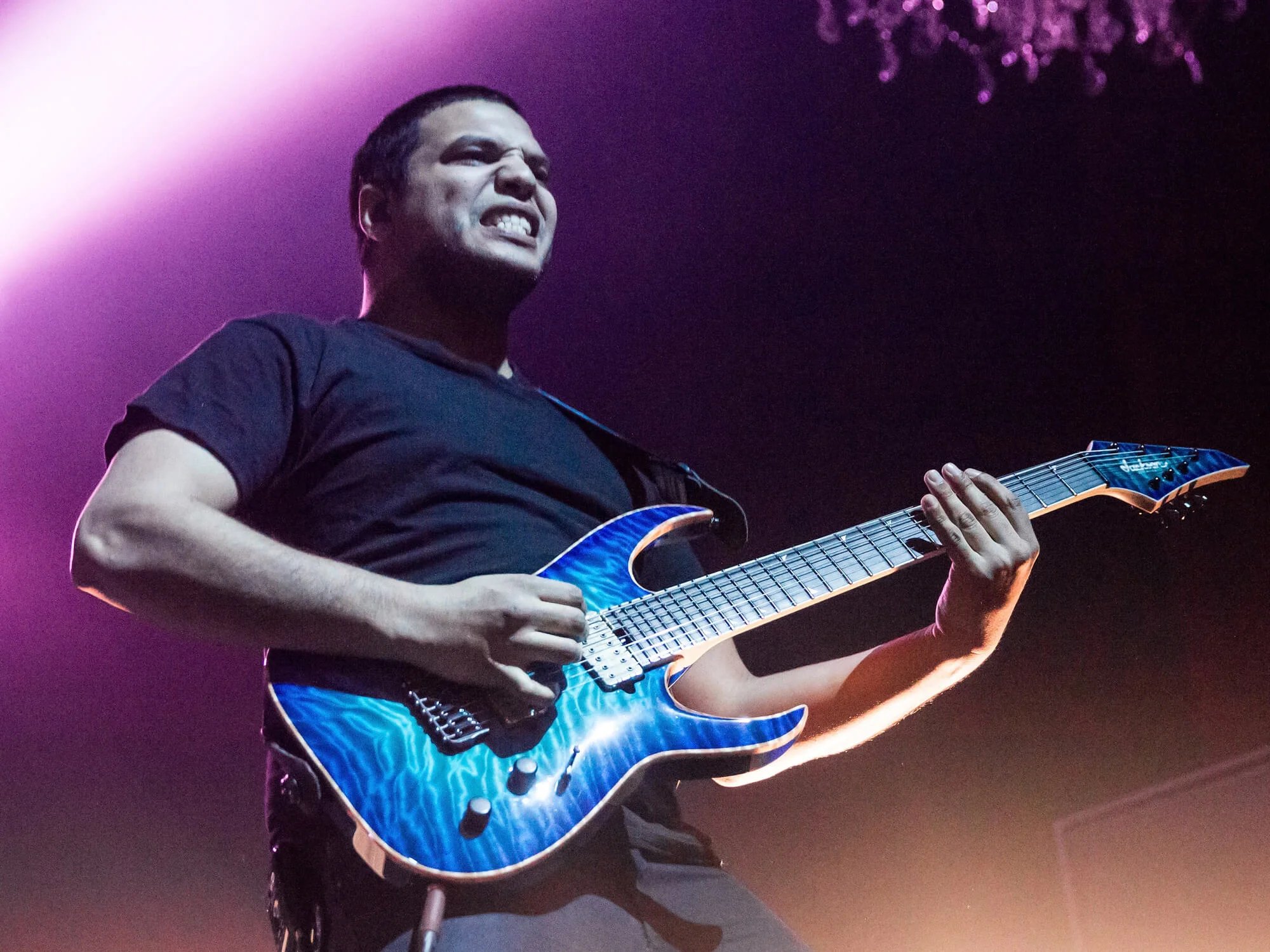
Misha Mansoor — £1,000 · Pro-Level Tone
Misha Mansoor's layered and compositionally bold tone took shape during a generation pushing the boundaries of modern guitar and remains one of the most sought-after sounds on guitar. Misha Mansoor (Periphery) defined the djent sound — ultra-tight 7-string palm muting through an Axe-Fx modeller with extreme low-end precision. Where Tosin Abasi leans toward fusion and arrangement, Mansoor's focus is heavy: massive riff construction, complex time signatures and a production-first approach to tone that blurs the line between guitarist and producer. At the £1,000 · Pro-Level mark — a serious investment that brings you within touching distance of the real thing — the build centres on a Jackson JS22 DKA Dinky running through a Blackstar HT Stage 60 MkII, with Source Audio EQ2 completing the signal chain, totalling ~£987.
Build Misha Mansoor's £1,000 · Pro-Level Rig
3 pieces · Total ~$1,253
What guitar does Misha Mansoor use?
Misha Mansoor is primarily associated with superstrat style guitars. At a £1,000 budget, Jackson JS22 DKA Dinky delivers the essential tonal character.
What to Buy
£1,000 · Pro-Level — Complete Gear List
Why This Rig Works
How Misha Mansoor's gear choices create the signature tone
Jackson JS22 DKA Dinky
The Jackson JS22 DKA Dinky provides the tonal foundation for the entire rig — its character shapes everything that follows.
Source Audio EQ2
Source Audio EQ2 — eq coloring added to the signal.
Blackstar HT Stage 60 MkII
The Blackstar HT Stage 60 MkII converts the guitar signal into audible sound and adds its own tonal character — EQ shaping, natural gain, and the overall feel of the final tone.
The Combined Tone
Tight, compressed high-gain through a 7-string — every palm mute is a precise, percussive event. The low B string must be clear and tight, not flabby: a noise gate and careful amp gain staging are essential. Clean passages contrast starkly with heavy riffs, often using chorus and light reverb. Mansoor's tone is as much a studio construction as a live sound.
Tone Tips
Getting the Sound Right
- At the £1,000 tier the effects chain matters: run Source Audio EQ2 in the correct signal order and test each pedal in and out individually — order changes the sound significantly and each piece contributes differently depending on what surrounds it.
- 7-string in drop G# or A (or standard B) — Periphery material is written for extended-range tunings
- Gate the signal aggressively: djent requires silence between notes; noise gates at input and in the loop
- Compress rhythm tracks in DAW post-amp: Mansoor's studio tone has significant post-processing
- Clean tones should be voiced differently — chorus, lighter reverb, softer attack for contrast with heavy sections
- Learn in odd meters: Periphery writes in 7/8, 11/8, mixed metre — the riffs make more sense once you feel the groupings
- Study the Periboard series (Mansoor's sample packs) to hear how the tone is constructed at mix level
Avoid These Pitfalls
Common Mistakes When Chasing This Tone
- Running the EVH 5150's gain channel at maximum — above 8 on most high-gain channels, palm mutes lose note separation and become an indistinct wall. The target is the minimum gain for the target saturation, not maximum
- Using the cab simulation on when running into a real guitar cabinet — cab simulation is for FRFR speakers or direct recording. Running a simulated cab into a real guitar cab double-simulates the cabinet sound, which sounds wrong
- Maximum gain on the amp channel — this is the most common mistake in high-gain playing. The clarity and note separation that makes fast playing readable degrades at maximum gain.
- Using single-coil pickups — the lack of output and mid-frequency push makes it impossible to achieve the tightness needed for high-gain rhythm playing.
- Skipping the Tube Screamer-style boost — this pedal is not about adding gain. It focuses the low end before the amp sees the signal, which produces tighter palm mutes.
Budget Alternatives
Same Tone, Different Budget
FAQ
Misha Mansoor Tone — Common Questions
Misha Mansoor is primarily associated with superstrat style guitars. At a £1,000 budget, Jackson JS22 DKA Dinky delivers the essential tonal character.
Misha Mansoor's amp is high gain voiced — high-gain with significant distortion from the amp itself. At the £1,000 level, Blackstar HT Stage 60 MkII is the closest match.
The £1,000 tier adds noticeably better build quality and tonal nuance over the £500 rig. This build totals £987 with Jackson JS22 DKA Dinky, Blackstar HT Stage 60 MkII, 1 effect. This is the tier where the tone becomes genuinely convincing for gigging and recording.
Misha Mansoor's essential pedals include EQ. At the £1,000 tier: Source Audio EQ2. EQ is the most important pedal — the others add nuance.
Misha Mansoor's tone is defined by djent, periphery, precise-low-end. The combination of superstrat guitar and high gain amp creates a sound that is immediately recognisable.
Misha Mansoor's gain approach is high-gain — dedicated high-gain amp channels or heavy drive pedals with significant distortion. At £1,000, this is replicated through Blackstar HT Stage 60 MkII paired with Source Audio EQ2.
Misha Mansoor — £1,000 · Pro-Level Complete Rig
~£987Guitar
Jackson JS22 DKA Dinky
EQ
Source Audio EQ2
Amp
Blackstar HT Stage 60 MkII
Tone Match
Closest Real-World Tone Match
If you like Misha Mansoor's tone, these players use a similar approach — same gear philosophy, comparable sound characteristics.
Related Tones