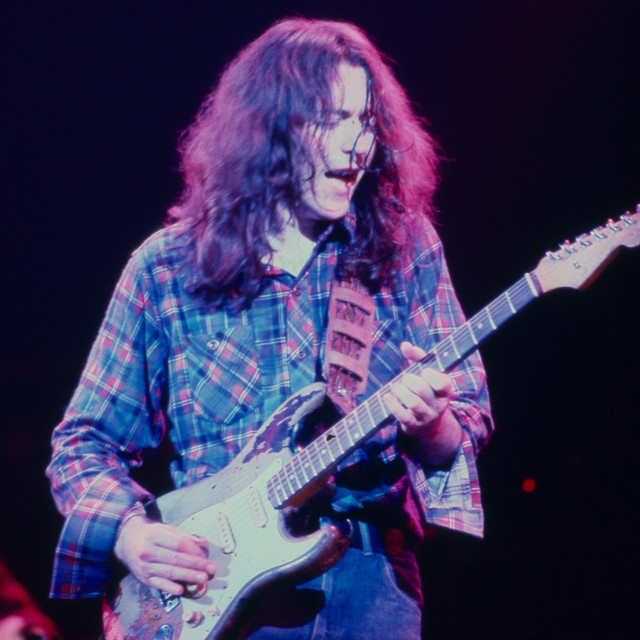
Rory Gallagher — £1,000 · Pro-Level Tone
Rory Gallagher's raw and emotionally charged tone took shape during a defining era for electric guitar and remains one of the most sought-after sounds on guitar. Rory Gallagher's 1961 Stratocaster was so worn from relentless touring that its sunburst finish had almost completely worn away. That battered Strat through a Marshall and Vox delivered an honest, unpolished blues-rock tone that never chased fashion — raw, direct and deeply personal. At the £1,000 · Pro-Level mark — a serious investment that brings you within touching distance of the real thing — the build centres on a Squier Classic Vibe 60s Stratocaster running through a Marshall DSL20CR, with Xotic EP Booster and Ibanez TS9 Tube Screamer completing the signal chain, totalling ~£966.
Build Rory Gallagher's £1,000 · Pro-Level Rig
4 pieces · Total ~£966
What guitar does Rory Gallagher use?
Rory Gallagher is primarily associated with strat style guitars. At a £1,000 budget, Squier Classic Vibe 60s Stratocaster delivers the essential tonal character.
What to Buy
£1,000 · Pro-Level — Complete Gear List
Why This Rig Works
How Rory Gallagher's gear choices create the signature tone
Squier Classic Vibe 60s Stratocaster
The alnico V pickups are the real deal — they deliver genuine Strat chime, quack and warmth that responds naturally to pick attack. An ideal foundation for Hendrix, Mayer, Gilmour or SRV tones.
- BoostXotic EP Booster
- Amp Boost / ODwarm mid-hump boost that makes your amp sing
Marshall DSL20CR
The DSL's crunch channel captures the classic JCM800-era Marshall sound that Slash and Frusciante are built on. At 20 watts you can push the power amp hard enough to get natural tube saturation without needing ear protection.
The Combined Tone
Heavily worn 1961 Fender Stratocaster into a Marshall Super Lead or Vox AC30, sometimes with a Rangemaster treble booster. The worn guitar has developed its own resonance over decades. An Ampeg Jet tape echo or treble booster are occasional additions. Gallagher's tone is characterised by his aggressive, physical pick attack.
Tone Tips
Getting the Sound Right
- Pick hard with a heavy attack — Gallagher's aggression comes from the right hand
- Middle or bridge pickup on the Strat for the raw, cutting lead tones
- Amp slightly breaking up, not high-gain — the dirt is on the edge of clean
- Treble booster before the amp sharpens pick attack and drives harmonic content
- Simple pentatonic and blues-scale vocabulary played with conviction — not complex runs
- Vibrato is expressive and physical — Gallagher would physically shake the neck
- Country and Celtic music influences emerge in some chord choices — maj6, add9 shapes
- Dobro and acoustic playing were integral to his sets — not just electric blues
Avoid These Pitfalls
Common Mistakes When Chasing This Tone
- Setting the TS9 gain above 5 into a clean amp — at high gain settings the TS becomes a distortion pedal that colours the tone heavily. Below 4, it's a boost and focus pedal. Single coils into a TS above 5 gets nasal and harsh
- Leaving the wah pedal engaged but stationary between rocking it — a cocked wah (fixed position, not moving) acts as a midrange filter that changes the core tone. Either rock it expressively or bypass it completely; a cocked wah changes the sound in ways that are often unintended
- Using a humbucker guitar as a substitute — the quack, string noise, and bright attack of single coils are irreplaceable. No amount of EQ on a humbucker produces the same result.
- Scooping the mids on a Marshall-style amp — the upper midrange emphasis is what makes British amps cut through. Mid-scoop EQ sounds good alone but disappears in a band mix.
- Using a distortion pedal to replace amp saturation — amp-driven tone has a specific feel (dynamics, touch sensitivity, natural compression) that pedal distortion cannot replicate. The source of gain matters.
- Setting gain too high on the overdrive pedal — most overdrive pedals are most useful at gain settings of 2-5, where they add character without dominating the tone. High gain settings on an OD pedal become a distortion, not an overdrive.
- Using a humbucker where single coils are needed — the quack, string definition, and high-frequency air of single coils cannot be EQ'd into a humbucker
- Adding a compressor before the amp "for more tone" — it kills the natural attack variation that defines the style. Blues tone is uncompressed and dynamic.
Budget Alternatives
Same Tone, Different Budget
FAQ
Rory Gallagher Tone — Common Questions
Rory Gallagher is primarily associated with strat style guitars. At a £1,000 budget, Squier Classic Vibe 60s Stratocaster delivers the essential tonal character.
Rory Gallagher's amp is british crunch voiced — the amp running hot, providing natural tube saturation. At the £1,000 level, Marshall DSL20CR is the closest match.
The £1,000 tier adds noticeably better build quality and tonal nuance over the £500 rig. This build totals £966 with Squier Classic Vibe 60s Stratocaster, Marshall DSL20CR, 2 effects. This is the tier where the tone becomes genuinely convincing for gigging and recording.
Rory Gallagher's essential pedals include Overdrive, Boost. At the £1,000 tier: Xotic EP Booster, Ibanez TS9 Tube Screamer. Overdrive is the most important pedal — the others add nuance.
Rory Gallagher's tone is defined by raw, authentic, bluesy. The combination of strat guitar and british crunch amp creates a sound that is immediately recognisable.
Rory Gallagher's gain approach is amp-driven — natural tube saturation from pushing the amp hard, not from distortion pedals. At £1,000, this is replicated through Marshall DSL20CR paired with Xotic EP Booster.
Rory Gallagher — £1,000 · Pro-Level Complete Rig
~£966Guitar
Squier Classic Vibe 60s Stratocaster
Boost
Xotic EP Booster
Overdrive
Ibanez TS9 Tube Screamer
Amp
Marshall DSL20CR
Tone Match
Closest Real-World Tone Match
If you like Rory Gallagher's tone, these players use a similar approach — same gear philosophy, comparable sound characteristics.
Related Tones