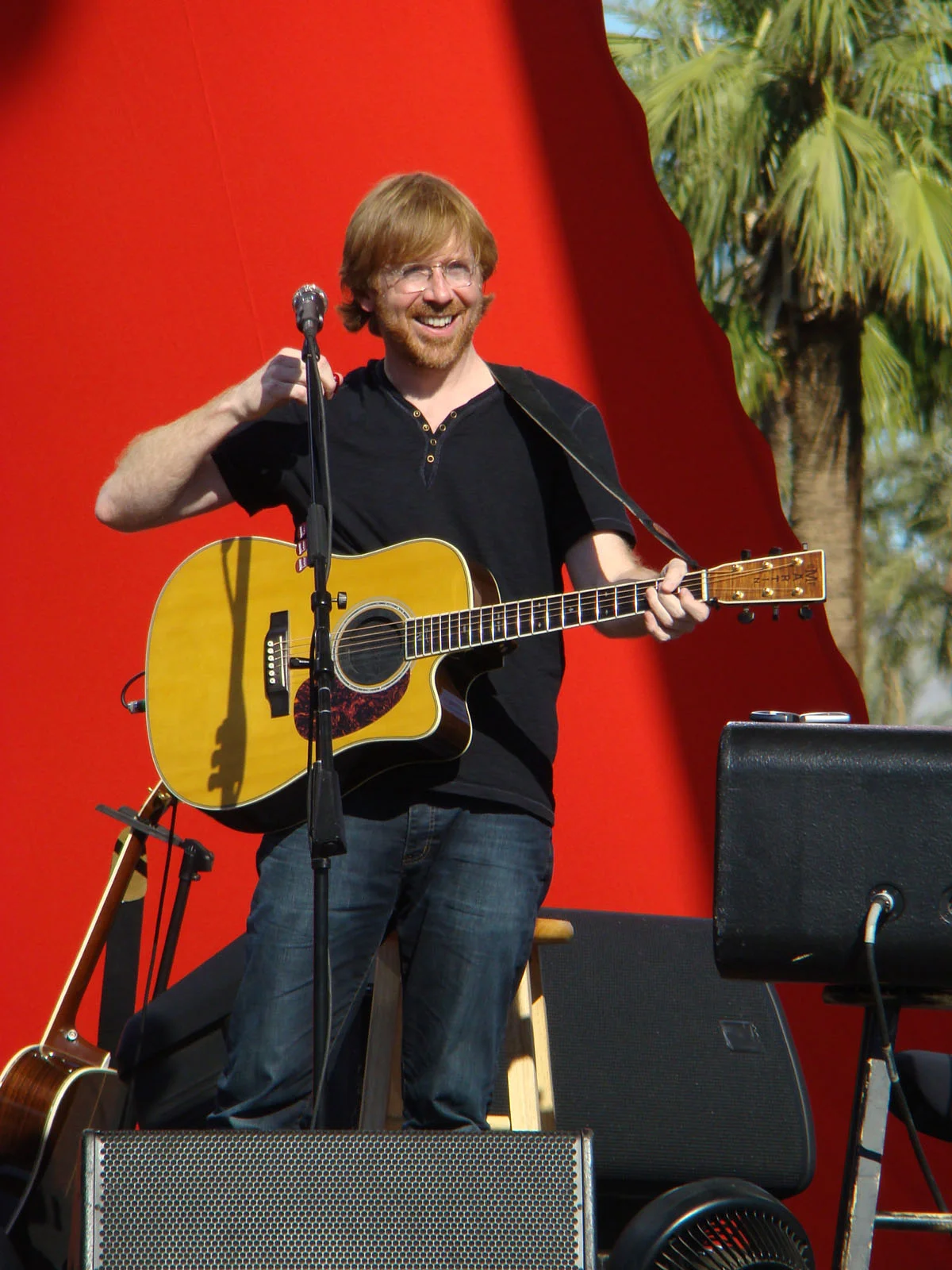
Trey Anastasio — £1,000 · Pro-Level Tone
As the frontman of Phish, Trey Anastasio built one of the most recognisable improvisational guitar voices in modern American music — warm, vocal and endlessly articulate across marathon jams. His tone is defined by hollow-body Languedoc guitars, a compressed-but-singing overdrive, and a remarkable touch sensitivity that lets him whisper or wail without ever sounding harsh. Replicating that fluid and dynamically adventurous sound at the £1,000 · Pro-Level mark means Squier Classic Vibe 60s Stratocaster into Fender Blues Junior IV. The effects — Boss DD-8 Digital Delay, Electro-Harmonix Holy Grail Nano — add the finishing texture. This build totals ~£996 and captures the core character — a serious investment that brings you within touching distance of the real thing.
Build Trey Anastasio's £1,000 · Pro-Level Rig
4 pieces · Total ~$1,265
What guitar does Anastasio use?
Anastasio is primarily associated with strat style guitars. At a £1,000 budget, Squier Classic Vibe 60s Stratocaster delivers the essential tonal character.
What to Buy
£1,000 · Pro-Level — Complete Gear List
Can't find one? See alternatives:
Why This Rig Works
How Trey Anastasio's gear choices create the signature tone
Squier Classic Vibe 60s Stratocaster
The alnico V pickups are the real deal — they deliver genuine Strat chime, quack and warmth that responds naturally to pick attack. An ideal foundation for Hendrix, Mayer, Gilmour or SRV tones.
- DelayBoss DD-8 Digital Delay
- ReverbElectro-Harmonix Holy Grail Nano
Fender Blues Junior IV
This is where the magic happens for Mayer and SRV tones. The EL84 power section breaks up beautifully when pushed, and the bright, clean headroom is exactly what Tube Screamer boost tones are built on.
The Combined Tone
Anastasio runs a hollow-body guitar (bridge pickup, often a Bill Lawrence-style humbucker) into a Ross compressor and a Tube Screamer stacked into clean Fender-voiced amps, letting amp headroom and pedal grind do the talking rather than high-gain distortion. The amp is set fairly clean with mids pushed, treble moderate, and a touch of natural breakup. A short slap-back to medium analog delay and subtle reverb glue the lead lines together.
Tone Tips
Getting the Sound Right
- The Fender Blues Junior IV stays cleaner longer than a Marshall-style amp — push it with a low-gain overdrive (gain at 2–3, level up) rather than cranking its own gain. Set treble at 6, bass at 4, and let the guitar's volume knob handle the dynamics.
- Stack a Ross-style compressor BEFORE a Tube Screamer — comp first smooths attack, then the TS9 adds the singing midrange. Set compressor sustain around 2 o'clock, level to unity.
- Set the Tube Screamer with Drive at 9–10 o'clock, Tone at noon, Level high — you want a mid hump and light grit, not a wall of distortion.
- Use a hollow or semi-hollow body for that woody, vocal sustain — solid-body strats sound too tight for his airy jam tone.
- Add a Klon-style transparent overdrive AFTER the Tube Screamer as a clean boost for solos — gain low, output high.
- Set delay to a medium 350–450ms with 2–3 repeats and low mix for ambience, not slapback — it should sit under the notes.
- Practise 'machine-gun' rapid alternate picking and Phish-style call-and-response licks — the tone serves the phrasing.
Avoid These Pitfalls
Common Mistakes When Chasing This Tone
- Setting the TS9 gain above 5 into a clean amp — at high gain settings the TS becomes a distortion pedal that colours the tone heavily. Below 4, it's a boost and focus pedal. Single coils into a TS above 5 gets nasal and harsh
- Leaving the wah pedal engaged but stationary between rocking it — a cocked wah (fixed position, not moving) acts as a midrange filter that changes the core tone. Either rock it expressively or bypass it completely; a cocked wah changes the sound in ways that are often unintended
- Setting the boost level too high relative to the base tone — a boost for solos should raise the presence of the guitar, not cause a volume jump that overwhelms the mix. Level matching matters.
- Not setting delay to song tempo — a delay that doesn't match the song tempo creates a rhythmic clash that builds and becomes increasingly obvious. Tap the tempo every time.
- Ignoring the room or PA system — prog guitar changes tone dramatically in different acoustic environments. Dialling in EQ in isolation gives a different result than through a full PA.
Budget Alternatives
Same Tone, Different Budget
FAQ
Trey Anastasio Tone — Common Questions
Anastasio is primarily associated with strat style guitars. At a £1,000 budget, Squier Classic Vibe 60s Stratocaster delivers the essential tonal character.
Anastasio's amp is boutique clean voiced — clean with headroom, pushed by an overdrive pedal. At the £1,000 level, Fender Blues Junior IV is the closest match.
The £1,000 tier adds noticeably better build quality and tonal nuance over the £500 rig. This build totals £996 with Squier Classic Vibe 60s Stratocaster, Fender Blues Junior IV, 2 effects. This is the tier where the tone becomes genuinely convincing for gigging and recording.
Anastasio's essential pedals include Delay, Reverb, Wah, Chorus. At the £1,000 tier: Boss DD-8 Digital Delay, Electro-Harmonix Holy Grail Nano. Delay is the most important pedal — the others add nuance.
Anastasio's tone is defined by improvisational, jazz-rock, clean-with-dynamics. The combination of strat guitar and boutique clean amp creates a sound that is immediately recognisable.
Anastasio's gain approach is clean-boosted — a clean amp pushed by an overdrive pedal. The pedal adds colour; the amp adds body. At £1,000, this is replicated through Fender Blues Junior IV paired with Boss DD-8 Digital Delay.
Trey Anastasio — £1,000 · Pro-Level Complete Rig
~£996Guitar
Squier Classic Vibe 60s Stratocaster
Amp
Fender Blues Junior IV
Delay
Boss DD-8 Digital Delay
Reverb
Electro-Harmonix Holy Grail Nano
Tone Match
Closest Real-World Tone Match
If you like Trey Anastasio's tone, these players use a similar approach — same gear philosophy, comparable sound characteristics.
Related Tones