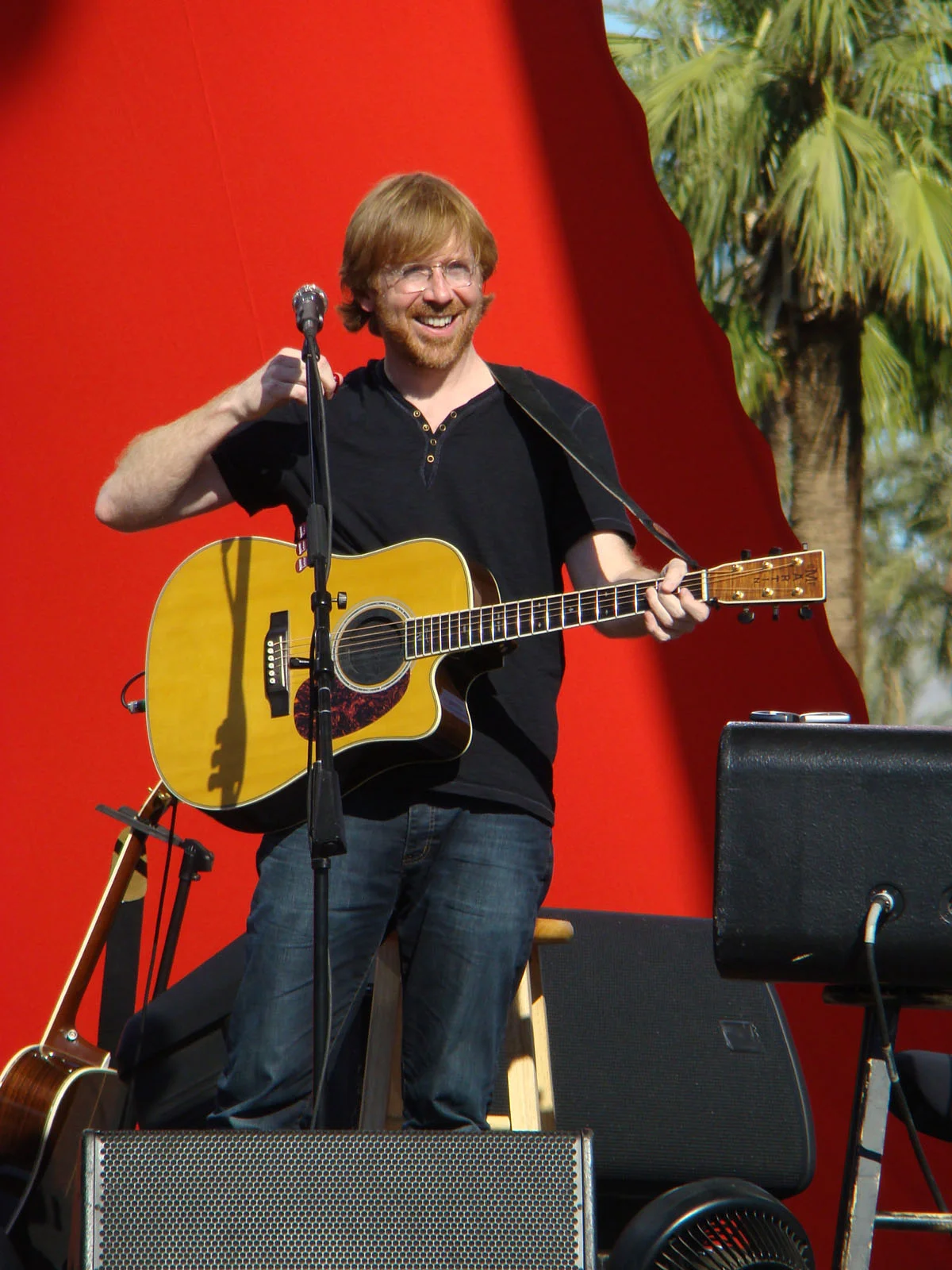
Trey Anastasio — £500 · Sweet Spot Tone
As the frontman of Phish, Trey Anastasio built one of the most recognisable improvisational guitar voices in modern American music — warm, vocal and endlessly articulate across marathon jams. His tone is defined by hollow-body Languedoc guitars, a compressed-but-singing overdrive, and a remarkable touch sensitivity that lets him whisper or wail without ever sounding harsh. Replicating that fluid and dynamically adventurous sound at the £500 · Sweet Spot mark means Epiphone SG Special into Fender Blues Junior IV. This build totals ~£598 and captures the core character — the sweet spot — enough to get genuinely close to the sound without breaking the bank.
Build Trey Anastasio's £500 · Sweet Spot Rig
2 pieces · Total ~$759
What guitar does Anastasio use?
Anastasio is primarily associated with strat style guitars. At a £500 budget, Epiphone SG Special delivers the essential tonal character.
What to Buy
£500 · Sweet Spot — Complete Gear List
Can't find one? See alternatives:
Why This Rig Works
How Trey Anastasio's gear choices create the signature tone
Epiphone SG Special
The SG body is lighter and more upper-fret accessible than a Les Paul, with a snappier attack. The humbuckers deliver the essential dark, punchy character needed for AC/DC and Black Sabbath tones.
Fender Blues Junior IV
This is where the magic happens for Mayer and SRV tones. The EL84 power section breaks up beautifully when pushed, and the bright, clean headroom is exactly what Tube Screamer boost tones are built on.
The Combined Tone
Anastasio runs a hollow-body guitar (bridge pickup, often a Bill Lawrence-style humbucker) into a Ross compressor and a Tube Screamer stacked into clean Fender-voiced amps, letting amp headroom and pedal grind do the talking rather than high-gain distortion. The amp is set fairly clean with mids pushed, treble moderate, and a touch of natural breakup. A short slap-back to medium analog delay and subtle reverb glue the lead lines together.
Tone Tips
Getting the Sound Right
- The Fender Blues Junior IV stays cleaner longer than a Marshall-style amp — push it with a low-gain overdrive (gain at 2–3, level up) rather than cranking its own gain. Set treble at 6, bass at 4, and let the guitar's volume knob handle the dynamics.
- Stack a Ross-style compressor BEFORE a Tube Screamer — comp first smooths attack, then the TS9 adds the singing midrange. Set compressor sustain around 2 o'clock, level to unity.
- Set the Tube Screamer with Drive at 9–10 o'clock, Tone at noon, Level high — you want a mid hump and light grit, not a wall of distortion.
- Run a clean Fender amp: Treble 6, Bass 4, Middle pushed to 7–8, volume high enough for slight natural breakup. Trey lives in the mids.
- Favour the bridge humbucker for solos but roll the guitar volume back to 7 for cleaner rhythm comping — touch dynamics are everything.
- Use a hollow or semi-hollow body for that woody, vocal sustain — solid-body strats sound too tight for his airy jam tone.
- Set the Klon Centaur with gain at minimum and output level slightly above unity — it acts as a signal booster with subtle treble enhancement rather than a distortion pedal. The single-coil character is preserved
- The Deluxe Reverb's transparency means every quality difference in the guitar signal is fully audible — string quality, nut slots, tuning machine resonance, and fret-levelling quality all affect the tone through this amp in ways that a higher-gain amp would mask
Avoid These Pitfalls
Common Mistakes When Chasing This Tone
- Setting the TS9 gain above 5 into a clean amp — at high gain settings the TS becomes a distortion pedal that colours the tone heavily. Below 4, it's a boost and focus pedal. Single coils into a TS above 5 gets nasal and harsh
- Leaving the wah pedal engaged but stationary between rocking it — a cocked wah (fixed position, not moving) acts as a midrange filter that changes the core tone. Either rock it expressively or bypass it completely; a cocked wah changes the sound in ways that are often unintended
- Leaving the guitar volume at 10 — single coil brightness at full volume can be harsh. Rolling back to 8-9 tames the top end without killing output.
- Running multiple pedals into the input — boutique amps are designed for the natural guitar signal. Too many pedals before the input changes the input impedance and alters the amp's response.
- Setting the boost level too high relative to the base tone — a boost for solos should raise the presence of the guitar, not cause a volume jump that overwhelms the mix. Level matching matters.
Budget Alternatives
Same Tone, Different Budget
FAQ
Trey Anastasio Tone — Common Questions
Anastasio is primarily associated with strat style guitars. At a £500 budget, Epiphone SG Special delivers the essential tonal character.
Anastasio's amp is boutique clean voiced — clean with headroom, pushed by an overdrive pedal. At the £500 level, Fender Blues Junior IV is the closest match.
Yes — £500 covers a real guitar and amp in the right tonal family. This rig totals £598 and captures the essential character. The guitar and amp account for 80% of the tone; pedals are secondary at this budget.
Anastasio's tone is defined by improvisational, jazz-rock, clean-with-dynamics. The combination of strat guitar and boutique clean amp creates a sound that is immediately recognisable.
Anastasio's gain approach is clean-boosted — a clean amp pushed by an overdrive pedal. The pedal adds colour; the amp adds body. At £500, this is replicated through Fender Blues Junior IV.
Trey Anastasio — £500 · Sweet Spot Complete Rig
~£598Guitar
Epiphone SG Special
Amp
Fender Blues Junior IV
Tone Match
Closest Real-World Tone Match
If you like Trey Anastasio's tone, these players use a similar approach — same gear philosophy, comparable sound characteristics.
Related Tones