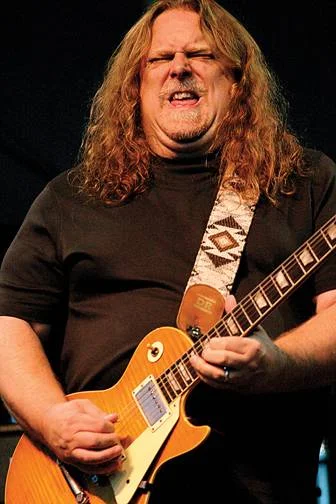
Warren Haynes — £2,500 · Premium Tone
Warren Haynes channels the Allman Brothers tradition through a more aggressive, modern blues-rock lens. His Les Paul through a Marshall and Mesa Boogie delivers a thick, sustained lead tone with wide vibrato and the feeling of barely controlled power behind every phrase. Replicating that raw and emotionally charged sound at the £2,500 · Premium mark means Gibson Les Paul Junior into Marshall DSL100H. The effects — Boss SD-1 Super OverDrive, Walrus Audio Fundamental Delay — add the finishing texture. This build totals ~£2442 and captures the core character — a premium build targeting the most accurate recreation possible.
Build Warren Haynes's £2,500 · Premium Rig
4 pieces · Total ~$3,101
What guitar does Warren Haynes use?
Warren Haynes is primarily associated with lp style guitars. At a £2,500 budget, Gibson Les Paul Junior delivers the essential tonal character.
What to Buy
£2,500 · Premium — Complete Gear List
Can't find one? See alternatives:
Why This Rig Works
How Warren Haynes's gear choices create the signature tone
Gibson Les Paul Junior
The Gibson Les Paul Junior delivers warm humbucker thickness and singing sustain — the classic foundation for rock and blues tones.
- OverdriveBoss SD-1 Super OverDrive
- DelayWalrus Audio Fundamental Delay
Marshall DSL100H
The Marshall DSL100H converts the guitar signal into audible sound and adds its own tonal character — EQ shaping, natural gain, and the overall feel of the final tone.
The Combined Tone
Gibson Les Paul Standard into a Marshall and Mesa Boogie run together (wet/dry). High but not extreme gain — the tone is warm and thick with strong natural harmonics. Haynes' wide, slow vibrato and dynamic picking attack (from soft to very hard) create enormous expressive range.
Tone Tips
Getting the Sound Right
- The Marshall DSL100H delivers power-tube saturation at master volume 6–7 — this compression and sag is what separates amp-driven tone from pedal tone. Set the master first, then dial back the channel gain to taste rather than the other way around.
- Wide vibrato starting slow and widening — inspired by BB King but applied to Les Paul tone
- Attack hard, then soften: dig in on the first note of a phrase, relax through it
- The tube screamer (TS808 or equivalent) set to low gain and high volume into the amp input creates the singing, harmonic-rich lead tone — the pedal's purpose is to push the amp input harder, not to add its own distortion character. The amp itself creates all the saturation
- Slide guitar in open E tuning plays a prominent role alongside standard fretting — Haynes switches between straight guitar and open-E slide within the same performance. Both require separate technique development, and the physical transition between them requires practiced preparation
- Study 'Banks of the Deep End' and 'Liz Reed' for the full Allman-Haynes synthesis — the former demonstrates the modern continuation of the Allman Brothers vocabulary and the latter shows exactly how Haynes absorbed Duane Allman's open-E slide approach into his own style
- With Les Paul humbuckers, TS9 into JCM800: the correct order of tweaking is (1) amp gain at 7-8, (2) then add TS with gain at 0 to tighten, (3) then adjust TS level to taste. Don't add TS gain — it's not needed and muddies the tone
- Delay in the effects loop of the JCM800 (after the preamp) produces cleaner repeats — the delay sees the amplified, saturated signal and repeats it as-is. Delay in front of the amp means each repeat gets re-amplified differently, which can sound thick but messy
Avoid These Pitfalls
Common Mistakes When Chasing This Tone
- Running the JCM800's gain channel at maximum — above 8 on most high-gain channels, palm mutes lose note separation and become an indistinct wall. The target is the minimum gain for the target saturation, not maximum
- Leaving the wah pedal engaged but stationary between rocking it — a cocked wah (fixed position, not moving) acts as a midrange filter that changes the core tone. Either rock it expressively or bypass it completely; a cocked wah changes the sound in ways that are often unintended
- Setting gain too high on the overdrive pedal — most overdrive pedals are most useful at gain settings of 2-5, where they add character without dominating the tone. High gain settings on an OD pedal become a distortion, not an overdrive.
- Too many repeats at high mix — more than 3 repeats makes the delay effect accumulate and overwhelm the dry guitar signal. Keep it to 2-3 repeats at a subtle mix level.
- Choosing a pick that is too heavy — thin to medium picks give edge noise and articulation that heavier picks smooth away. That edge is part of the sound.
Budget Alternatives
Same Tone, Different Budget
FAQ
Warren Haynes Tone — Common Questions
Warren Haynes is primarily associated with lp style guitars. At a £2,500 budget, Gibson Les Paul Junior delivers the essential tonal character.
Warren Haynes's amp is british crunch voiced — clean with headroom, pushed by an overdrive pedal. At the £2,500 level, Marshall DSL100H is the closest match.
The £2,500 tier uses Warren Haynes's actual gear choices or direct equivalents. Total: £2,442. The tonal step up from £1,000 is real but diminishing — worth it for regular performers and studio work.
Warren Haynes's essential pedals include Overdrive, Delay. At the £2,500 tier: Boss SD-1 Super OverDrive, Walrus Audio Fundamental Delay. Overdrive is the most important pedal — the others add nuance.
Warren Haynes's tone is defined by southern-rock, blues-rock, slide. The combination of lp guitar and british crunch amp creates a sound that is immediately recognisable.
Warren Haynes's gain approach is clean-boosted — a clean amp pushed by an overdrive pedal. The pedal adds colour; the amp adds body. At £2,500, this is replicated through Marshall DSL100H paired with Boss SD-1 Super OverDrive.
Warren Haynes — £2,500 · Premium Complete Rig
~£2442Guitar
Gibson Les Paul Junior
Overdrive
Boss SD-1 Super OverDrive
Amp
Marshall DSL100H
Delay
Walrus Audio Fundamental Delay
Tone Match
Closest Real-World Tone Match
If you like Warren Haynes's tone, these players use a similar approach — same gear philosophy, comparable sound characteristics.
Related Tones