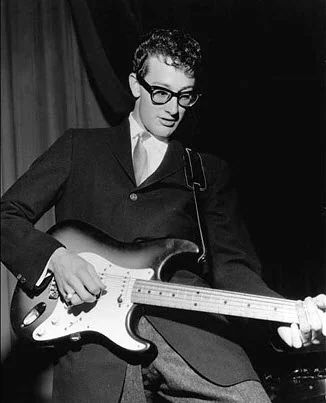
Buddy Holly
Charles Hardin Holley — Buddy Holly — was one of the most creatively fertile rock and roll songwriter-guitarists of the 1950s, recording a extraordinary body of work in just two years (1957–1958) before his death in a plane crash at 22. His influence is disproportionate to his output: The Beatles modelled themselves on the Crickets (their name is a direct homage), Bob Dylan cited him as foundational, and the Fender Stratocaster became synonymous with early rock and roll primarily through Holly's association. He was among the first rock artists to write his own material, use studio overdubbing, and perform as a self-contained rhythm-lead unit within a trio format.
Bright, twangy Stratocaster rhythm and lead through a modest Fender combo amp — Holly plays both rhythm and occasional lead, with the Strat's bridge pickup providing the characteristic trebly jangle. The playing is rhythmically precise and melodically simple in the best sense: direct, hooky, immediately memorable. No effects — purely guitar and amplifier.
Signal Chain Order
Why Buddy Holly's Rig Works
Holly's Stratocaster, released by Fender only a year before he started using it, was still a genuinely new instrument in 1955 — most guitarists of the era were still playing archtop hollow bodies or Telecasters, and the Strat's brighter, more percussive single-coil bridge pickup produced a trebly jangle that hadn't yet become a familiar rock and roll sound. That novelty, combined with his prominent visual use of the guitar, is a large part of why the Stratocaster became so closely identified with early rock and roll's sonic identity.
Running the Tweed Deluxe close to its natural overdrive point, rather than fully clean, is what gives Holly's rhythm playing its slightly gritty, focused edge — a completely clean amp would leave his straightforward, hooky chord patterns sounding thin, while the amp's mild natural breakup adds just enough warmth and harmonic content to make simple three-chord rhythm parts sound full and purposeful.
As one of the first rock artists to function as a self-contained rhythm-lead unit within a trio (rather than having a dedicated lead guitarist separate from rhythm), Holly's approach required a single guitar tone versatile enough to carry both roles — the Strat's pickup selector switching between bridge for cutting rhythm and neck for warmer, more melodic passages let one guitarist cover functions that many contemporary bands split across two players.
Guitars
Fender Stratocaster
1955–1959Holly's defining instrument — one of the earliest major rock and roll associations between an artist and the Stratocaster. His 1955 and later 1958 Stratocasters are the guitars on virtually every Holly recording. The Strat's three single-coil pickups provide the bright, clear tone of his rhythm playing and the direct, singing quality of his occasional leads.
Gibson J-45 (acoustic)
1956–1959Acoustic guitar for recording, TV appearances, and acoustic-format performances — Holly played acoustic guitar with the same direct, rhythmically committed style as electric.
Amplifiers
Fender Deluxe Tweed
1955–1959Holly's primary amplifier — the Tweed Deluxe's warm, natural breakup at moderate volume produces the slightly gritty, direct quality of his recordings. The amp runs close to its natural overdrive point, creating the focused, warm tone of the Crickets recordings.
Fender Bassman
1957–1959Used for larger venue amplification — the Bassman's 4x10 configuration projects more output than the Deluxe for touring contexts.
Effects Pedals
Key Albums & Tone
"That'll Be the Day", "Oh, Boy!", "Maybe Baby" — the debut Crickets album. Stratocaster through Fender Tweed combo: bright, direct, and rhythmically committed. The recordings are simple in the best sense — no studio artifice, just a great band playing great songs through modest equipment.
"Peggy Sue", "Listen to Me", "Words of Love" — the solo-name album. The "Peggy Sue" drum pattern and Strat rhythm work established Holly's signature rhythmic guitar approach. The Stratocaster bridge pickup is throughout: bright, jangling, percussive.
Frequently Asked Questions
What guitar does Buddy Holly use?
Fender Stratocaster and Gibson J-45 (acoustic). Holly's defining instrument — one of the earliest major rock and roll associations between an artist and the Stratocaster. His 1955 and later 1958 Stratocasters are the guitars on virtually every Holly recording. The Strat's three single-coil pickups provide the bright, clear tone of his rhythm playing and the direct, singing quality of his occasional leads.
What amp does Buddy Holly use?
Fender Deluxe Tweed and Fender Bassman. Holly's primary amplifier — the Tweed Deluxe's warm, natural breakup at moderate volume produces the slightly gritty, direct quality of his recordings. The amp runs close to its natural overdrive point, creating the focused, warm tone of the Crickets recordings.
What pedals does Buddy Holly use?
Buddy Holly does not use effects pedals.
What is Buddy Holly's signature sound?
Bright, twangy Stratocaster rhythm and lead through a modest Fender combo amp — Holly plays both rhythm and occasional lead, with the Strat's bridge pickup providing the characteristic trebly jangle. The playing is rhythmically precise and melodically simple in the best sense: direct, hooky, immediately memorable. No effects — purely guitar and amplifier.
About This Data
Gear information for Buddy Holly is compiled from live performance footage, rig-rundown interviews, manufacturer and signature-model documentation, and cross-referenced guitar press coverage — not a single source. Where accounts conflict (a common issue with decades-old gear history), we favour the version corroborated by the most independent sources and note genuine ambiguity in the text rather than presenting a guess as settled fact.
This page is maintained by Alex Hall, last reviewed July 2026. Spotted something out of date or inaccurate? Let us know — corrections are usually made within a few days.