Song Rig
Not Fade Away
Buddy Holly · The Crickets: "The Chirping" Crickets · 1957
Tone Overview
What Makes This Sound Unique
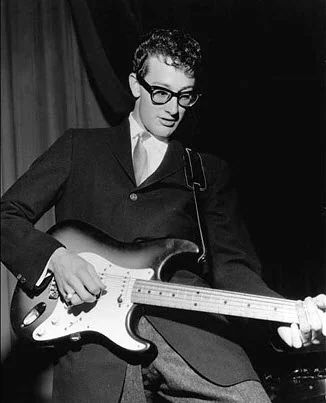
The Bo Diddley beat applied to Buddy Holly — a percussive guitar tone where the rhythm pattern is the entire content of the song. The Stratocaster's bridge pickup provides a sharp, nasal attack well-suited to the syncopated rhythm. The 1957 Coral Studios recording captures the guitar in a live room with natural reverb.
Signal Chain
- 1Fender Stratocaster (bridge pickup)
- 2Small Fender amp (Tremolux or Deluxe)
- 3Natural studio reverb
Amp Settings
Clean and slightly trebly — the percussive rhythm requires note definition more than warmth. The Strat bridge pickup provides the bright, nasal attack that makes each chord hit distinct in the rhythm pattern.
Technique
How to Play It
Bo Diddley beat — the distinctive rhythmic pattern of Not Fade Away (long-long-short, long-short) is a Cuban hambone rhythm popularised by Bo Diddley. Holly plays this with all downstrokes and a heavy right-hand strum.
Budget Alternative
Achievable With
Stratocaster bridge pickup → any clean combo amp → practice the Bo Diddley clave rhythm: DON-don-don, DON-don (emphasised and unstressed pattern). This basic rhythm underlies hundreds of rock and roll songs.
Your Gear
Adapt to My Amp
More from Buddy Holly
Other Song Rigs
That'll Be the Day
The "Chirping" Crickets · 1957
One of the foundational rock 'n' roll guitar tones — Buddy Holly's Fender Strato…
View rig →Peggy Sue
Buddy Holly · 1957
Distinctive for its steady, unwavering triplet arpeggio pattern on the guitar — …
View rig →Oh Boy!
The "Chirping" Crickets · 1957
Bouncing, energetic early rock 'n' roll — the guitar tone is quintessentially Bu…
View rig →Everyday
Chirping Crickets · 1957
A song with no guitar — Everyday is notable for what Buddy didn't play. The rhyt…
View rig →Rave On
Rave On · 1958
Buddy Holly's most energetic recording — a driving rock and roll track with a sh…
View rig →