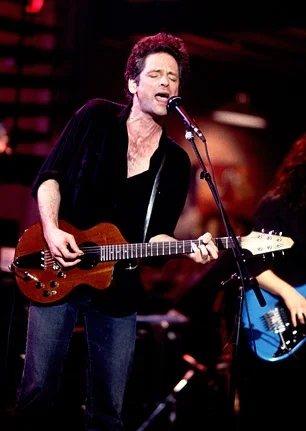
Lindsey Buckingham
Lindsey Buckingham joined Fleetwood Mac in 1974 alongside Stevie Nicks and transformed the band from a British blues outfit into one of the most commercially successful rock acts of the 1970s and 1980s. As lead guitarist, vocalist, and primary producer, his influence on the band's sound is total. His guitar technique is highly unusual: he primarily uses a bare finger rather than a pick, producing a warmer, more controlled attack ideal for his fingerpicked acoustic style and the percussive bass-and-melody single-note patterns that define Fleetwood Mac's guitar approach. His studio production is equally distinctive — complex layering, unconventional recording approaches, and pop-craft that elevates songwriting above instrumental showmanship.
Clean, precisely articulated finger-picked guitar — the absence of a pick produces a softer attack and more controlled tone than plectrum playing. The Travis-picking fingerstyle patterns on 'Never Going Back Again' and 'Big Love' are technically demanding but serve the song melody rather than displaying technique. Electric tone is clean-to-slightly overdriven, favoring the warmth of the Strat's neck pickup over aggressive gain.
Signal Chain Order
Why Lindsey Buckingham's Rig Works
Playing bare-fingered rather than with a pick fundamentally changes what Buckingham's Travis-picking patterns can do — fingers let him strike multiple strings independently and simultaneously with different force and timing, which is what makes his interlocking bass-and-melody single-note patterns (playing what sounds like two parts at once) physically possible in a way a single pick striking one string at a time cannot replicate.
Keeping the Twin Reverb clean rather than driven is essential groundwork for that technique to be heard clearly — his dynamics come entirely from finger attack (nail angle, strike force, fingertip versus nail contact), and any amp saturation would compress and flatten those subtle variations, erasing the exact detail his fingerpicking is designed to communicate. This mirrors the same clean-platform philosophy found in Mark Knopfler's rig, another prominent fingerstyle player.
Favoring the neck pickup almost exclusively for electric work compounds the same warmth-preserving logic — the neck position's naturally rounder, less aggressive voicing complements finger attack's already-softer transient, producing a consistently warm character across his acoustic and electric playing rather than the brighter, more percussive tone a bridge pickup combined with pick attack would typically produce.
Guitars
Fender Stratocaster
1975–presentBuckingham uses various Stratocasters for electric work — his preferred configuration uses the neck pickup almost exclusively for the warmer, rounder tone that complements his fingerpicking technique. Bridge pickup for occasional brighter lead passages.
Martin D-28
1973–presentPrimary acoustic guitar — the D-28's spruce top and rosewood back produce the full, projecting acoustic tone on 'Never Going Back Again', 'Landslide', and 'Big Love'. His Travis-picking technique on the D-28 produces the interlocking bass and melody patterns.
Gibson Les Paul
1978–1985Used for specific harder-edged passages — the Les Paul appears on Tusk and Tango in the Night era material where more sustained electric guitar is required.
Amplifiers
Fender Twin Reverb
1974–presentBuckingham's consistent amplifier choice — the Twin's clean headroom suits his fingerpicking style, where dynamics are controlled by touch rather than amp saturation. The spring reverb adds subtle dimension to the clean tone.
Amp guide →Fender Deluxe Reverb
1983–1990Smaller Deluxe Reverb for studio work requiring a slightly warmer, less pristine clean tone — the Deluxe breaks up more readily under hard picking than the Twin.
Amp guide →Effects Pedals
Ibanez TS-808 Tube Screamer
1980–presentTube Screamer for mild overdrive — Buckingham uses it at low gain settings for a warm, slightly compressed overdrive texture on electric lead passages. Not used for heavy distortion.
Boss CE-2 Chorus
1982–1990CE-2 for the shimmering chorus texture on several Tango in the Night recordings — adds three-dimensional quality to clean arpeggios and sustained chords.
Boss DD-3 Delay
1983–presentDelay for studio layering and live lead passages — used to create the ambient, spatial quality on sustained notes in the Fleetwood Mac context.
Key Albums & Tone
"Go Your Own Way", "The Chain", "Never Going Back Again" — the best-selling Fleetwood Mac album. "Never Going Back Again" is the definitive demonstration of Buckingham's fingerpicking technique: D-28 acoustic, Travis-picking pattern, warm close-mic recording. "Go Your Own Way" features the driving, aggressive electric guitar that contrasts with his usual clean approach.
"Big Love", "Little Lies", "Seven Wonders" — the 1980s production peak. Buckingham's solo electric on "Big Love" is entirely his fingerpicking pattern on electric guitar without bass or rhythm — technically demanding and immediately recognizable.
Experimental double album — the most diverse and unconventional Fleetwood Mac record. Buckingham's guitar work ranges from sparse acoustic to layered studio texture.
Frequently Asked Questions
What guitar does Lindsey Buckingham use?
Fender Stratocaster and Martin D-28. Buckingham uses various Stratocasters for electric work — his preferred configuration uses the neck pickup almost exclusively for the warmer, rounder tone that complements his fingerpicking technique. Bridge pickup for occasional brighter lead passages.
What amp does Lindsey Buckingham use?
Fender Twin Reverb and Fender Deluxe Reverb. Buckingham's consistent amplifier choice — the Twin's clean headroom suits his fingerpicking style, where dynamics are controlled by touch rather than amp saturation. The spring reverb adds subtle dimension to the clean tone.
What pedals does Lindsey Buckingham use?
Lindsey Buckingham uses Ibanez TS-808 Tube Screamer, Boss CE-2 Chorus, Boss DD-3 Delay.
What is Lindsey Buckingham's signature sound?
Clean, precisely articulated finger-picked guitar — the absence of a pick produces a softer attack and more controlled tone than plectrum playing. The Travis-picking fingerstyle patterns on 'Never Going Back Again' and 'Big Love' are technically demanding but serve the song melody rather than displaying technique. Electric tone is clean-to-slightly overdriven, favoring the warmth of the Strat's neck pickup over aggressive gain.
About This Data
Gear information for Lindsey Buckingham is compiled from live performance footage, rig-rundown interviews, manufacturer and signature-model documentation, and cross-referenced guitar press coverage — not a single source. Where accounts conflict (a common issue with decades-old gear history), we favour the version corroborated by the most independent sources and note genuine ambiguity in the text rather than presenting a guess as settled fact.
This page is maintained by Alex Hall, last reviewed July 2026. Spotted something out of date or inaccurate? Let us know — corrections are usually made within a few days.