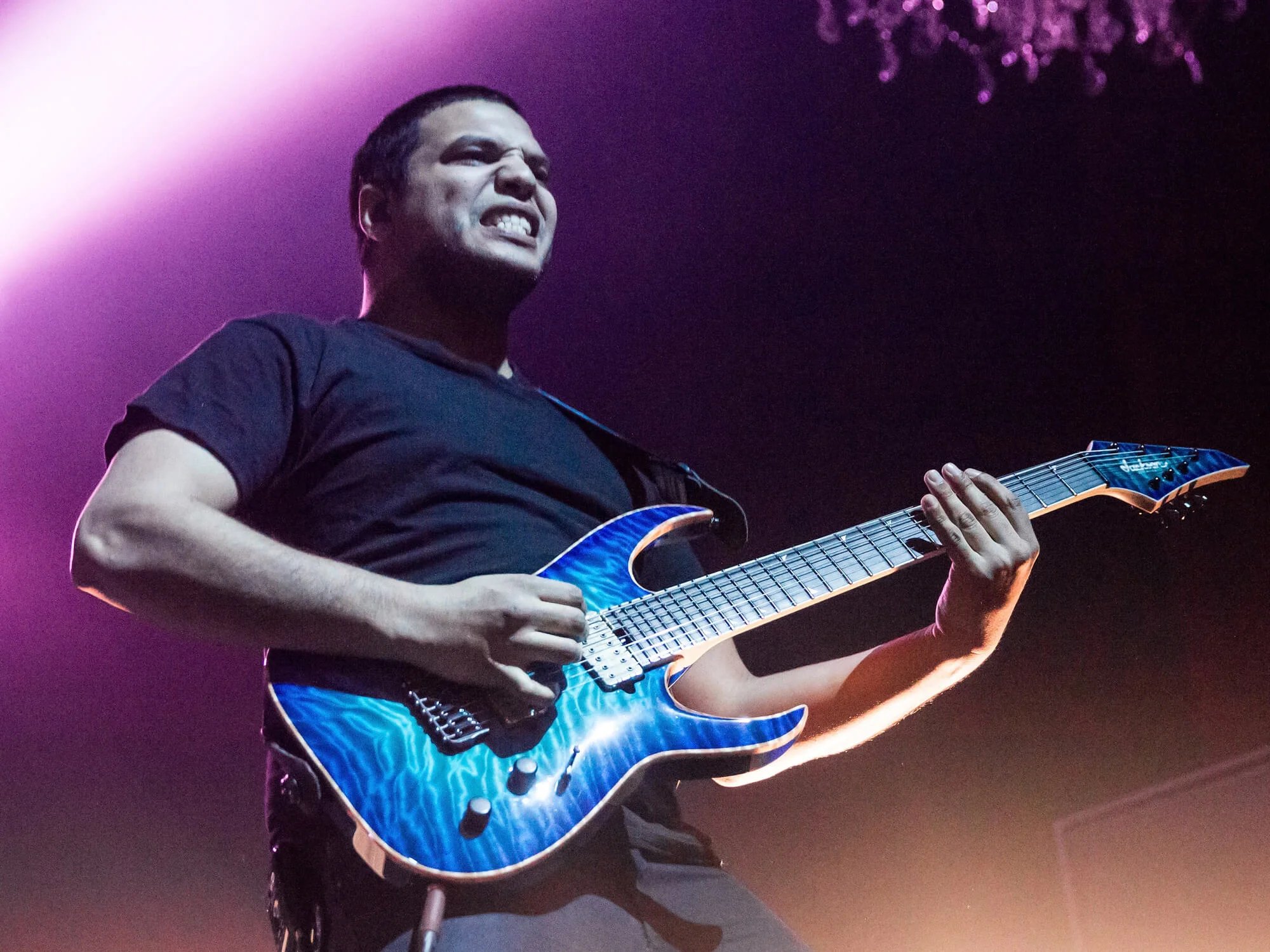
Misha Mansoor
Misha Mansoor is the founder and primary guitarist of Periphery, the band most responsible for defining the djent subgenre of progressive metal in the late 2000s. Djent — named after the onomatopoeia for the percussive, palm-muted attack on a downtuned guitar — was developed independently by Meshuggah in Sweden but Mansoor took it into a more melodic, technically progressive direction accessible to the mainstream metal audience. He recorded Periphery's first album entirely at home using Axe-Fx digital processing, pioneering the high-quality home recording approach that became standard in modern metal. His Bulb productions and Guitar Center clinic work have made him one of the most influential guitarists in contemporary metal production.
Heavy, articulate djent rhythm guitar with a tight, compressed low end that retains definition even in drop tunings — the Fractal Axe-Fx or real-amp-into-cab combination produces the characteristic modern metal tone: scooped mids, very tight bass response, and bright attack that makes palm mutes sound percussive rather than muddy. Extended range guitars (7 and 8-string) provide the low register without sacrificing the upper string clarity.
Signal Chain Order
Why Misha Mansoor's Rig Works
The digital precision of the Axe-Fx is described as suiting djent's need for perfectly consistent palm mutes, and that's a genuinely different requirement than a traditional tube amp is optimized for — djent's signature percussive attack depends on every palm-muted note landing with identical tightness and definition across an entire song, and a modeled digital signal chain reproduces that exact same response take after take in a way a real tube amp's natural, session-to-session variability doesn't guarantee as reliably.
Extended-range guitars (7 and 8-string) solve a specific tonal problem rather than simply adding more notes — reaching djent's characteristic sub-bass palm-mute textures on a standard 6-string would require downtuning so far that the strings lose tension and definition; adding extra low strings lets the lowest notes stay properly tensioned and tight while the upper strings remain in a normal, articulate register for melodic and lead work.
Mansoor recording Periphery's debut entirely at home using Axe-Fx processing wasn't just a budget workaround — it demonstrated that studio-quality modern metal tone no longer required an expensive studio's real amps and mic'd cabinets, which is precisely why his production approach became a template genre-wide; the digital modeling's exact reproducibility is what made professional-sounding results achievable outside a traditional studio in the first place.
Guitars
Ibanez RG2228 (8-string)
2009–presentExtended range guitar for maximum register — the 8-string provides a low F# that gives djent rhythm parts their characteristic sub-bass texture.
PRS Misha Mansoor Signature
2014–presentCustom PRS 7-string built to Mansoor's specification — his preferred instrument for recording and touring following the Guitar of the Year design collaboration.
Ibanez RG7321 (7-string)
2006–2014The guitar used for the early Periphery recordings (the Bulb home demos) — a budget 7-string that became significant as the instrument on influential home recordings.
Amplifiers
Fractal Audio Axe-Fx II
2012–presentThe Axe-Fx is central to the modern Periphery sound — Mansoor uses it for both recording and live performance, running custom amp models (often Friedman or Diezel-based) for the djent rhythm tone. The digital precision of the Axe-Fx suits the perfectly consistent palm mutes required by djent.
Diezel VH4
2016–presentReal amp used for specific recordings when the Axe-Fx simulation needs the character of a real power amp and speaker. The VH4's articulate, tight high-gain suits extended-range playing.
Effects Pedals
Key Albums & Tone
Luck as a Constant, Make Total Destroy — the definitive djent album in the Periphery catalog. Axe-Fx driven 7 and 8-string guitars: percussive palm mutes, complex polyrhythmic riffs, and soaring melodic leads over the djent rhythmic foundation.
Musically most diverse Periphery album — djent heaviness alongside jazz-influenced clean sections and progressive rock complexity. The Axe-Fx tone is refined and precise throughout.
Frequently Asked Questions
What guitar does Misha Mansoor use?
Ibanez RG2228 (8-string) and PRS Misha Mansoor Signature. Extended range guitar for maximum register — the 8-string provides a low F# that gives djent rhythm parts their characteristic sub-bass texture.
What amp does Misha Mansoor use?
Fractal Audio Axe-Fx II and Diezel VH4. The Axe-Fx is central to the modern Periphery sound — Mansoor uses it for both recording and live performance, running custom amp models (often Friedman or Diezel-based) for the djent rhythm tone. The digital precision of the Axe-Fx suits the perfectly consistent palm mutes required by djent.
What pedals does Misha Mansoor use?
Misha Mansoor does not use effects pedals.
What is Misha Mansoor's signature sound?
Heavy, articulate djent rhythm guitar with a tight, compressed low end that retains definition even in drop tunings — the Fractal Axe-Fx or real-amp-into-cab combination produces the characteristic modern metal tone: scooped mids, very tight bass response, and bright attack that makes palm mutes sound percussive rather than muddy. Extended range guitars (7 and 8-string) provide the low register without sacrificing the upper string clarity.
About This Data
Gear information for Misha Mansoor is compiled from live performance footage, rig-rundown interviews, manufacturer and signature-model documentation, and cross-referenced guitar press coverage — not a single source. Where accounts conflict (a common issue with decades-old gear history), we favour the version corroborated by the most independent sources and note genuine ambiguity in the text rather than presenting a guess as settled fact.
This page is maintained by Alex Hall, last reviewed July 2026. Spotted something out of date or inaccurate? Let us know — corrections are usually made within a few days.