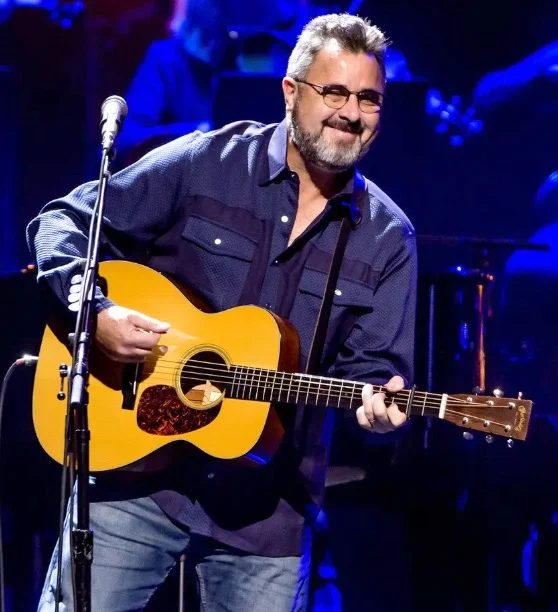
Vince Gill
Vince Gill is the most decorated solo artist in Country Music Association history and one of the most versatile guitarists in any genre. His guitar playing spans bluegrass flatpicking, country chicken-picking, jazz-influenced lead, and rock-adjacent electric work, all executed with the same relaxed, expressive ease. As a vocalist, songwriter, and instrumentalist, he has been a dominant presence in Nashville since 1983. His tone is immediately warm and approachable — friendly rather than aggressive — matching his reputation as the most respected and liked musician in Nashville's studio and touring community.
Warm, singing lead guitar tone in multiple styles — country lead through a Telecaster or Gibson archtop with hybrid picking; bluegrass flatpicking on a Martin dreadnought; occasional rock lead through his PRS Custom. The defining quality is warmth and tasteful restraint: Gill plays what the song requires, not what demonstrates his technique. The tone is always clean, warm, and song-serving.
Signal Chain Order
Why Vince Gill's Rig Works
Maintaining three genuinely different instruments — a Telecaster for country and rock electric, an ES-175 archtop for jazz-influenced lead, a Martin dreadnought for bluegrass flatpicking — rather than trying to coax all these styles from one guitar reflects Gill's belief that each vocabulary is tied to its instrument's specific physical character, similar to Guthrie Govan's genre-spanning approach but organized around separate dedicated instruments rather than one do-everything guitar.
Keeping every setup clean and warm rather than reaching for gain or aggressive EQ across any of his styles is a deliberate expression of his reputation for tasteful restraint — Gill's playing philosophy prioritizes serving the song over displaying technique, and a consistently clean, unprocessed tone across genres keeps the focus on note choice and phrasing rather than tonal spectacle, regardless of which instrument or style he's working within.
Switching between hybrid picking for fast country passages and flat picking for bluegrass reflects each tradition's own established technical vocabulary — bluegrass flatpicking has its own idiomatic vocabulary built around a single flat pick's specific attack, while hybrid picking's independent finger control suits country's syncopated, chicken-pickin' phrasing, and Gill's fluency in switching between them cleanly is part of what makes him respected across genre boundaries within Nashville's studio community.
Guitars
Fender Telecaster
1975–presentPrimary country and rock electric — the Tele's bridge single-coil provides the twangy, cutting attack for country lead work. Gill uses both bridge and neck positions depending on the song's sonic needs.
Gibson ES-175
1985–presentArchtop for jazz-adjacent and smooth country lead work — the warm humbucker tone of the ES-175 suits the more jazz-influenced harmonic language of Gill's sophisticated country arrangements.
Martin D-28
1975–presentPrimary acoustic guitar for bluegrass flatpicking and acoustic country — the D-28's full, projecting dreadnought tone for ensemble acoustic playing.
Amplifiers
Fender Twin Reverb
1978–presentGill's consistent choice — the Twin's clean headroom and spring reverb provide the platform for his diverse guitar styles. The reverb is at low settings for subtle dimension.
Amp guide →Effects Pedals
Boss CE-2 Chorus
1985–presentLight chorus for adding shimmer to clean electric passages — used at subtle settings so it enhances rather than dominates the guitar tone.
Key Albums & Tone
"When I Call Your Name", "Pocket Full of Gold" — the breakthrough album. Gill's guitar serves the song throughout: Telecaster twang on country numbers, warm archtop leads on ballads. His Nashville-standard session precision is audible in every part.
Six Grammy wins era — the Telecaster/Twin combination and warm archtop at their most song-focused. The guitar work is wholly in service of the melody and production.
Frequently Asked Questions
What guitar does Vince Gill use?
Fender Telecaster and Gibson ES-175. Primary country and rock electric — the Tele's bridge single-coil provides the twangy, cutting attack for country lead work. Gill uses both bridge and neck positions depending on the song's sonic needs.
What amp does Vince Gill use?
Fender Twin Reverb. Gill's consistent choice — the Twin's clean headroom and spring reverb provide the platform for his diverse guitar styles. The reverb is at low settings for subtle dimension.
What pedals does Vince Gill use?
Vince Gill uses Boss CE-2 Chorus.
What is Vince Gill's signature sound?
Warm, singing lead guitar tone in multiple styles — country lead through a Telecaster or Gibson archtop with hybrid picking; bluegrass flatpicking on a Martin dreadnought; occasional rock lead through his PRS Custom. The defining quality is warmth and tasteful restraint: Gill plays what the song requires, not what demonstrates his technique. The tone is always clean, warm, and song-serving.
About This Data
Gear information for Vince Gill is compiled from live performance footage, rig-rundown interviews, manufacturer and signature-model documentation, and cross-referenced guitar press coverage — not a single source. Where accounts conflict (a common issue with decades-old gear history), we favour the version corroborated by the most independent sources and note genuine ambiguity in the text rather than presenting a guess as settled fact.
This page is maintained by Alex Hall, last reviewed July 2026. Spotted something out of date or inaccurate? Let us know — corrections are usually made within a few days.