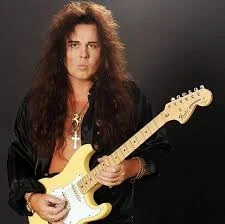
Yngwie Malmsteen
Yngwie Johan Malmsteen arrived in the United States in 1982 and immediately revolutionised lead guitar technique in heavy metal. His synthesis of Baroque and Classical harmony — particularly Bach, Vivaldi, and Paganini — with the gain and sustain of 1970s Marshall-driven metal created the neoclassical metal genre. His technique is precise, fast, and built on a foundation of alternate picking, sweep arpeggios, and modal improvisation in the harmonic minor scale. The scalloped fretboard is central to his approach: it allows extreme vibrato pressure without pitch flattening.
Operatic, violin-like lead tone with extreme vibrato depth and speed — the scalloped neck allows vibrato that sounds more like a bowed string than a plucked one. Bright, mid-forward Marshall gain with high-output DiMarzio pickups provides sustain without flabbiness. Conspicuously no reverb, no chorus: Malmsteen runs essentially dry into a driven Marshall, letting the note speak without spatial embellishment.
Signal Chain Order
Why Yngwie Malmsteen's Rig Works
The scalloped fretboard is the single most consequential modification in this rig, and its function is purely mechanical: with the wood carved away between the frets, a fretting finger only ever touches the string itself, never the fretboard. That removes the friction and resistance a flat fretboard creates during a bend, letting Malmsteen apply far more downward pressure and achieve wider, faster vibrato without the note choking out or going sharp unpredictably — the violin-like vibrato quality that defines his tone is a direct mechanical consequence of this single modification, not simply a skill applied to a standard guitar.
Running essentially no reverb or chorus, dry into a dimed Marshall, is a deliberate rejection of spatial effects that might otherwise blur the extreme precision of his alternate-picked and sweep-picked passages — reverb tails in particular would smear the space between rapid notes, undermining the exact separation his technique depends on being heard clearly.
The DOD 250 set for minimal drive and maximum output functions purely as an impedance-matching signal boost into the Marshall's front end, not as a distortion source in its own right — this is the same boost-not-overdrive principle found throughout blues and rock rigs on this site, but here it's in service of maximizing sustain and harmonic content for extended, singing neoclassical phrases rather than adding grit.
Guitars
Fender Stratocaster (scalloped, DiMarzio YJM)
1982–presentMalmsteen's defining instrument — a vintage-spec Strat with the fretboard scalloped between all 22 frets, DiMarzio YJM humbucker in the bridge, and a brass nut for sustain. The scalloping means fingers don't contact the fretboard wood, only the string — enabling extreme vibrato pressure without fretting-out. He uses primarily the bridge pickup, almost always.
Fender Yngwie Malmsteen Stratocaster
1988–presentFender's official signature model replicating his specs: scalloped maple fretboard, brass nut, DiMarzio YJM pickup, large headstock. Essentially a factory recreation of his modified vintage Strats.
Amplifiers
Marshall JMP 50W
1982–1987The 50W JMP at full volume — Malmsteen runs it dimed. The 50W version's EL34 output stage compresses and saturates differently than the 100W, producing a smoother, more sustaining overdrive ideal for his violin-like lead work.
Marshall JMP-1 Preamp
1990–presentRack-based preamp used in later rigs for reliable stage gain — the JMP-1 replicates the JMP gain character in a more consistent format for touring.
Marshall 50W Plexi Replica
1984–1990Various vintage and replica 50W Plexis — he has used original 1968–1972 Marshall heads and high-quality replicas, consistently preferring the 50W specification.
Effects Pedals
DOD 250 Overdrive/Preamp
1982–2000The only consistently used pedal — the DOD 250 is set for minimal drive with maximum output, functioning as a gain boost and impedance driver rather than a standalone overdrive. It pushes the front end of the Marshall harder. Malmsteen has said 'I don't use effects' — the DOD is the exception.
Furman PQ-4 Parametric EQ
1988–presentParametric EQ in the rack for fine-tuning the Marshall gain character and mid frequency push — adds the characteristic scooped-but-not-scooped nasal mid that distinguishes his live tone from studio recordings.
Key Albums & Tone
"Black Star", "Far Beyond the Sun", "Evil Eye" — the debut that created the neoclassical metal genre. The scalloped Strat through the Marshall JMP produces a violin-like, singing tone. The DOD 250 pushes the amp into near-saturation. Recording is relatively dry — the focus is entirely on the note.
"I'll See the Light Tonight", "Disciples of Hell" — slightly warmer production than Rising Force. The guitar tone has more low-mid weight.
"Heaven Tonight", "Dreaming" — the polished major-label production debut. The guitar tone is more refined and studio-treated than earlier recordings, though the rig is essentially unchanged.
Full orchestral collaboration — the guitar tone is pure and unprocessed, designed to blend with orchestral strings without electronic effects.
Frequently Asked Questions
What guitar does Yngwie Malmsteen use?
Fender Stratocaster (scalloped, DiMarzio YJM) and Fender Yngwie Malmsteen Stratocaster. Malmsteen's defining instrument — a vintage-spec Strat with the fretboard scalloped between all 22 frets, DiMarzio YJM humbucker in the bridge, and a brass nut for sustain. The scalloping means fingers don't contact the fretboard wood, only the string — enabling extreme vibrato pressure without fretting-out. He uses primarily the bridge pickup, almost always.
What amp does Yngwie Malmsteen use?
Marshall JMP 50W and Marshall JMP-1 Preamp. The 50W JMP at full volume — Malmsteen runs it dimed. The 50W version's EL34 output stage compresses and saturates differently than the 100W, producing a smoother, more sustaining overdrive ideal for his violin-like lead work.
What pedals does Yngwie Malmsteen use?
Yngwie Malmsteen uses DOD 250 Overdrive/Preamp, Furman PQ-4 Parametric EQ.
What is Yngwie Malmsteen's signature sound?
Operatic, violin-like lead tone with extreme vibrato depth and speed — the scalloped neck allows vibrato that sounds more like a bowed string than a plucked one. Bright, mid-forward Marshall gain with high-output DiMarzio pickups provides sustain without flabbiness. Conspicuously no reverb, no chorus: Malmsteen runs essentially dry into a driven Marshall, letting the note speak without spatial embellishment.
About This Data
Gear information for Yngwie Malmsteen is compiled from live performance footage, rig-rundown interviews, manufacturer and signature-model documentation, and cross-referenced guitar press coverage — not a single source. Where accounts conflict (a common issue with decades-old gear history), we favour the version corroborated by the most independent sources and note genuine ambiguity in the text rather than presenting a guess as settled fact.
This page is maintained by Alex Hall, last reviewed July 2026. Spotted something out of date or inaccurate? Let us know — corrections are usually made within a few days.