Rig Builder
Budget Rig Breakdown
Signal Chain


Essentials
Complete Your Rig
The accessories every serious guitarist needs — cables, strings, and the rest.
Ernie Ball Regular Slinky Strings (10-46)
Standard for most electric styles — bright, responsive, and widely used by touring professionals.
Planet Waves American Stage Guitar Cable 10ft
Solderless ends and lifetime warranty. The cable most session guitarists trust.
Dunlop Jazz III Pick (Pack of 6)
The most-used pick among serious players — precision tip improves articulation and speed.
Boss TU-3 Chromatic Tuner Pedal
The professional standard for live tuning. True bypass, powers other pedals, ultra-accurate.
Levy's M8 Guitar Strap
Quality leather strap used by touring guitarists. Genuine comfort for 3-hour sets.
Technique
Key Tone Tips
- Tune to C or B standard — QOTSA's heaviness is almost entirely tuning-based. In standard tuning, the same riffs sound thin
- Heavy strings (.12s or .13s) are required for the low tunings to stay in tune and have the right tension and articulation
- The quarter-note feel is paramount — Homme plays very "in the pocket," right on the beat with almost no swing or rush
- Single-note riffs on the low strings with the bass player doubling them is the QOTSA formula — listen to how guitar and bass lock on "No One Knows"
- The tone is thick and mid-heavy, not bright and aggressive — if it sounds like metal, pull the treble back and boost the mids
- Fuzz is used sparingly and specifically — not on every song. When it appears, it's a sudden surge in harmonic density
- Orange amp at moderate gain — the Orange character provides the warmth without excessive distortion
- Drop C power chords with the first finger barring the bottom two strings produce the "wall of riff" QOTSA chord sound
- Jazzmaster pickups have a distinctive single-coil character — warmer and less bright than a Strat, which contributes to the less aggressive quality
- The palm-muted dropped-tuning riff is the core QOTSA structural element — 'No One Knows,' 'Go with the Flow,' and 'Little Sister' all use this as the rhythmic foundation. The heavier the palm muting, the more mechanical and hypnotic the groove becomes
- Homme's vocal phrasing and guitar melody occupy deliberately separate rhythmic layers — the guitar riff and vocal melody often avoid landing on the same beats, creating polyrhythmic tension without complex notation. Analysing the rhythm of each independently reveals the offset relationship
- The cranked-amp character comes from the amp working at the edge of breakup — the guitar's volume knob controls whether the amp pushes over into overdrive. Rolling back the volume cleans up completely; full volume drives the amp into its natural overdrive, which is the QOTSA recording sound
Background
About Josh Homme's Sound
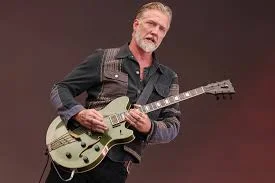
Josh Homme of Queens of the Stone Age creates some of modern rock's most hypnotic, locked-in riffs — baritone-ish tuned-down tones, drone-based single-note riffs, and a commitment to groove that makes QOTSA impossible to stand still to.
Tone History
Josh Homme's Tone Evolution
Homme pioneered the bass-amplifier guitar sound during the Kyuss years — playing guitar through Sunn Concert bass amps created the cavernous, undefined low-end that made desert rock. QOTSA refined this into a more focused Mesa Boogie / Vox dual-amp approach, using the Vox for top-end clarity.
Full timeline: 3 eras →Song Breakdowns
Josh Homme Song Rigs
No One Knows
Songs for the Deaf · 2002
Songs for the Deaf was recorded with Homme's "Desert Session" approach — lo…
Go with the Flow
Songs for the Deaf · 2002
Go with the Flow is the most accessible QOTSA track and a perfect example o…
The Lost Art of Keeping a Secret
Rated R · 2000
Rated R was the album where Homme fully crystallised the desert rock aesthe…