Song Rig
Behind Blue Eyes
Pete Townshend · Who's Next · 1971
Tone Overview
What Makes This Sound Unique
The acoustic/electric contrast within one song — the quiet verse uses a 12-string acoustic guitar for its chiming clarity, while the full electric entry uses a Les Paul and Marshall for maximum power chord impact. The dynamic shift between the two tonal worlds is the song's primary dramatic device.
Signal Chain
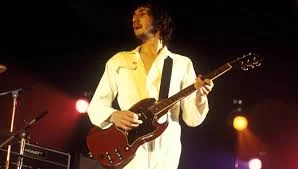
- 1Gibson SG Special (P90 pickups, bridge position for heavy section)
- 2Marshall Super Lead (cranked for electric sections)
- 3Guild or Gibson 12-string acoustic (verses)
Amp Settings
The electric sections are played at full Marshall volume to create maximum contrast with the quiet acoustic verse. Townshend used power chords exclusively in the heavy sections — no single-note leads, just raw chord power.
Technique
How to Play It
Windmill strumming on the heavy chord sections — Townshend's full-arm rotation generates more pick velocity than a wrist-only stroke, producing a harder initial attack and a more aggressive chord tone.
Budget Alternative
Achievable With
SG or Les Paul → Marshall JCM800 at high volume → 12-string acoustic guitar for the verse sections (cannot be replicated electrically). The dynamic contrast requires two actual instruments.
Your Gear
Adapt to My Amp
More from Pete Townshend
Other Song Rigs
Won't Get Fooled Again
Who's Next · 1971
Power chords through a heavily overdriven Marshall — the defining statement of h…
View rig →Pinball Wizard
Tommy · 1969
Townshend's most accomplished acoustic guitar performance — the opening twelve-s…
View rig →Baba O'Riley
Who's Next · 1971
The synthesiser introduction was performed by Townshend on an ARP synthesizer be…
View rig →My Generation
My Generation · 1965
Feedback as music — Townshend deliberately exploited amplifier feedback as a com…
View rig →The Seeker
Odds and Sods · 1970
One of The Who's most straightforward rock tracks — Townshend strips away the or…
View rig →