Song Rig
My Generation
Pete Townshend · My Generation · 1965
Tone Overview
What Makes This Sound Unique
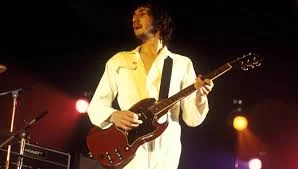
Feedback as music — Townshend deliberately exploited amplifier feedback as a compositional element three years before Hendrix, using a Rickenbacker 1998 into a Fender Dual Showman to create controlled squealing feedback that punctuates the song's statement of generational defiance.
Signal Chain
- 1Rickenbacker 1998 (or Fender Stratocaster)
- 2Fender Dual Showman 85W (very loud)
- 3Fender 2×15 cabinet
Amp Settings
High volume and high presence — the feedback requires the amp to be played at stage volume. Townshend positioned himself close to the speaker cabinet to induce specific pitches of feedback on cue during the song's instrumental breaks.
Technique
How to Play It
Guitar smashing and feedback exploitation as technique — My Generation live performances ended with Townshend destroying the guitar against the stage and amp. Musically, the windmill strumming technique covers all six strings with each chord stab.
Budget Alternative
Achievable With
Any electric guitar → any amp at high volume → stand 2–3 feet from the speaker cabinet for feedback. The specific pitch of the feedback can be changed by moving toward or away from the amp and by angling the guitar headstock toward the speakers.
Your Gear
Adapt to My Amp
More from Pete Townshend
Other Song Rigs
Won't Get Fooled Again
Who's Next · 1971
Power chords through a heavily overdriven Marshall — the defining statement of h…
View rig →Pinball Wizard
Tommy · 1969
Townshend's most accomplished acoustic guitar performance — the opening twelve-s…
View rig →Baba O'Riley
Who's Next · 1971
The synthesiser introduction was performed by Townshend on an ARP synthesizer be…
View rig →Behind Blue Eyes
Who's Next · 1971
The acoustic/electric contrast within one song — the quiet verse uses a 12-strin…
View rig →The Seeker
Odds and Sods · 1970
One of The Who's most straightforward rock tracks — Townshend strips away the or…
View rig →