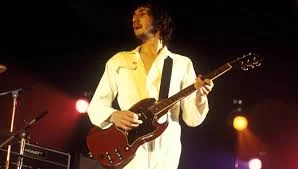
Sound Like Pete Townshend
Getting Pete Townshend's powerful and driving sound is within reach at any budget. Pete Townshend invented the power chord vocabulary and the windmill strumming technique that became the visual and sonic template for hard rock. His Gibson SG or Hamer through Marshall stacks — played at arena-destroying volume — produced one of the most physically powerful rhythm guitar tones ever captured. The guides below cover the full range — from the £200 entry point to the £2,500 premium build. Compare tiers and choose the level that suits you.
Quick Answer
To sound like Pete Townshend, start with a Epiphone SG Special into a Boss Katana 100 MkII, with a Boss GE-7 Graphic EQ as your key effect.
Tone Analysis
Pete Townshend's Guitar Tone — In Depth
Tone Philosophy
Pete Townshend invented the windmill strum. Before The Who, no one had used the guitar as a rhythmic visual gesture on that scale. His approach to tone was built around the maximum impact of the power chord — the most energy from the fewest notes — and the Marshall stack as a machine for producing controlled chaos at concert volume. Feedback was not an accident to be avoided but a tool to be deployed.
The Signature Sound
The Who live tone — the power chords of My Generation, the sonic architecture of Baba O'Riley, the extended improvisations on Young Man Blues — is a Rickenbacker or Gibson SG through a Marshall Super Lead stack, run loud enough for controlled feedback. The power chord voicing that Townshend developed is simple: root and fifth, often on the lower strings, played with the flat of the pick for maximum percussive attack. The simplicity is strategic — the chord must cut through the chaos of the band.
Key Gear
Townshend has used a wide range of guitars, often destroyed on stage as part of the performance. The Rickenbacker 330 and 360 were primary in the early years; Gibson SGs and Les Pauls came later. Gibson J-200 for acoustic work. His amplifiers were Marshall Majors — the 200-watt versions — in a period when most rock guitarists were using 50 or 100 watts. More power, more volume, more stage presence.
Playing Approach
The windmill strum is the visual signature, but Townshend's real technical contribution is rhythm guitar energy. He plays rhythm guitar as a lead instrument — not supporting the melody but driving the arrangement with force and precision. His left-hand chord approach on synthesiser-based compositions like Baba O'Riley involved re-voicing conventional chords to work specifically with the pedal-drone nature of synthesiser pads.
Legacy
The Who's impact on arena rock and punk was enormous. Their live approach — maximum volume, physical destruction, planned spontaneity — redefined what a rock concert could be. Townshend's power chord rhythm style influenced every punk and post-punk guitarist who came after.
Budget Comparison
Pick Your Budget Level
£500 · Sweet Spot
~£477
- GuitarEpiphone SG Special
- EQBoss GE-7 Graphic EQ
- AmpBoss Katana 100 MkII
£2,500 · Premium
~£2496
- GuitarGibson SG Junior
- EQEmpress ParaEQ
- DistortionBoss DS-1 Distortion
- AmpMarshall DSL100H
Shop Now
Buy the Key Gear — £500 Sweet Spot
Guitar, amp and essential effects for the authentic Pete Townshend sound. The guitar and amp together account for 80% of the tone.
Complete the Rig
Essentials Every Guitarist Needs
These aren't exciting — but every rig needs them. Buy once, sorted forever.
Tone Profile
Pete Townshend's Sound
Gibson SG Special or Hamer guitar into Marshall Super Lead stacks at maximum volume. Very high amp gain from sheer volume, not pedals. Townshend's open-chord rock voicings and windmill strumming create percussive attacks that cut through even the loudest drum kit. Feedback is a compositional tool.
Modeling Amps
Get Pete Townshend's Tone on Your Modeler
Targeting Hiwatt DR103. Use these amp models and IRs as your starting point — dial in from there using the knob settings above.
Master high, preamp low — Hiwatt is a power amp voicing
Low gain, high volume — Hiwatt cleans are extremely loud
Song Match
Which Pete Townshend Songs Suit Your Amp
Tone Match
Closest Real-World Tone Match
If you like Pete Townshend's tone, these players use a similar approach — same gear philosophy, comparable sound characteristics.
Weekly Tone Tips
One setting, one artist insight, one gear pick. No noise.