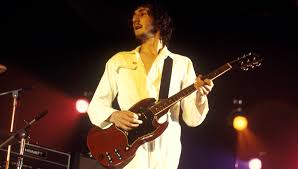
Pete Townshend — £500 · Sweet Spot Tone
At £500 · Sweet Spot, Pete Townshend's powerful and driving tone is more accessible than most players expect. Rooted in a defining era for electric guitar, their sound — Pete Townshend invented the power chord vocabulary and the windmill strumming technique that became the visual and sonic template for hard rock. His Gibson SG or Hamer through Marshall stacks — played at arena-destroying volume — produced one of the most physically powerful rhythm guitar tones ever captured. — starts with Epiphone SG Special and Boss Katana 100 MkII, totalling ~£477. That combination captures the defining characteristics without the premium price tag.
Build Pete Townshend's £500 · Sweet Spot Rig
3 pieces · Total ~£477
What guitar does Pete Townshend use?
Pete Townshend is primarily associated with sg style guitars. At a £500 budget, Epiphone SG Special delivers the essential tonal character.
What to Buy
£500 · Sweet Spot — Complete Gear List
Why This Rig Works
How Pete Townshend's gear choices create the signature tone
Epiphone SG Special
The SG body is lighter and more upper-fret accessible than a Les Paul, with a snappier attack. The humbuckers deliver the essential dark, punchy character needed for AC/DC and Black Sabbath tones.
Boss GE-7 Graphic EQ
Boss GE-7 Graphic EQ — eq coloring added to the signal.
Boss Katana 100 MkII
The extra headroom lets you push the clean channel harder before it breaks up, essential for loud-amp technique. More speaker excursion gives a fuller, more three-dimensional clean.
The Combined Tone
Gibson SG Special or Hamer guitar into Marshall Super Lead stacks at maximum volume. Very high amp gain from sheer volume, not pedals. Townshend's open-chord rock voicings and windmill strumming create percussive attacks that cut through even the loudest drum kit. Feedback is a compositional tool.
Tone Tips
Getting the Sound Right
- Windmill strumming: lock elbow and rotate the full arm from the shoulder — dramatic arc
- Power chords with open top strings ring beneath — creates a fuller sound than muted power chords
- Guitar at full volume into a loud Marshall — power tube saturation is the gain source
- Open-chord voicings: G5 with open D and G strings ringing, D/F# with open strings
- Aggressive right-hand strumming using the full weight of the arm, not just the wrist
- Feedback: hold the guitar close to the amp cone and let standing waves develop
- Pete rarely plays lead — his value is in the rhythm; chord choices carry the melody
- Auto-Swell: strum a chord and fade up the guitar volume after picking for a smooth swell
Avoid These Pitfalls
Common Mistakes When Chasing This Tone
- Scooping mids on the Marshall Super Lead with humbuckers — the mid-forward character of British amps with humbuckers is the central sound of classic rock. A mid scoop removes the fundamental voice of the combination
- Adding too much bass on the amp — the lightweight SG body has natural mid-forward resonance. Adding bass makes the tone muddy rather than heavier.
- Using a high-gain distortion pedal instead of amp gain — British crunch amps have a specific harmonic character when driven from their own gain stage. A pedal changes this character.
- Playing at bedroom volume expecting amp-driven tone — the power-tube saturation that defines this gain structure only occurs when the amp is working at substantial output. This is not replicable at low volumes.
- No noise gate at high gain — self-noise at high gain levels is constant and distracting. A gate is not optional for this style.
- Setting gain to maximum — above 8 on most amp channels, note separation degrades and riffs lose definition. The loudness feels greater but the clarity goes down.
Budget Alternatives
Same Tone, Different Budget
FAQ
Pete Townshend Tone — Common Questions
Pete Townshend is primarily associated with sg style guitars. At a £500 budget, Epiphone SG Special delivers the essential tonal character.
Pete Townshend's amp is british crunch voiced — the amp running hot, providing natural tube saturation. At the £500 level, Boss Katana 100 MkII is the closest match.
Yes — £500 covers a real guitar and amp in the right tonal family. This rig totals £477 and captures the essential character. The guitar and amp account for 80% of the tone; pedals are secondary at this budget.
Pete Townshend's essential pedals include EQ. At the £500 tier: Boss GE-7 Graphic EQ. EQ is the most important pedal — the others add nuance.
Pete Townshend's tone is defined by windmill-strumming, power-chords, mid-heavy. The combination of sg guitar and british crunch amp creates a sound that is immediately recognisable.
Pete Townshend's gain approach is amp-driven — natural tube saturation from pushing the amp hard, not from distortion pedals. At £500, this is replicated through Boss Katana 100 MkII paired with Boss GE-7 Graphic EQ.
Pete Townshend — £500 · Sweet Spot Complete Rig
~£477Guitar
Epiphone SG Special
EQ
Boss GE-7 Graphic EQ
Amp
Boss Katana 100 MkII
Tone Match
Closest Real-World Tone Match
If you like Pete Townshend's tone, these players use a similar approach — same gear philosophy, comparable sound characteristics.
Related Tones