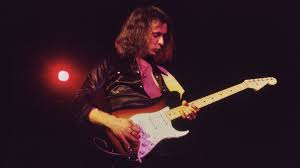
Ritchie Blackmore — £500 · Sweet Spot Tone
At £500 · Sweet Spot, Ritchie Blackmore's heavy and assertive tone is more accessible than most players expect. Rooted in a defining era for electric guitar, their sound — Ritchie Blackmore fused classical music — Bach, Baroque modes and minor key drama — with hard rock aggression to create the foundation of neoclassical rock guitar. His Fender Stratocaster through a Marshall stack (boosted with a Dallas Rangemaster) produced a bright, sharp and harmonically complex tone that inspired generations of metal guitarists. — starts with Squier Classic Vibe 60s Stratocaster and Boss Katana 50 MkII, totalling ~£477. That combination captures the defining characteristics without the premium price tag.
Build Ritchie Blackmore's £500 · Sweet Spot Rig
3 pieces · Total ~£477
What guitar does Ritchie Blackmore use?
Ritchie Blackmore is primarily associated with strat style guitars. At a £500 budget, Squier Classic Vibe 60s Stratocaster delivers the essential tonal character.
What to Buy
£500 · Sweet Spot — Complete Gear List
Why This Rig Works
How Ritchie Blackmore's gear choices create the signature tone
Squier Classic Vibe 60s Stratocaster
The alnico V pickups are the real deal — they deliver genuine Strat chime, quack and warmth that responds naturally to pick attack. An ideal foundation for Hendrix, Mayer, Gilmour or SRV tones.
Joyo Vintage Overdrive
Joyo Vintage Overdrive — overdrive coloring added to the signal.
Boss Katana 50 MkII
Its 'Brown' amp character at low gain is an excellent approximation of the Fender-style clarity that Hendrix, Mayer, Gilmour and SRV all relied on. Built-in effects mean you're a few knob turns away from the right tone.
The Combined Tone
Fender Stratocaster (sometimes with a scalloped neck) into a Marshall Super Lead boosted with a Dallas Rangemaster or homemade preamp. The combination is brighter and more cutting than the typical Les Paul/Marshall tone — treble-heavy, harmonically complex and very directional. Blackmore's use of Dorian and Aeolian modes gives the leads a classical, compositional feel.
Tone Tips
Getting the Sound Right
- Scalloped fretboard: the wood between frets is carved away — string bends and vibrato require less finger pressure
- Dorian mode (minor with raised 6th) is Blackmore's primary scale — darker than major, brighter than natural minor
- Treble booster before amp: sharpens the attack and drives the amp into harmonic saturation
- Bridge pickup of the Strat gives the cutting, nasal quality central to the sound
- Bach two-part invention fingerings: practise right-hand lead with left-hand bass notes simultaneously
- Classical phrasing: long note values, strong sense of resolution to the root or 5th
- Amp EQ: treble 8, mid 5, bass 4 — bright and forward in the mix
- Vibrato is fast and even — Blackmore's vibrato has a controlled mechanical quality
Avoid These Pitfalls
Common Mistakes When Chasing This Tone
- Stacking a second overdrive after the TS9 with single coils — the combined mid emphasis of two stacked ODs into single-coil pickups produces a congested, nasal sound that struggles to sit in a mix
- Running the tone knob at 10 the entire time — the tone control on a Strat is an expressive tool. Rolling it back changes the character of the sound in ways that affect how you phrase.
- Using a high-gain distortion pedal instead of amp gain — British crunch amps have a specific harmonic character when driven from their own gain stage. A pedal changes this character.
- Playing at bedroom volume expecting amp-driven tone — the power-tube saturation that defines this gain structure only occurs when the amp is working at substantial output. This is not replicable at low volumes.
- Setting gain too high on the overdrive pedal — most overdrive pedals are most useful at gain settings of 2-5, where they add character without dominating the tone. High gain settings on an OD pedal become a distortion, not an overdrive.
- Scooping mids to "sound heavier" — a guitar with mids removed disappears under bass and drums. Metal tone cuts through a mix, and that requires midrange.
- Using single-coil pickups — the lack of output and mid-frequency push makes it impossible to achieve the tightness needed for high-gain rhythm playing.
Budget Alternatives
Same Tone, Different Budget
FAQ
Ritchie Blackmore Tone — Common Questions
Ritchie Blackmore is primarily associated with strat style guitars. At a £500 budget, Squier Classic Vibe 60s Stratocaster delivers the essential tonal character.
Ritchie Blackmore's amp is british crunch voiced — the amp running hot, providing natural tube saturation. At the £500 level, Boss Katana 50 MkII is the closest match.
Yes — £500 covers a real guitar and amp in the right tonal family. This rig totals £477 and captures the essential character. The guitar and amp account for 80% of the tone; pedals are secondary at this budget.
Ritchie Blackmore's essential pedals include Overdrive, EQ. At the £500 tier: Joyo Vintage Overdrive. Overdrive is the most important pedal — the others add nuance.
Ritchie Blackmore's tone is defined by classical-influenced, baroque-rock, marshall-driven. The combination of strat guitar and british crunch amp creates a sound that is immediately recognisable.
Ritchie Blackmore's gain approach is amp-driven — natural tube saturation from pushing the amp hard, not from distortion pedals. At £500, this is replicated through Boss Katana 50 MkII paired with Joyo Vintage Overdrive.
Ritchie Blackmore — £500 · Sweet Spot Complete Rig
~£477Guitar
Squier Classic Vibe 60s Stratocaster
Overdrive
Joyo Vintage Overdrive
Amp
Boss Katana 50 MkII
Tone Match
Closest Real-World Tone Match
If you like Ritchie Blackmore's tone, these players use a similar approach — same gear philosophy, comparable sound characteristics.
Related Tones